

provider
4K IPTV
Read the full term total in its advertised currency and ask which accounts are eligible in your market.
4kiptv.app · Check exact market
Open the official 4K IPTV websiteThe 1 month plan is listed at €6.99 EUR. The operator also lists 3 reseller pack sizes.

4kiptv.app
The 1 month plan is listed at €6.99 EUR. The operator also lists 3 reseller pack sizes.
The 1 month plan is listed at €6.99 EUR. The operator also lists 3 reseller pack sizes.
Read the full term total in its advertised currency and ask which accounts are eligible in your market.
4kiptv.app · Check exact market
Open the official 4K IPTV website4K IPTV maintains the site at 4kiptv.app. Check who issues the invoice and who replaces the access if the app or TV changes. The buyer needs both answers before paying for a long term.
Document review · November 19, 2026. Playback performance, service rights and ZIP-level access require separate evidence.
The 1 month plan is listed at €6.99 EUR. The operator also lists 3 reseller pack sizes.


4kiptv.app
A customer can pay the correct price at 4kiptv.app, plug a decent player into a good television and still watch a programme that looks soft. There are several legitimate explanations. The original programme may be lower resolution. The app may choose a different rendition. The box may output a fixed resolution regardless of what it receives. The television may enlarge a picture that was smaller at the source. Buying a longer subscription changes none of those links by itself.
Approach this provider with two questions. Will the actual account play the programmes this household needs on the equipment it owns? What complete term, in euros, is the family willing to buy once it has checked? The dated offer on November 19, 2026 was €6.99 for one month, €18.99 for three months, €29.99 for six or €44.99 for twelve. The seller's FAQ describes a one-day trial by request after a suitable player has been installed. A family hoping to judge quality has a much better use for that day than browsing hundreds of channel names.
The name 4K IPTV identifies this listing under the exact address 4kiptv.app. Another store with “4K” in its name has its own terms. A television described as 4K identifies a capability of the display. And a programme delivered in native UHD is a claim about a particular source. Keep those meanings separate whenever someone asks whether a plan “has 4K.” The useful answer describes the source, the hardware path and the viewing location, and gives the viewer something they can actually observe.
Draw four boxes on a piece of paper. Put the programme and feed in the first, the app in the second, the device producing the picture in the third and the screen in the fourth. A television with an app built into it occupies the last two boxes. A display with an external stick has two distinct devices in that part of the diagram. Add a soundbar or receiver only if the picture really passes through it. This simple map stops a help request about the stick turning into instructions for the television's app store.
In the first box write more than a channel brand. Add the programme title, local time and any exact feed label the seller has supplied. A sporting event on a different regional feed can have different production and distribution arrangements. If native resolution is integral to the purchase, ask the operator what information it can confirm for the named feed. A vague assurance about selected UHD material may be accurate at a service level and still leave this programme unresolved.
In the app box note which player is installed, its publisher and any source information it actually reports. Do not assume every player shows the original stream properties. In the device box note an available output setting if you know it. A box set to output UHD may keep that output resolution when it scales up a lower-resolution input. In the screen box note the picture mode and the size of the set. Once those facts are available, a seller can see what the household already knows and which part of the path remains uncertain.
| Access period | Total shown in EUR | Another way to cover the same period at the recorded prices |
|---|---|---|
| One month | €6.99 | The shortest listed paid term |
| Three months | €18.99 | Three separate months would total €20.97 |
| Six months | €29.99 | Two three-month terms would total €37.98 |
| Twelve months | €44.99 | Two six-month terms would total €59.98 |
Every amount in the table stays in euros. A U.S. buyer needs to know which currency the checkout will present, which party handles any conversion, and what the card issuer will charge under that buyer's actual account terms. A conversion shown as an estimate during shopping can differ from the final amount booked. Record the euro price, the currency offered on the payment screen and the eventual statement amount as three separate facts. The store has no universal U.S. exchange rate to apply to the monthly heading.
If both payment and statement are in euros for a particular buyer, the comparison remains straightforward. The year costs €15 more than the six-month term. If you can confirm only seven months of use, the six-month price plus the recorded one-month price would total €36.98, subject to renewal availability and terms. That is €8.01 below the annual amount. For a household moving in the eighth month, this small calculation provides a better starting point than the lowest advertised monthly average.
A payment method that incurs a fixed charge on each purchase can change the comparison between one upfront term and several renewals. Use the actual fee from the issuer or seller where available. Avoid inventing a charge just to make one option look better. The household's effective cost is the recorded subscription payment plus any confirmed software or payment charges necessary for that setup. An optional receiver, a faster broadband package or a second television is a separate buying decision unless it proves indispensable to the test.
4kiptv.app asks prospective customers to install a suitable player and then request the trial with their device and app name. Do that preparation ahead of the programme you intend to evaluate. Select one programme for motion, one for legible details and one for a household requirement such as captions or a particular local feed. A slow studio interview, for example, is useful for checking speech timing. It tells you much less about motion during a fast pan. Choose a sample that can answer the question you are asking.
Write down what success looks like in language the viewer would use. The score graphic should remain readable from the usual chair. Speech should match the speaker's mouth closely enough that nobody notices it during ordinary viewing. A caption user should be able to select and retain the needed track. The screen should recover when the viewer exits and reopens the app. Those outcomes are more defensible than claiming to measure UHD quality by eye. If the viewer cannot see reliable input data, report the visual result and leave the original resolution unconfirmed.
Use part of the trial in the usual busy hour. If the television will be used after everyone is home, a perfect picture at mid-morning does not settle what happens then. Keep other observations in perspective. A single freeze cannot establish a long-term reliability rate, and one clean evening cannot guarantee next month's lineup. The trial is a narrowly framed decision aid for this specific arrangement. Record the date, approximate time, equipment and whether support can answer the unresolved item before expiry.
The decision at the end can be modest. A successful day may justify the one-month purchase while the household learns how renewal works. An unsuccessful caption or local-feed check may justify waiting even when the picture looks excellent. The value of the trial lies in being free to reach either answer.
A buyer reading the seller's device directory will find separate entries for the Fire TV Cube and Fire TV Stick. The entries point to an important buying detail. A product family name does not identify the exact operating system or generation. The FAQ specifically distinguishes Android packages intended for Fire OS from devices using Vega OS. Before anyone suggests an installer, identify the hardware in the device's own settings and find its supported store path. Written instructions for a different generation can look convincing right up to the point where there is no compatible app to open.
With an external stick selected on an HDMI input, open the stick's settings rather than the television's settings. Note the full product name and software information offered there. Use the manufacturer listing or the installed store on that device to identify a suitable player. Confirm the app's publisher and the method the seller supports for entering the issued account. If the recommended app is unavailable in that device's region, tell the seller the result and ask for an approved alternative. The missing listing is a fact worth resolving before money changes hands.
The site's FAQ also says it has not established a current verified native installer of its own. A filename found in an old post does not acquire a trusted publisher because its name includes “4K.” There is no need to seek out a file from an unknown mirror to complete this buying trial. If the installed store route does not work for the device, this can simply be a poor fit for the household. Establish that early enough to compare another supported device or a different offer.
For a Cube connected through an audio system, write down the physical route that produces the picture and the sound. If a change in the receiver input stops both, check the selected input before re-entering the service account. A family member who knows where the sound comes from can often explain an apparent player failure in one sentence. Service access, software and physical input selection are related, but each has its own control.
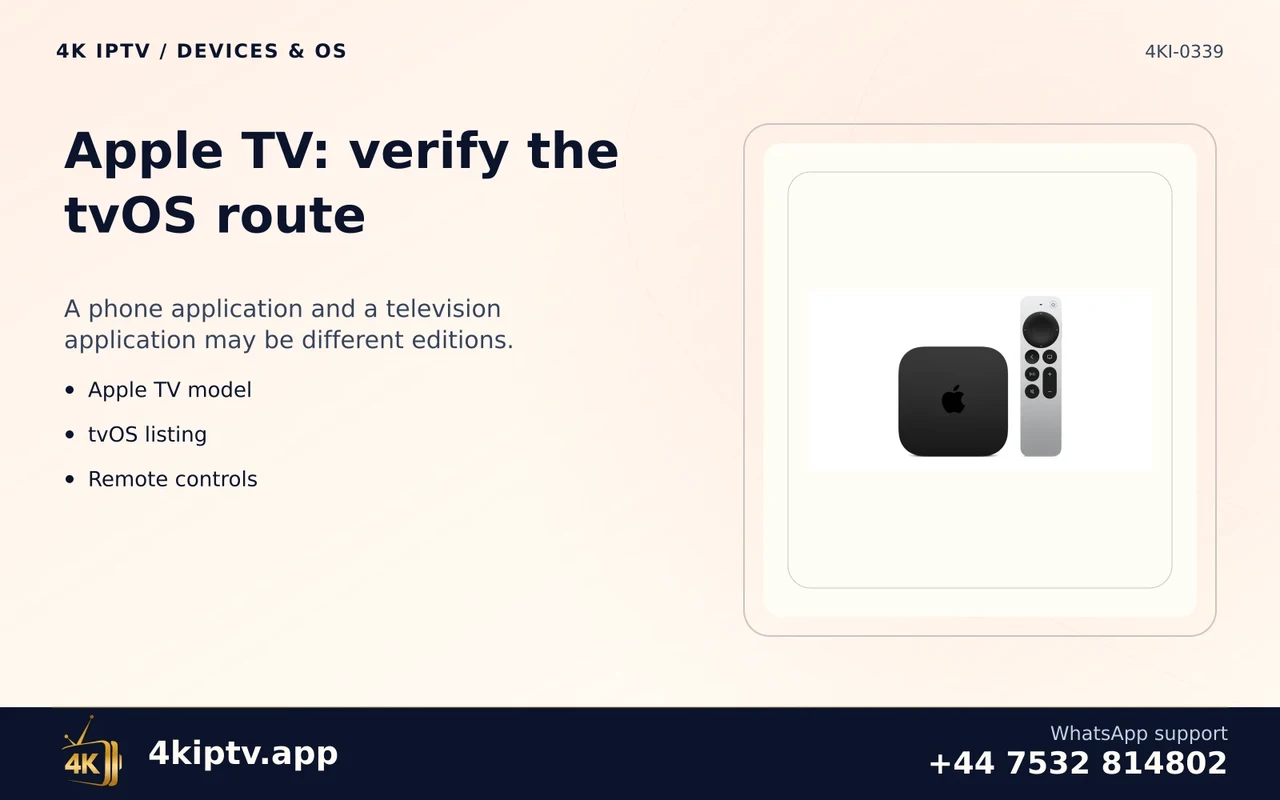
A buyer can own an Apple phone and an Apple TV without owning the same app licence on both. The seller's device guide points to tvOS apps for Apple TV. Search the actual Apple TV store for the intended player and inspect its listing. Check which account method it supports, whether the developer charges a fee and whether the licence covers the household's existing purchase. An iPhone listing does not by itself show that the app has a remote-friendly television edition.
For Android TV the device guide makes a similar distinction between a television application and a phone application. On the set or the connected box, look for the television version intended for a directional remote. The app should open, let the viewer reach the login fields and allow selection of the necessary controls without a touchscreen. If an essential control is unreachable from the remote, a screenshot of the same menu on a phone will not rescue the television setup. Support needs the actual model, store listing and behavior.
Google TV recommendations shown on the device home screen are separate from the contents of the chosen player. If the viewer selects a title from device recommendations and is sent to another provider's purchase screen, first determine which app opened. The original IPTV account may be functioning exactly as configured inside its own player. A family can avoid a great deal of confusion by practicing two routes side by side. The first opens the television home screen. The second opens the installed player and searches its guide.
Try that distinction with the person who will use the service. Ask them to leave a programme, return to the correct app and find the same item again. If they consistently choose the device's global search instead, arrange the app where it is easy to reach using the platform's normal controls. A one-time adjustment to the home screen can matter more to a viewer than the nominal specification printed on a streaming box.
First imagine a single older programme looks soft while a contemporary studio show on another source looks clean. A common screen and device can clearly produce a sharper picture. Ask about the production or feed for the older programme before changing the whole system. Where possible, compare like material on an authorized source. A restored film, an archival studio recording and a current live production are different imaging problems. The viewer should not expect identical texture simply because all are shown on one modern screen.
Next imagine every programme inside one player looks soft but a different authorized video app on the same device looks normal. Check what the player itself reports, whether it has a selected quality option and whether the visual result changes after its ordinary restart. Keep the television picture mode and viewing seat the same. A support representative may have a player setting worth checking. An improvement observed after changing the source and the television mode together gives no clear answer about which change helped.
Finally imagine the picture looks sharp when people are still and breaks up when the camera moves. Try a second programme with motion at roughly the same time. Note whether the sound also breaks or only fine image detail changes. The possible causes include the source, the chosen encoding or local playback conditions. A snapshot of an attractive pause frame is weak evidence about a motion problem. Explain the direction of movement and what disappears from view, such as a score ticker becoming hard to read on every pan.
A purchase decision can be made from observations without diagnosing the entire chain. Someone who needs one specific live programme to be watchable can decide that the present setup fails that need. Someone satisfied with the normal picture can record the benefit without claiming to have verified native UHD. Supporting a buyer means leaving enough room for a precise honest answer when the marketing term is larger than the evidence.
A new subscription is often accompanied by advice to buy faster internet. Start with the service already installed in the home. Try the intended programme while the family uses its network in the ordinary way. If reception degrades, compare a repeat observation when the equipment location and picture settings are unchanged. A comparison between a stick hidden behind a metal-backed television and a laptop sitting beside the router is an imperfect test. The devices see different radio conditions before the app even enters the picture.
If a suitable wired connection is already available, try it on a compatible device while leaving the other variables alone. If wiring cannot be tried, record where the device sits and any obvious change in signal when the television or cabinet position changes. Avoid buying adapters before checking whether the hardware and player support the arrangement. A single failed trial on an unfamiliar player does not establish that a new broadband contract will help. The household should know which symptom the expense is meant to solve.
Timing matters. If every application becomes slow only when a large household transfer runs, note the overlap and repeat a comparison when the transfer finishes. If only one named feed is affected while other feeds in the same player remain usable, tell the provider that contrast. The observation narrows the investigation without assigning blame. An error before the player even accepts an account is yet another category. A household bandwidth upgrade is an unlikely first response to a missing app listing or a mistyped field.
Before choosing the twelve-month term, ask whether the problem would still make sense to tolerate after the first week. If the only workable routine involves moving equipment every evening or turning off another person's normal internet use, include that inconvenience in the decision. The lowest full-term cost can still be expensive in the currency of family patience.
For resellers, 4kiptv.app publishes a customer-month model. One credit funds one month on a supported account. The charge shown for the three-, six- and twelve-month terms is therefore three, six and twelve credits respectively. The three pack amounts in the operator's price and reseller material are €85 for 100 credits, €276.50 for 350 and €690 for 1,000. The quantities identify entire packs. A seller's willingness to supply exactly the shortfall in a particular forecast has to be established separately.

| Pack | Unit allocation | One three-month activation | One six-month activation | One twelve-month activation |
|---|---|---|---|---|
| 100 credits | €0.85 | €2.55 | €5.10 | €10.20 |
| 350 credits | €0.79 | €2.37 | €4.74 | €9.48 |
| 1,000 credits | €0.69 | €2.07 | €4.14 | €8.28 |
Take a desk with seven annual renewals already confirmed. Those consume 84 credits, leaving 16 from a starter pack. It can then carry two confirmed six-month renewals, leaving four. It could also handle four one-month accounts with that remainder. That sequence consumes the whole hundred. The customers booked more than one term type, yet the seller can explain every debit without dividing money into arbitrary percentages. The monetary allocation of this exact work is the €85 pack price before the desk's other costs.
Changing the mix changes how useful the balance feels. Seven annuals leave 16, while eight annuals leave four and no room for another annual unless there is a top-up. A dashboard showing a positive balance is not evidence that it can meet the next named order. Put the next order's term beside the balance before promising activation. The same four credits cover a quarter and one monthly term or four monthly terms, each with a different schedule of people to support.
Consider a reseller forecasting 360 customer-months over the next year. The 350 pack looks close enough to tempt someone into advertising all 360 as funded. It falls short by ten. The forecast alone does not make the 1,000 pack a good buy either. Ask how many orders are confirmed, when they need activation and whether additional packs can be combined under the proposed account. Model the confirmed work by date and distinguish money committed today from money that can remain available for now.
For an illustration, four 100-credit packs would supply 400 and cost €340 at the recorded prices. A 350 plus a 100 would supply 450 and cost €361.50, subject to the operator permitting the sequence. The first option is €21.50 cheaper in immediate stock purchases for 360 customer-months and leaves 40 credits. The second leaves 90. Neither total tells the reseller whether holding an additional 50 credits is useful. That depends on confirmed follow-on demand, stock conditions and how much cash the desk needs for its other obligations.
A different buyer might need 700 credits with payment already received for the corresponding customer terms. Two 350 packs would supply exactly 700 for €553. One 1,000-credit block costs €690 and leaves 300 after those orders. That is €137 more to hold the extra stock. A future order can make the purchase sensible, but a hypothetical customer does not make today's money reappear. Place both invoices next to the actual renewal calendar before deciding which rate to negotiate.
Customer-month stock also differs from a network or infrastructure contract. Purchasing a thousand credits gives an account balance under the operator's terms. It does not specify transmission capacity for a stadium event, an encoder, storage or rights to distribute a production. If the prospective customer is a venue, a hotel or a business wanting a live feed for guests, ask the operator for an appropriately authorized business arrangement and written scope. A dozen consumer terms joined together cannot establish commercial display rights.
If the household decides to buy, keep three short records. The first describes the tested device, player and programme requirements. The second records the selected subscription, amount in euros, checkout currency, any separate app fee and the issuer shown on the receipt. The third records the actual activation and expiry. Those records answer three different questions if anything changes later. Someone replacing a remote probably needs the first. Someone disputing an amount needs the second. A buyer renewing early needs the third.
Check the account allowance against the home routine. A viewer moving from a living-room set to a bedroom box after stopping playback differs from two viewers watching simultaneously. State the scenarios separately and ask what the purchased account permits. This is especially useful when the trial took place entirely on a single device while the planned paid use includes another. The seller's FAQ asks buyers to confirm the concurrent allowance for the account offered. A photograph of two compatible devices cannot provide that confirmation.
If a quoted extra feature motivated the purchase, record it in language that makes it identifiable. For example, include the named local feed and territory or the supported caption arrangement on the named player. The operator can then correct a missing feature or explain a limitation against an intelligible order record. Avoid writing unsupported promises into your own notes and treating those notes as the seller's commitment. Keep the actual written reply where the purchaser can find it.
Separate charge corrections from viewing troubles. A customer who sees a different euro total should identify the selected term, the amount presented and the amount actually charged. A customer who sees a lower-quality picture should identify the feed, device and time. Combining both in one vague complaint about value can delay resolution even if both are genuine. The right facts let the appropriate party address its part.
Give the post a title that names the observable symptom and the relevant platform. “Motion breaks up on one live feed on Apple TV” helps a reader decide whether they can contribute. “Awful service” gives no such opening. Say whether the problem affects one programme or several, whether another authorized app behaves normally and whether you can see any actual input information. The community can reason about an observation. It cannot inspect the account from a public post and should never need a private login to understand it.
Use a simple before-and-after structure for a change somebody suggested. If you changed a picture setting on the television, name that setting and leave the box output alone for the comparison. If you changed the app's quality setting, say which two values were compared. Note the time and use the same programme segment where that is legitimately available. Conditions can still differ, so present the result as what happened on this setup, not a universal cure.
A useful answer may be that the screen's information banner reports output rather than source resolution. Another could be that the device's time zone explains a programme guide mismatch. Mark a reply as a solution only if it solves the issue you reported or correctly identifies the limitation you wanted explained. If the operator later resolves a feed problem, add the outcome without posting credentials, payment evidence or an unredacted support conversation. A short accurate closing note helps the next person with the same symptom.
Someone reading that thread while shopping should resist turning it into a reliability score. A named model and date make the report more useful, but the reader may have a different feed, platform, network or viewing address. The value of the forum is its ability to reveal what to ask and how to isolate a symptom. A single good or bad experience cannot establish a general verdict about every term on sale.
A television can draw its own menus in unusually clean lettering while the programme underneath looks soft. An app can also draw score information, guide text or a player-control bar independently of the image it receives. If a buyer pauses on a razor-sharp app menu and concludes that the programme itself was delivered in UHD, the test has measured the wrong thing. Use on-screen labels to identify what layer is being judged. Text that forms part of the broadcaster's own picture is different from a label painted over it by the television.
Set up a small comparison from the normal seat. On the same programme, note whether the broadcaster's own fine lettering, faces in the distance and moving edges are visible enough for the task. Then open the player's own menu and note whether its text is comfortable to read. A customer may discover two different results. The live picture can be adequate while the menu is too small to operate, or the menu may be beautifully sharp while a particular feed looks heavily processed. Changing to a longer subscription cannot enlarge an app's menu unless the player already offers that control.
A useful support note can describe both findings in a single sentence. “The guide lettering is readable from eight feet, while the numbers in the score graphic lose definition during movement on this named programme.” This gives the operator a chance to identify the source and gives the household a concrete criterion for a later comparison. Public research rarely supplies enough information to tell a family whether its favorite seat, eyesight and display size will be comfortable together. The one-day trial is the right place to settle that human part of the choice.
A U.S. buyer may be shopping for a programme that appears once a week. If the ordinary trial runs midweek and the programme airs on Sunday, a clean Wednesday test is a valuable equipment check. It leaves Sunday itself untested. Ask the seller to distinguish three things in writing. Identify the station or feed available to the proposed account, the viewing market for which it is offered and any event-dependent restrictions the customer should expect. Then ask whether the trial can be scheduled to include the broadcast.
If scheduling cannot be changed, put a price on how much certainty the buyer actually has. The recorded one-month term is €6.99. It can be a deliberate first paid period for a household willing to risk that amount to learn more. The €44.99 year is a different commitment. A family that would not buy any term without the Sunday programme should wait for adequate evidence. Someone primarily interested in other confirmed programming may willingly choose a month even while that one event remains open.
A written question to the operator need not include an elaborate account history. “For this ZIP and this single-screen arrangement, which feed carries the Sunday programme on the selected date, and may I test that exact feed during the trial?” gives the seller a precise task. If the reply describes a different date or market, identify the discrepancy and keep the original question. An event preview photograph, a league logo or the name of a subscription channel cannot turn an answer for another market into coverage for your home.
After the programme airs, update the household record with what really happened. If a different title appeared, record the title, feed and time. If it played and the picture met the family's needs, say so. That creates one dated observation to support the next renewal. It remains one observation even if the result was excellent.
If a relative or independent installer sets up the television, ask for a small handover before they go. The owner should know which account belongs to the viewer, which app has been installed and who can change it later. Write the supported player name and its actual publisher, the app store used and whether the installer or the household paid any software fee. Ask whether the player licence lives under the household's own account. A living room can work perfectly on installation day yet become difficult to recover after a replacement box or a password change.
Document the ordinary route from the power button to a familiar programme. Give the viewer the remote and ask them to carry it out once alone. The installer can watch for trouble with input selection, text entry, captions or the distinction between the home screen and the player's guide. Leave one short instruction for the thing that caused trouble. A page of generic remote diagrams is seldom as useful as knowing which one button returns this particular box to the expected entrance.
The work order should separately identify funds paid for equipment, installation labor, software and the 4kiptv.app term. If the household later wants to compare the cost of renewing, the television bracket or installation visit should not mysteriously appear in the subscription price. A clean separation also helps the installer. When asked why a receipt has a larger figure than €44.99, the person can point directly to the work and equipment supplied. A family member taking over the bills a year later can distinguish a settled one-time expense from a continuing service without asking everyone to reconstruct the original visit.
Imagine choosing a year because the current setup passes the trial, then replacing the television in month four. Check whether the device doing the playback is changing. If the household will keep its existing streaming box, much of the app and account configuration may remain on that box. The new screen can still introduce different inputs, picture modes or sound behavior. If the household intends to move from the box into a native TV app, it is also changing the player platform. That needs a fresh look at store availability and licensing.
Keep a short before-and-after record of the old expiry and account method without copying secrets into a shared note. Ask the provider how to move the permitted account to the new device and whether an old session needs to be closed. Retain the old configuration until the new route opens and shows the correct remaining term. A paid year is time on a documented account. A request to change the device ought to start by locating that account rather than assuming another annual purchase is necessary.
On the new set, revisit the earlier picture check from the same seat if practical. A much larger display can make existing source defects easier to see. A different picture mode can make motion look unfamiliar. A higher panel specification cannot supply detail the original source lacks. If the monthly terms once looked far apart in a shopping decision, they may feel small beside the cost of a disappointing hardware purchase. Resolve the screen and source question before buying new equipment specifically for a single programme.
For someone starting from scratch, the practical sequence runs in the other direction. Inspect the intended platform, find a legitimate player, request trial activation, collect observations, then choose the shortest listed term that covers the amount of use you can defend. A proven and stable yearly routine can support an annual purchase. An unresolved compatibility question on the only television can justify keeping all €44.99 until a working route is available.
Keep the first satisfactory picture observation with the original order. If the family reports a change later, the note provides a comparison with the same device and the same normal seat. The provider can check whether a feed changed, while the viewer can check an updated player or a new television picture mode. Without the original note it is easy to blame the subscription for every change in how a screen looks. With the note, even a household that never measured the underlying resolution can give a clear account of the practical difference that matters.
4kiptv.app pricing · Operator FAQ on trials, credits, installers and picture quality · Device-specific setup directory · 4K IPTV reseller packs and deductions · One-month term and trial instructions.
Suppose you expect to watch for six months. At the listed single-month amount, six separate purchases would total €41.94 EUR. The six-month offer asks for €29.99 EUR up front. That comparison assumes every new month is available at the listed amount. Check renewal separately before relying on it.
| Viewing period | Separate monthly purchases | Single matching term | Difference | Monthly purchases to reach term price |
|---|---|---|---|---|
| 3 months | €20.97 EUR | €18.99 EUR | €1.98 EUR | 3 |
| 6 months | €41.94 EUR | €29.99 EUR | €11.95 EUR | 5 |
| 12 months | €83.88 EUR | €44.99 EUR | €38.89 EUR | 7 |
Read the final column as a spending threshold. If you expect to cancel sooner, compare the shorter commitment with the cash you would have paid up front. The figures exclude fees the seller has not confirmed.
Check 4K IPTV subscription termsThe smallest priced pack in this register holds 100 credits and costs €85.00 EUR. The largest holds 1000 for €690.00 EUR. Their displayed unit costs are €0.85 and €0.69 respectively. The published deduction for a standard twelve-month customer is 12 credits. Check the operator’s treatment of additional screens and renewals.
Choose a matchup to see the actual currency, term and outcome.
Open the caption on a website-sourced image to see its original. The remaining captions identify material supplied with the provider archive.


