

provider
8K IPTV
Check the source for your exact term and which device and player support are provided.
8kiptv.app · Check exact market
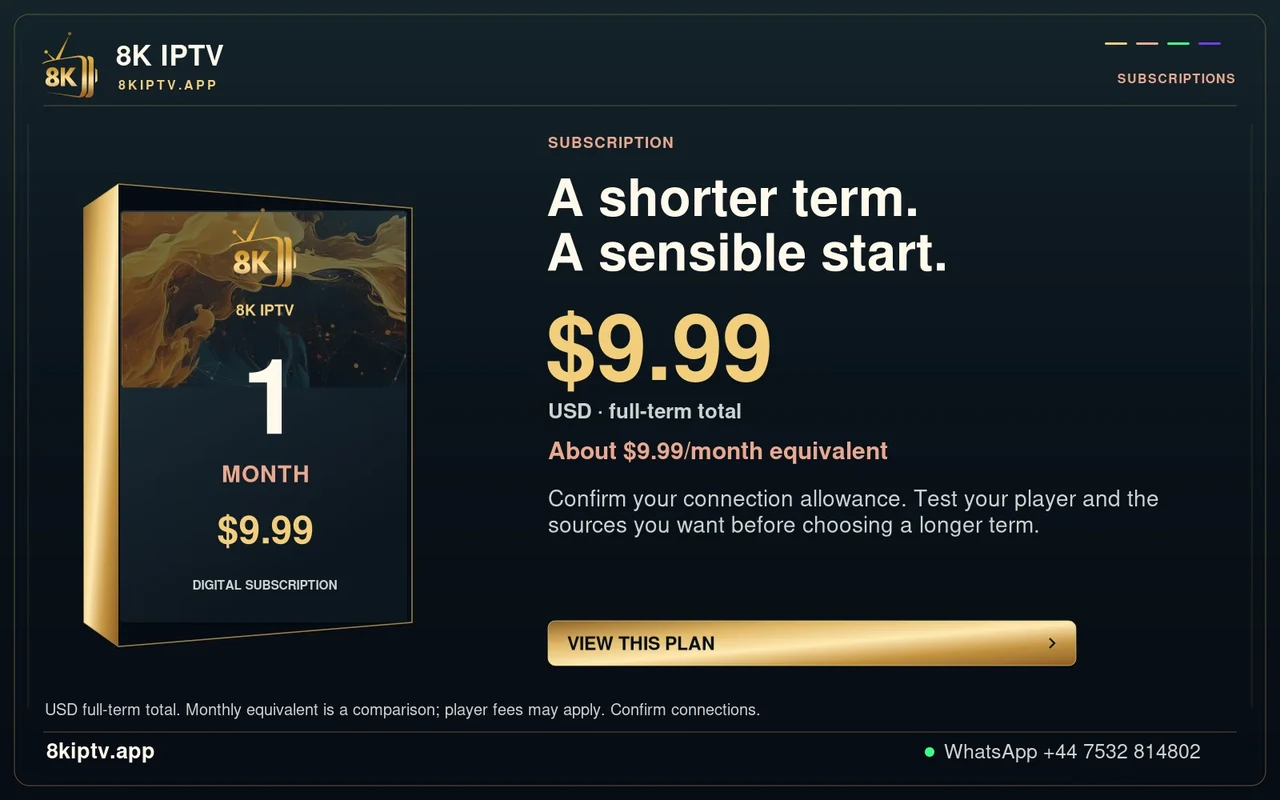
Open the official 8K IPTV websiteThe 1 month plan is listed at $9.99 USD. The operator also lists 3 reseller pack sizes.

8kiptv.app
The 1 month plan is listed at $9.99 USD. The operator also lists 3 reseller pack sizes.
The 1 month plan is listed at $9.99 USD. The operator also lists 3 reseller pack sizes.
Check the source for your exact term and which device and player support are provided.
8kiptv.app · Check exact market
Open the official 8K IPTV website8K IPTV maintains the site at 8kiptv.app. Check who issues the invoice and who replaces the access if the app or TV changes. The buyer needs both answers before paying for a long term.
Document review · November 19, 2026. Playback performance, service rights and ZIP-level access require separate evidence.
The 1 month plan is listed at $9.99 USD. The operator also lists 3 reseller pack sizes.

8kiptv.app
Picture a home at seven in the evening. Someone starts the news in the living room. Another person takes a tablet into the kitchen and opens the same television service. The house has one internet bill, both viewers are at home, and both devices can run a player. There are nevertheless two active playbacks if both programs keep running. 8K IPTV on 8kiptv.app describes its standard personal offer as one active connection. That condition, more than any difference between the lengths of its four plans, can determine whether the product fits the family.
The same home an hour later might have a simpler need. The first viewer stops playback and carries on in the kitchen with the tablet. Only one person wants a picture at a time. Whether the specific account can move between these particular devices, how it handles a recent session and whether a different player is needed are questions for the operator. They are good questions to ask before choosing a year at $54.99. Buying a longer version of a standard one-connection plan does not itself establish that two streams are permitted.
All four personal prices are in USD. The other listed totals are $9.99 for one month, $24.99 for three and $39.99 for six. The site also describes a free one-day trial by request after an appropriate player has been installed. In practical terms the family can prepare the actual screen, ask how the proposed account handles its real use pattern, and then choose a useful date for a test. A household with a predictable viewing routine can learn a great deal in one carefully chosen evening.
This profile concerns the seller on 8kiptv.app. Similar 8K names appear elsewhere. Keep this exact domain on the purchase record, use the contact route it publishes and retain the issuer named on the actual receipt. An app installed from a recognized publisher, a recommendation found on an editorial site and a service account purchased from a particular seller each have their own place in the household record. They need to be identifiable when a device changes months later.
Take a piece of paper and draw three columns for time, room and who watches. Collect a normal weekday, a weekend morning and an evening when two people want different things. A home can own five capable screens and genuinely need only one active connection. Another home might have just a television and one phone yet need two every Thursday. The deciding fact is overlap, not the number of app icons or the number of people living at the address.
| Example use requested by the household | Expected pattern | Ask 8K IPTV to confirm |
|---|---|---|
| Watch a bulletin in the lounge, close it and finish another program in the kitchen | Sequential | Whether the issued account can switch between the named devices and how to end the previous session |
| Watch a match on the TV while a different program runs on a tablet | Simultaneous | Which account arrangement explicitly allows two active playbacks and its full price |
| One family member remains at home while another watches during travel | Simultaneous and in two locations | Both location eligibility and the active-screen allowance for that arrangement |
| Move the only viewing device to a new permanent home | One device at a new location | Whether the account and intended viewing options are supported at the new address |
| Use a phone as the remote for a player on the television | Depends on the actual playback path | How the named app handles the receiver, remote control and session |
A single evening can change classification mid-program. A phone may initially control playback on a television without showing a separate stream. The user then opens another program on the phone itself. Describe the exact action to support and ask whether the account sees a second session. Do not infer what counts from a casting symbol. The app, receiver and operator have to support the intended way of watching.
If the overlap occurs only occasionally, the household might choose to use one confirmed screen or a different authorized service already available in the other room. If it happens every evening, ask for a written price and terms for the required arrangement. The public standard price is not enough to quote that configuration. Decide whether the seller can supply it before comparing its annual amount with a competitor's offer for two simultaneous connections. The comparison is meaningful only when both figures cover what the family actually does.
Suppose support confirms the account can be used sequentially on the living-room device and a supported tablet. Prepare both players using the operator's instructions. Never give an account to a second household or assume that permission to move a device includes permission to share beyond the issued terms. Start on the main television and note the app and account option in use. Watch an ordinary program, then stop it using the player's supported control. If the seller asks users to close the app or sign out before switching, follow that process.
Move to the second confirmed device and start the permitted account. Record what happens in ordinary language. Perhaps it opens straight to the guide. Perhaps it asks the viewer to select the account again. Perhaps it reports an active session. The time, error and stage are useful facts to bring to support. Repeatedly opening additional apps while the message shows will usually muddy the account of what happened. Give the operator information it can use to investigate the intended two-device handoff.
A remote power button can create a subtle problem. Turning off a television might switch off only its display while an external streaming device remains powered. A different device may stay in standby or preserve a player in the background. Ask how the particular player and account should be stopped. Do not declare that every television continues streaming when turned off or that every player releases a session immediately. Test the actual configuration with the operator's permission and note the procedure the household can reliably repeat.
Next hand the remote to the regular viewer and ask them to demonstrate the move back to the living room. If they need three support messages to reproduce the sequence, that inconvenience belongs in the purchase decision. A person living alone might rarely care. A family that shifts meals and viewing between rooms several times each day might care a great deal. Put the measured human effort beside the monthly equivalent. A service is cheap only to the extent that it does the job the household bought it for.
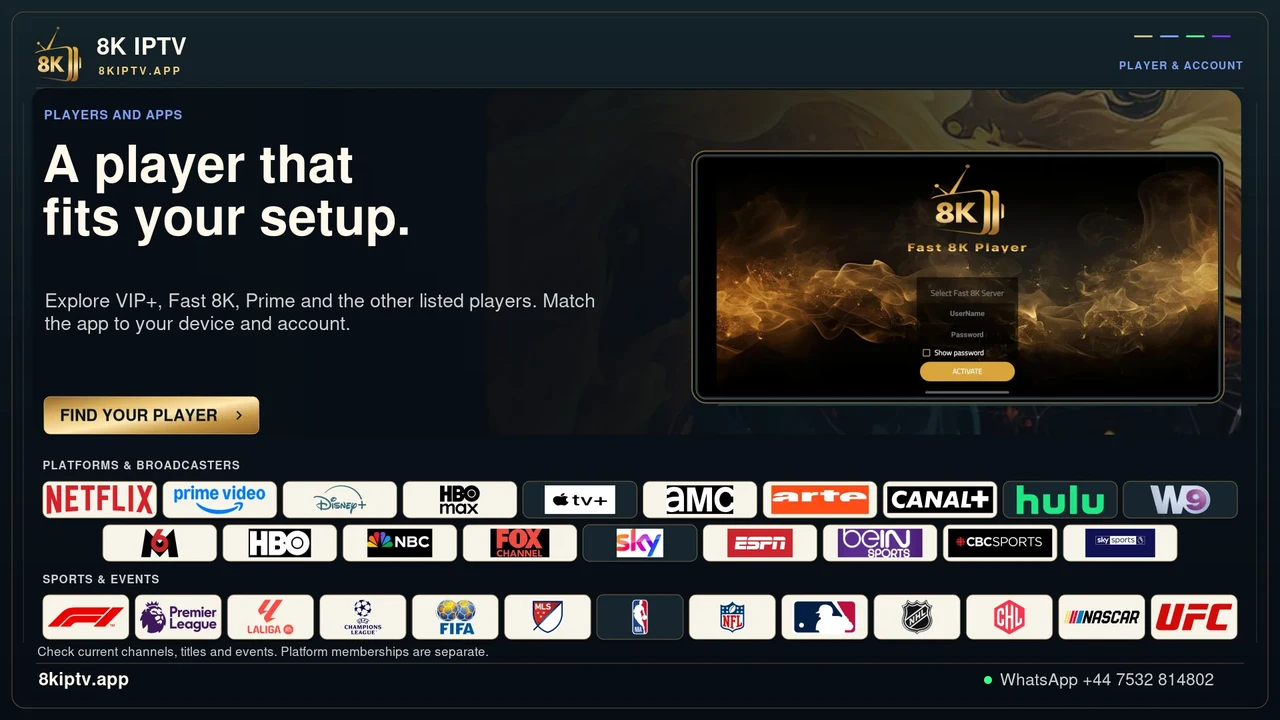
8kiptv.app describes player entries including VIP+, Fast 8K, Prime and desktop choices. Read the operator's current reference for the intended device rather than choosing the first app with a familiar name. A supported player might exist in several versions or on several platforms, and a similarly named download can belong to another publisher. Ask for the exact app, publisher, current reference and account method that match the service order.
At installation, note which question the screen asks. A player may need account details, an operator-assigned choice or a form of configuration handled through its own supported method. A sign-in request is distinct from a player licence activation. If there is a separate software charge, find out who receives it, when it expires and how the household would restore it on a replacement device. A yearly 8kiptv.app service term and a player licence can have unrelated billing dates.
A television connected to a streaming box gives the household a further choice. Running a native TV app and running an app on the box are separate setups even though the same panel displays the result. Identify the device that will run the chosen player. A family may already have a perfectly usable box and remote, making a second native player unnecessary. Equally, the regular viewer may prefer a single remote without changing inputs. The right route is the supported one they can operate independently.
Record the app version once the initial setup works. This one detail can explain a lot after an update. A friend following an old screenshot might suggest a menu name that has moved in the current release. With the version and the exact new wording, the seller or publisher has a reasonable chance of locating the corresponding control. No public post needs to include a service password or full playlist link. Other viewers can discuss how to reach a menu without seeing information that belongs to the account holder.
Choose the hour of the week that actually decides the purchase. For a household watching news after work this might be half past six in the main room. For someone checking caption readability it might be the evening drama the regular viewer knows well. For someone returning to a bedroom television after a shift it might be a late handoff from the lounge. Ask the seller when the one-day trial can start and whether it represents the same devices and configuration as the paid product being considered.
Set up the player in advance as the operator describes. Have the intended controller, display and home network ready. A trial clock can be spent on the wrong work if the customer first discovers that the television is on an incompatible platform after access has already been issued. The installation question can usually be narrowed before activation. The viewing test needs the real account, device and room.
During the session, note at least one result for the household's essential tasks. Did the requested program appear on the correct feed? Could the regular viewer turn on the required captions? Was movement between rooms possible in the agreed sequence? Did an app exit leave a clear route back to the live guide? Those are observations. They say something about the buyer's equipment and experience. A broad conclusion about service quality everywhere would require evidence the trial does not supply.
Keep a spare line for the question a successful picture cannot answer. The family may need to know what happens during travel, how an additional screen would be billed or whether a local station changes after moving house. Write the question while the equipment and account are fresh in mind. If support has an answer, attach it to the private purchase record. If it remains open, decide how much money it is sensible to commit before resolving it.
| Standard personal term | Listed service price | Comparison with individual months at $9.99 | Example household question |
|---|---|---|---|
| One month | $9.99 | Same amount | Will the existing television and account handoff fit an ordinary week? |
| Three months | $24.99 | $4.98 less than three separate months | Is the family staying at this viewing address for a season? |
| Six months | $39.99 | $19.95 less than six separate months | Will the room or main viewing device change before then? |
| Twelve months | $54.99 | $64.89 less than twelve separate months | Are the required allowance, device and bill payer settled for a year? |
The last column is deliberately practical. A screen-hours calculation can make any annual product look cheap if it assumes the family will watch every day. A family member who follows only one short season might watch far fewer evenings. For that person a smaller total paid for the useful part of the year can be better than the lowest cost per theoretical hour. Work from the dates and ordinary habits the buyer can actually name.
Calculate the cost of uncertainty explicitly. A household with a likely move in three months could commit $24.99 for a quarter or $54.99 for the year. The annual decision places another $30 of service money at risk before the new location is confirmed. A family with a settled address and a successful trial may see that $30 as an attractive price for nine more months. A person moving outside the intended region may prefer to keep it until eligibility is clear.
Add separate charges to the working budget. Suppose the buyer's suitable player has a separate fee confirmed by its publisher. Put the actual figure next to “player,” its merchant and its renewal date. Leave the line open until it is known. Likewise, the household cannot determine the price of two active screens simply by doubling $54.99 unless the operator confirms that exact arrangement. Ask for the total due for the account the buyer needs and compare it with an equivalent offer.
At checkout keep a screenshot or receipt identifying the term, currency, seller and amount without publishing private payment details. Record whether a renewal is manual or recurring as described by the merchant in the transaction. A support conversation alone may not establish that the household has purchased anything. The payment acknowledgment, activation and visible expiry are separate events that can be recorded cleanly as each happens.
The site's public travel guidance asks account holders to check the proposed location with support. This is sensible for reasons that go beyond the app. A device can operate on a different network while the operator's territorial or account conditions still limit use. A U.S. household visiting another state, traveling internationally or leaving one family member watching at home presents a different case in each instance. State the dates, country or general location, device and whether there will be concurrent playback elsewhere.
A specific enquiry might describe a three-night work trip, one tablet and no viewing at the home address during that time. Another might describe a person overseas while the family plans to watch the living-room TV every night. The first needs confirmation for the location and device change. The second also asks for concurrent use and a separate location at the same time. An answer to the first request should not silently be applied to the second.
The hotel or short-term rental may introduce its own limitations. A television input could be unavailable to guests, Wi-Fi may require a browser sign-in, and an unfamiliar remote may make a perfectly supported app impractical. Check the accommodation's normal rules and available equipment. Keep an alternative authorized viewing plan where the event matters. An operator's permission for a trip is important, but it cannot change the hotel's television controls or network sign-in process.
A borrowed screen also raises a simple handover issue. Avoid leaving service or personal app-store accounts signed in when the visit ends. Use the ordinary sign-out procedure for any permitted guest device, retain the account owner's recovery information privately and verify that the home viewer can return to their usual setup. If the family used a travel device temporarily, record whether it remains registered and how to retire it through the supported route. Travel should end with the account back under the purchaser's control.
Moving an account into another room of the same home may require only a supported player on that screen and an agreed way of ending the previous session. Moving the household across a state line or into another country raises viewing eligibility, local feed and possibly store-region questions. Treat these as different enquiries even if the physical television travels with the buyer in both cases. A quiet assumption about location can make an annual renewal look secure when a crucial condition is still open.
Start with dates. When does the old lease end, when will the new connection be active and when does the existing service expire? A buyer who has several paid weeks left after moving may be able to test the new room before choosing a longer renewal with the seller's approval. If the term ends the day before the move, ask about a short extension or published short-term option. Any special arrangement needs a written operator reply. The published price table cannot invent a flexible transfer option.
Think about local viewing needs separately from account continuity. The account might be able to sign in at the new address while the family wants a different local news edition. Name the new station or market requirement explicitly. A program followed at 6 p.m. in the old room may be carried on a different affiliate or at a different local time. Ask the seller to confirm the particular feed and use the broadcaster's own schedule to identify it accurately.
The hardware in the new room may also change. Perhaps the old flat was furnished and the customer relied on its television's native app. Their new television might use another operating system. Carry a record of the old app name and licence, then open the new device's approved store or relevant operator guide. A paid service term may survive an authorized move even though an app licence or local favorites list needs separate attention. Recovering those details from an old photo is easier if the buyer kept the original purchase papers.
A message about an active session is easy to misinterpret. The account holder might immediately suspect an unauthorized user. Begin with the ordinary household inventory. Was a film still playing on an external box when the television was turned off? Did a phone continue playback in the background? Did someone use a second approved device earlier and forget to close the player? Work through the seller's supported procedure for ending playback. The device's standby behavior and the account's session handling can be different things.
Make one attempt on the intended device after stopping the old session as instructed. Note the local time, exact app message and whether the guide opens before the warning appears. If the result persists, contact the operator privately with the account or order reference. Ask it to check the issued allowance and explain any expected release interval. Avoid promising the household a fixed wait period taken from another seller or another version of a player. The operator can answer for the account it issued.
If the account holder has reason to believe that account details were shared unintentionally, use the seller's proper recovery or credential-change route. Do not post the service login, QR code or full setup link on the forum to ask whether it looks familiar. A forum reader can help distinguish an active-session error from an app installation error without needing credentials. Keep enough private purchase evidence to establish rightful control with the merchant.
After resolving the issue, write down which component needed attention. If an external player continued after the television was switched off, note its ordinary stop command beside the remote. If a device was meant to be retired, record how the operator removed its registration. If the household simply requires two screens at the same time every evening, the issue belongs in an account quote rather than a troubleshooting log. A durable fix addresses the real use pattern and saves the family from replaying the same support conversation next week.
A household of one can still make an expensive choice if it uses only a short portion of the term. Consider someone away for four months, home for four and away again. An annual term covers the whole calendar period at $54.99, but the purchase decision depends on permitted use during the absences and whether any programs matter while the person is away. If the only planned use is four months at home, a quarter plus one month totals $34.98 at the published rates and supported renewal sequence.
A different individual might spend six months at one address and the rest at another. If the operator confirms permitted use in both places, the annual price could be attractive. Two independent six-month purchases at $39.99 each would total $79.98 if the second price holds. The difference from the annual total is $24.99. That saving should be weighed against any unresolved location or device condition. Ask the seller about the specific arrangement before treating that dollar difference as available.
The single viewer may also have several legitimate viewing needs in the same week. A phone used on transit and a television used at home are sequential uses if they occur at different times. That says nothing definitive about whether the proposed mobile network and locations are allowed under this account. Ask the operator and confirm the app is usable on the actual phone given the viewer's accessibility, data and battery needs. A long-term plan can still be a poor fit if it solves only half of the person's real routine.
Give the renewal decision a small checkpoint. A week before the term ends, write the number of evenings the service actually solved the intended need and any issue still requiring permission or support. No one needs a detailed viewing diary for a whole year. A few genuine observations can show whether the buyer regularly used the account or bought it for a program that was never available. That is a stronger basis for renewal than the discovery of another promotional price box.
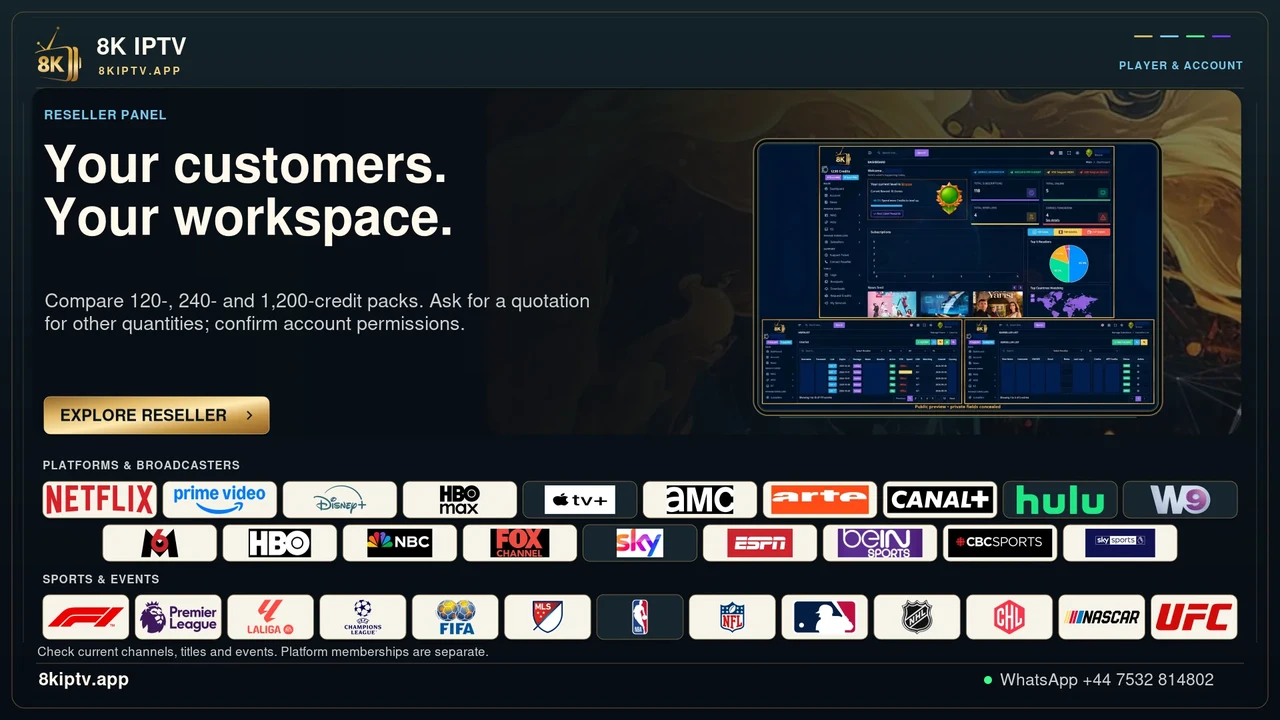
8kiptv.app publishes three reseller packs. The quantities and totals are 120 credits for $222, 240 for $429.60 and 1,200 for $2,028. The stated model uses one credit per customer-month. A confirmed twelve-month customer account would therefore use twelve standard credits. This gives a retailer a measurable stock unit. It does not convert a household account's one active screen into several simultaneous connections, and it does not automatically authorize supplying customers in any territory.
| Trade pack | Cash purchase | Stock share for one quarter | Stock share for one standard year | Whole standard years the pack could supply |
|---|---|---|---|---|
| 120 credits | $222.00 | $5.55 | $22.20 | 10 |
| 240 credits | $429.60 | $5.37 | $21.48 | 20 |
| 1,200 credits | $2,028.00 | $5.07 | $20.28 | 100 |
Read the last column as capacity under the published standard model, assuming authorized accounts and actual demand. A panel capable of supporting ten individual annual customers does not give one family permission to sign in from ten homes. The retailer should document the customer, term, expected expiry, location where relevant and any special permissions for each account. A public product page and a stock ledger can supply some of those facts. The operator must supply the conditions for the proposed trade relationship.
Suppose a small business has seven standard annual orders with agreed start dates. They require 84 credits, leaving 36 from the 120-credit pack. The stock allocated to the seven at $1.85 per credit is $155.40; $66.60 remains represented by unused balance. If the next three annual orders arrive, the remainder will cover them. If nobody else orders, the same $66.60 remains tied up. Present the full $222 to the person funding the purchase and the allocation separately to the person pricing each transaction.
For an unusual account, request the applicable debit in writing. A customer needing several active screens, travel or replacement access may not match the standard configuration. Record who can approve that request and who can correct a line if the customer receives a mismatched device method. Buying wholesale stock around a permission that has never been granted is a larger error than paying a few cents more per credit. First match the service to the named customer; then compare the pack required to supply it.
A shared household can often improve its experience by agreeing on three ordinary actions. The first viewer starts the intended app on the correct device. When finished, they stop the player in the way the operator recommends. The next person then opens the approved account on the next device if sequential use has been confirmed. Write those steps in the terms printed on the actual remote and screen. Avoid language such as “terminate session” if the viewer's menu simply says “Stop.”
Add one recovery route. What should someone do if the television powers up on a broadcast input or a game console instead of the streaming box? Identify the input and the device that runs the app. If the television itself hosts the player, name the home button or menu the regular viewer uses. Keep the note short enough to read while standing beside the set. A three-page setup document on the purchaser's laptop helps very little when a relative is trying to switch on the evening news.
Store the private payer's record separately. It should include the seller domain, account or order reference, full term paid, activation date, expiry and any separate app licence. Note who is authorized to approve changes and which conditions were agreed for moving between screens. If a customer needs help, the adult managing the account can provide the reference through the proper private support channel while the viewer describes what is happening on the television.
Before handing a device to a visitor, think about what it exposes. A supervised demonstration of the guide on a household television is different from handing over an app containing saved credentials or pairing it with another person's device. Keep account details with the rightful holder and use the operator's terms for guest or travel use. The aim is a convenient evening in the intended household. Convenience should not obscure who controls the account at the end of the visit.
A parent asks an adult child to pay for three months of television. The parent lives alone and watches one screen. The child lives at another address and will help with the original setup. This sounds like a simple one-connection use pattern, yet three details should be clear before anybody pays. Which address is the intended viewing address? Who is the named customer the seller will recognize for recovery and renewal? What can the helper do on that customer's behalf when support needs to verify an order?
Send the enquiry in those terms. Do not treat the child's payment address as a substitute for the parent's viewing location. If the family wants messages to go to the child, ask whether that is supported and obtain the parent's agreement. A helper can photograph the device model, read the on-screen error or sit beside the parent while the operator explains the menu. The ability to assist with a remote does not by itself give that person authority to change the account, order another term or view private billing details.
Where practical, run the trial in the parent's home rather than trying the account at the child's address and carrying the login over later. The television, network, app store and viewing habits can differ. Sit in the regular chair and try the ordinary remote. Check the one local bulletin or language the parent actually watches. Have the parent turn everything off and restart it once. Then let the parent call the sequence back in their own words. Keep the simplest instruction that works and leave out details that belong only to the person managing the account.
Set expectations about help from another location. If the child later wants to reproduce a playback problem on their own television while the parent continues watching, that would create two active playbacks and involve two locations. Ask the operator for an approved diagnostic route. In many cases the helper can do something more useful without opening another session. They can ask what the input label says, whether the guide appears, which program is affected and when the problem began. A short video of the remote operation with private account details hidden may establish the stage of the fault.
At renewal, ask the regular viewer how often the service met the need for which it was bought. The child may prefer the annual rate because it involves fewer bills. The parent may be spending part of the year away or may want a different language option. Reconcile those two perspectives before selecting the term. If buying three more months, the published service figure is $24.99. If buying a year, it is $54.99. The additional $30 should buy something the parent expects to use, not simply a convenient entry in the helper's calendar.
If the helper will be unavailable, give the named account holder a recovery plan the seller recognizes. That might mean access to an agreed email address, safe storage of the purchase reference and the published support route. Avoid leaving the only receipt on a departing employee's phone or identifying the account by an old social-media handle. When the people who watch, pay and provide help are different, a well-kept record is part of the value of the installation.
| Record before committing to the term | Household entry |
|---|---|
| Exact merchant and receipt domain | 8kiptv.app |
| Main device, external box if used and chosen player | |
| Second screen and whether it overlaps with the first | |
| Operator's answer for switching or simultaneous use | |
| Old and new location if travel or a move is planned | |
| Trial start, finish, ordinary viewing time and result | |
| Term selected, full price, app cost and renewal arrangement | |
| Person who operates each screen and person who pays | |
| Buyer confirmation and date |
If a single active session fits the family, the next decision is whether the chosen device, requested feed and support arrangements held up in the trial. If two screens regularly overlap, ask for the exact supported arrangement and its full price before using the standard website figure in a comparison. The household can then make a straightforward choice. It knows what is permitted, who can watch when, what leaves the account today and which question would change the answer at renewal.
On a shared set, check one more practical point before the buyer signs. Who can respond if the screen reports that the line is in use while the person who usually manages the account is away? Give the regular viewer the simple steps already approved by the operator and a way to reach the account holder. Do not ask the viewer to alter private account information to clear an ordinary session error. The proper response to a forgotten stop command can be quite different from the proper response to an unexpected device.
A family that writes down this distinction makes fewer accidental purchases. It is unlikely to order another month just because a second viewer opened the account too soon, or to buy more screens when an external player merely needed to finish its previous session. At the next review, compare how often those cases arose with the price of a properly quoted higher allowance. What looked like a problem once a month and what happens twice every evening deserve different budget decisions.
Suppose you expect to watch for six months. At the listed single-month amount, six separate purchases would total $59.94 USD. The six-month offer asks for $39.99 USD up front. That comparison assumes every new month is available at the listed amount. Check renewal separately before relying on it.
| Viewing period | Separate monthly purchases | Single matching term | Difference | Monthly purchases to reach term price |
|---|---|---|---|---|
| 3 months | $29.97 USD | $24.99 USD | $4.98 USD | 3 |
| 6 months | $59.94 USD | $39.99 USD | $19.95 USD | 5 |
| 12 months | $119.88 USD | $54.99 USD | $64.89 USD | 6 |
Read the final column as a spending threshold. If you expect to cancel sooner, compare the shorter commitment with the cash you would have paid up front. The figures exclude fees the seller has not confirmed.
Check 8K IPTV subscription termsThe smallest priced pack in this register holds 120 credits and costs $222.00 USD. The largest holds 1200 for $2,028.00 USD. Their displayed unit costs are $1.85 and $1.69 respectively. The published deduction for a standard twelve-month customer is 12 credits. Check the operator’s treatment of additional screens and renewals.

Choose a matchup to see the actual currency, term and outcome.
Open the caption on a website-sourced image to see its original. The remaining captions identify material supplied with the provider archive.


