

provider
B1G IPTV
Ask which published pack, checkout domain and permissions apply to the specific reseller account.
b1giptv.io · Check exact market
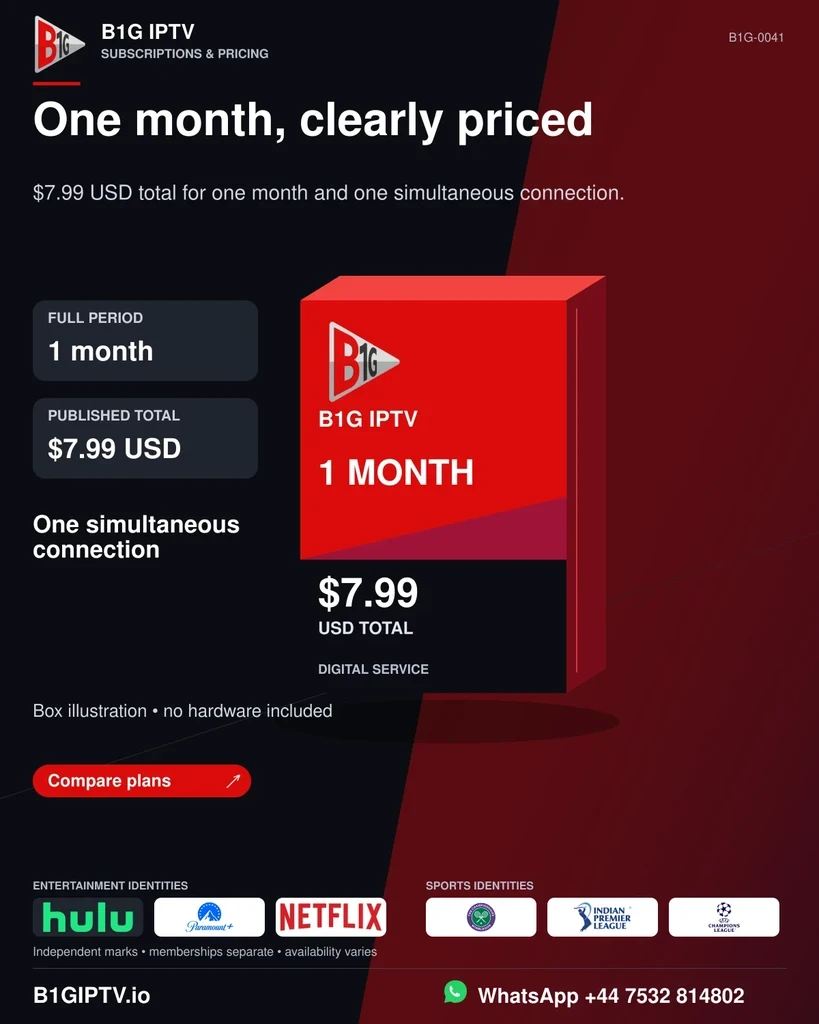
Open the official B1G IPTV websiteThe 1 month plan is listed at $7.99 USD. The operator also lists 7 reseller pack sizes.

b1giptv.io
The 1 month plan is listed at $7.99 USD. The operator also lists 7 reseller pack sizes.
The 1 month plan is listed at $7.99 USD. The operator also lists 7 reseller pack sizes.
Ask which published pack, checkout domain and permissions apply to the specific reseller account.
b1giptv.io · Check exact market
Open the official B1G IPTV websiteB1G IPTV maintains the site at b1giptv.io. Check who issues the invoice and who replaces the access if the app or TV changes. The buyer needs both answers before paying for a long term.
Document review · November 19, 2026. Playback performance, service rights and ZIP-level access require separate evidence.
The 1 month plan is listed at $7.99 USD. The operator also lists 7 reseller pack sizes.

b1giptv.io
Start with the reason someone is shopping. A fan asks whether buying B1G IPTV will let the family watch a particular college game. The recognizable characters in the seller’s name cannot answer that. The useful details are the two teams, date, scheduled broadcaster, viewing address and account the household is considering. Check the schedule with the broadcaster or competition, then ask B1G IPTV about that specific authorized feed for the proposed account. Keep the broadcaster and the seller as two distinct names in the answer.
This is a good example of what the $7.99 monthly price can and cannot settle. The price identifies the published base amount for one month of B1G’s standard, single-connection subscription. It does not identify the broadcaster for Saturday’s game or whether a second family member can stream a different programme at the same time. A shopper who needs only that one event should settle the event question before spending even the smallest amount. A shopper establishing a regular household service has several other things worth testing.
B1G IPTV uses b1giptv.io and its current store prices the four retail terms in U.S. dollars. The retail listing we checked on November 19, 2026 gives one simultaneous connection on every term. Its commercial programme is unusually straightforward about the unit of stock. One credit funds one customer-month for a standard term. The priced packs are 100, 500 and 1,200 credits. Separate requests for 60, 120, 300 or 600 are quotation routes. Read the differing quantities carefully before comparing screenshots.
This review follows the purchase from a single-evening question to the much larger obligations of a reseller. The same discipline helps both people. Identify what is being purchased, state the unit, confirm who can supply it and keep enough of the transaction to repair a mistake later. A single customer wants the right programme on the right screen. A reseller may have promised that same sort of service to dozens of customers with different terms and devices.
Take the college-game example one step further. Open the competition’s published fixture or broadcaster schedule and identify the date, teams, start time and listed outlet. The Big Ten Network schedule is one source for events actually shown on BTN. If another outlet is announced for the game you care about, follow that source instead. A general Big Ten logo, a season schedule showing only opponents or a graphic from last year cannot establish who has the current game rights at your address.
Next translate that information into a question for the seller. Name the actual broadcaster, the event, local viewing area and time. If a local affiliate or regional feed is involved, provide its call sign where known. Ask whether the specific account and authorized distribution arrangement cover that feed under those conditions. The seller may be able to identify an available feed, say that it cannot confirm the event, or direct you to a separate authorized viewing route. Those outcomes lead to different buying decisions.
It is worth asking whether the fixture is live, delayed, a replay or a highlights programme. A programme guide can show a familiar team name while the entry describes a repeat or a studio show. A buyer who will be watching friends react to the live play needs the live event. A buyer content to watch a replay at home later has another acceptable outcome. State which matters. A screenshot of a title with the clock cropped out leaves the distinction unresolved.
A one-day service trial may fall before the event. Use it to test the interface, remote, guide readability, audio, captions and a representative permitted programme. A successful trial of those functions does not establish future carriage of a particular event. Save the seller’s dated written response to the event question separately. If support cannot confirm it and the match is the only reason to buy, the honest decision can be to wait or use the broadcaster’s available authorized option.
If the family is still interested after the game, choose one station that matters on an ordinary weekday and do the same check. A service purchased for a famous event can become an expensive distraction if it does not meet the household’s normal use. Conversely an account that fits the family’s regular viewing may be worthwhile even if the single event requires another arrangement. The buyer should know which of those decisions they are making.
| B1G retail term | Full base total | Rounded monthly equivalent | Concurrent sessions listed |
|---|---|---|---|
| One month | $7.99 | $7.99 | One |
| Three months | $19.99 | $6.66 | One |
| Six months | $34.99 | $5.83 | One |
| Twelve months | $44.99 | $3.75 | One |
The annual figure deserves a closer look because it is only $10 higher than the six-month amount. A reader who has already tested the device, established the one-screen fit and knows the household will remain at the address for the year may find that an easy decision. A family staying for five weeks still has to find $44.99 today and has no assurance it can use the remaining months. Ask whether a shorter term meets the purpose before asking which row has the smallest equivalent.
Three individual months would total $23.97 at $7.99 each. The quarter saves $3.98 if the household stays for all three months and the later monthly prices would otherwise have stayed fixed. Two quarters cost $39.98, against $34.99 for six months, a difference of $4.99. Two six-month terms cost $69.98, or $24.99 above the year. These figures value the option to reconsider at intermediate dates. They also assume the same account allowance, terms and fee treatment throughout.
For seven months, one six-month term and one month add to $42.98 under unchanged rates and a permitted renewal sequence. The annual term is $2.01 higher. For eight months, one six-month term and two monthly terms would total $50.97, already $5.98 above the annual listing. This is a practical question for an academic-year lease or a long seasonal job. Write down when the household will leave and whether a move changes the viewing location or permitted use. The term that looks best on paper may extend beyond the last date it actually helps.
Check the currency printed on the current seller page and on the actual payable quote. Older search descriptions or saved advertising from a different edition can linger after a website changes. A number without its currency and term can look deceptively familiar. Keep the merchant identity beside the total, and hold a separate record for a player licence purchased through the device’s app store. The party who collected the software charge may be different from the party responsible for the viewing account.
A standard B1G subscription describes one simultaneous connection for each of the four terms. Paying for twelve months extends how long the account lasts under those published terms. A household needing two different programmes at once should ask B1G to quote that arrangement before buying one year on the assumption that a longer period unlocks more streams. Having two compatible devices is useful information, but it does not determine the purchased concurrency.
Start a household test with a simple distinction. Are two viewers sharing one picture, or are two playback sessions running? Four people sitting around one television use a single playing stream for ordinary household planning. One person leaving the living-room stream on while starting a second player in the kitchen may use two active sessions. Ask the seller how the chosen player releases a session, particularly where a paused programme or a TV switched to another input leaves the app running.
Test device changes in a supported order. Stop the authorised stream on the first device, exit as directed, and try the second device if the account permits switching. If a limit message appears, record the exact text and how long it has been since ending playback. Avoid opening additional players while diagnosing the problem. Support then has a clean account history to inspect and the household has a repeatable way of switching once the behaviour is understood.
Some arrangements need a separate location answer. Grandparents and grandchildren watching together in one home are a different case from relatives trying to use the same account across two addresses. A purchaser taking a device while travelling should specify the destination, duration and whether anybody will continue watching at home. Establish both the location terms and the active-stream allowance. Satisfying one condition cannot answer the other.
A comparison with another provider should use the same household requirement. B1G’s annual $44.99 total is a useful quote for its listed one-screen arrangement. Another provider’s annual offer may include several concurrent connections or a different currency. To answer which costs less for two simultaneous viewers, obtain actual quotes for two permitted sessions and compare the complete amounts. Multiplying $44.99 by two gives an arithmetic hypothetical, not an operator offer or confirmation that two accounts may be used in the intended arrangement.
B1G’s app page asks buyers to identify the device and request current instructions through support. Its Fire TV guide points users toward the actual Amazon Appstore route for compatible television players and separates Amazon’s device account from the credentials used inside the viewing app. A Google Play listing on a phone belongs to a different software route. The family can avoid a surprising amount of setup work by establishing which device will actually play the programme.
Begin with the model, software and connected inputs. A Fire TV Stick normally reaches a television over HDMI, so identify the correct television input before diagnosing any software. The manufacturer’s home menu may remain on screen if the stick has not been selected. If a stick or box is absent and the family wants to use the television natively, obtain instructions for the television’s platform and store region. Naming the attached box or explicitly saying “native TV app” gives support an actionable starting point.
Modern products sharing a brand name may have different operating systems. B1G’s own app guidance distinguishes Android-based Fire OS from other Fire TV software routes, including Vega OS. A named Android installer is useful only where the intended device supports that installer. Confirm the appropriate player and publisher for the exact model. The buyer’s ability to download a file someone forwarded does not establish that it belongs on the device.
After installing the intended player, open it and record the state of the first account screen. A request for a device-store password, a player activation request and a viewing-account form belong to different parties. Use the publisher or seller route appropriate to the stage. In particular, keep B1G subscription details out of the device retailer’s account-verification prompts. Somebody helping by telephone can often diagnose the problem by asking what logo and heading appear above the empty fields.
Only then request the advertised one-day trial. Agree what time it starts and use the same screen, remote and connection the household plans to keep. A test performed entirely on a friend’s new phone gives limited information about an older television attached to the family’s soundbar. A buyer who can reach the requested feed, hear it, control captions and return after changing inputs has collected useful evidence long before choosing a six- or twelve-month term.
Give the trial one decisive purpose. A household buying for live sports might choose a legal sports broadcast representative of the movement and on-screen graphics it cares about. A viewer who relies on captions should pick a specific feed and programme that supplies that caption language. A family buying for local news should identify the station and local bulletin. The results of three completed tests matter more than a casually reported number of categories in a menu.
Write down the beginning state. Who supplied the trial, which player and device received it, which market the seller confirmed and what successful viewing would look like? An example might be “Read the local score from the sofa with the picture in motion” or “Start the local evening bulletin and select readable English captions using the ordinary remote.” If the requirement is vague, a three-minute glimpse of any moving picture can feel like a pass even when the household’s actual need remains unresolved.
Next check ordinary recovery. Exit the player, change the TV input or allow the device to sleep in its normal way, then return. Observe whether the selected app, guide and preferences remain accessible. If one person installed the app for somebody else, hand over the remote without giving instructions. Where the viewer struggles, note the state of the screen and the button they expected to use. Often a short input label or clear favourite makes the difference.
If sound or picture fails, narrow the problem. Check the television input, test a second authorized item in the same player and see whether the guide or menus remain responsive. A silent single programme can indicate a track choice; a silent HDMI input across multiple apps can point toward the local audio path. A buffer on one local station can require a different enquiry from slow starts across the entire home network. A concise support note keeps such cases separate.
Finish with a decision that can be read later. Put the outcome, unresolved item, source and date in the note beside the proposed term. “The Fire TV worked after selecting the correct HDMI input. We still need the seller to confirm the particular fixture and the app licence renewal” is a stronger basis for a purchase than calling the entire trial good. It lets another family member take over the order without repeating every test or guessing which important question remained open.
B1G states that one reseller credit represents one customer-month. A standard one-month term uses one credit, a quarter uses three, a half-year uses six and a year uses twelve. The store’s term is useful because it includes both sides of the calculation. Multiply each customer by the number of months issued. The published mapping describes inventory consumption. It does not describe a physical month on the calendar, a day count or the number of devices a customer may use simultaneously.
| B1G pack | Credits | Published price in USD | Unit cost | Complete standard annual terms if used only for years |
|---|---|---|---|---|
| Starter | 100 | $99 | $0.99 | 8, with 4 credits left |
| Professional | 500 | $445 | $0.89 | 41, with 8 credits left |
| Enterprise | 1,200 | $948 | $0.79 | 100, with none left |
Eight annual customers on a Starter pack use 96 credits. Four remain, enough for one quarterly term and one monthly term, or four separate standard months. A reseller who promises a ninth annual customer would need another eight credits beyond the remaining balance. If customer subscriptions all have different expiry dates, the arithmetic is still the same, but the schedule on which those remaining credits are needed becomes part of good service.
A Professional pack can cover many more customers, yet the 500 credits do not imply 500 annual subscriptions. For example, twenty annual commitments, thirty quarters and ten six-month terms would use 240, 90 and 60 credits respectively. That is 390 customer-months with 110 still available. The number of customer accounts in this illustrative mix is sixty. Reporting “we sold 390 accounts” would confuse the inventory unit with the people receiving service.
Allocate the cost of a year by multiplying the relevant pack rate by twelve. The result is $11.88 on Starter, $10.68 on Professional and $9.48 on Enterprise. None of those figures is the cash required to acquire a pack. None is a recommended consumer price, a guaranteed margin or the cost of looking after a household for twelve months. A reseller serving customers through trial setup, remote help and annual renewal must account for its own work separately.
The unit rule also affects how staff explain an extension. If a standard B1G customer renews for three months, a three-credit debit is the published starting point. Record the prior expiry, what the customer bought and the result shown by the operator. Ask how early renewals or nonstandard configurations work before promising an exact end date. A correct number in the debit column does not by itself prove the operator extended the correct customer or chose the expected starting date.
Starter costs $99 and Professional $445. Five individual Starter packs would provide 500 credits for $495 at unchanged published rates. Buying one Professional pack saves $50 when the business genuinely needs all five hundred credits subject to identical conditions. Buying only the first Starter pack keeps $346 of cash uncommitted on that first order. A modest support desk with fluctuating sales may care much more about that $346 than a hypothetical $50 saving spread across stock it may never use.
Take an operator expecting 360 standard customer-months over a known period. Four Starter packs would supply 400 credits for $396, leaving 40 after the planned work. A Professional pack costs $445 and would leave 140. The larger pack has the lower cost per credit, yet the four smaller whole packs cost $49 less to acquire against this demand. Whether they can be purchased, combined and held on equal terms must come from the operator. The example makes the questions about balance management and top-up timing worth asking.
Now move confirmed demand to 470 credits. Five Starter packs would cost $495 and leave 30. A Professional pack would cost $445 and leave the same 30. At that demand the benefit of the Professional price is direct. If reliable demand is only 100 this month and the rest remains speculative, the reseller can still examine what it would cost to buy incrementally and when it needs a written price for the next purchase.
Enterprise is 1,200 credits for $948. Two Professional packs plus two Starters would also produce 1,200 credits and cost $1,088 at the displayed rates. The Enterprise pack is $140 less for the same count, assuming comparable conditions. An operator who has never managed more than a hundred customer-months should also account for the time to support, document and renew the larger population. Stock can be delivered all at once. Human support capacity is usually built over time.
For a new buyer, write the confirmed demand, expected but uncommitted demand and cash available as separate figures. Put customer promises due before the next expected replenishment at the top. An operator can then choose a quantity tied to actual obligations, ask for a quote on an intermediate amount or defer speculative stock. A pack name such as Professional or Enterprise describes a commercial tier. It is not a measure of how seriously a small desk will serve its customers.
B1G’s reseller page explicitly separates the priced 100, 500 and 1,200-credit packs from custom enquiries at 60, 120, 300 and 600 credits. Someone needing exactly 120 standard customer-months has a sensible reason to request the 120-credit quotation. It would be a mistake to multiply 120 by the published Starter, Professional or Enterprise unit rate and publish that result as B1G’s price. The operator has reserved those quantities for a quote.
A useful request identifies the desired quantity, currency, intended use and the point at which credits will be needed. Ask for the full amount, any fee, expiry of the quote, balance conditions, delivery method, standard deductions and any special conditions linked to the proposed customer configuration. If the use involves multiple territories or another reseller, ask which activities the account is authorized to perform. Keep actual customers’ private information out of the initial enquiry.
A quote becomes more informative when compared with an attainable alternative. For the 120-credit need, two Starter packs would provide 200 credits for $198 on the published schedule if the operator allows two purchases. The 120-credit quote might require less cash but leave no spare stock, or it might offer additional terms that change the comparison. Until the quote arrives, $198 is the cost of a hypothetical two-pack alternative. It is not the official custom 120 price.
At 600 credits, one Professional and one Starter would total $544 for exactly 600. Six Starter packs would total $594. A separately quoted 600 pack could be compared with those figures once its price and conditions are known. Ask whether a single combined order has different expiry treatment, operator permissions or support expectations. A lower total is less useful if it applies to a different product or customer setup.
Preserve the quote in the private business records with its effective date and seller identity. When staff later see a 300-credit card without a price, they should be able to tell whether the business possesses a current written quote for its own account or is simply looking at a general enquiry. Publishing a negotiated private amount as a public universal rate can mislead other buyers and leave the reseller unable to honour its advertised offer.
A retailer can get every number right and still hand the buyer an unusable television. Set up practical ownership at the same time as the account. The customer should know which device runs the player, which remote selects its input, who supplies the viewing account and who owns the relevant email or support contact. A buyer who depends entirely on the installer’s private phone to renew, resolve a payment or remember the chosen app has not received a complete handover.
Give the customer an ordinary operating note, written in terms they can see. It may contain the HDMI input label, player name, route to the guide, how to stop viewing and the support contact. Leave the account password, payment details, device pairing identifiers and unrestricted panel addresses out of a note left beside the television. Use the agreed private channel for any access details the owner legitimately needs.
For a family buying B1G for local or college sport, include the name of the feed or broadcaster they checked and the date on which it was confirmed. A record saying only “sports works” goes stale immediately. A record naming a game, date, confirmed viewing area and player can be read accurately next season, even when the broadcast arrangement changes. It also gives support a focused question if a listed game moves from one outlet to another.
Ask the regular viewer to do three things before the installer leaves. Start the known programme, return to the guide and exit the player so the one concurrent connection is available for an allowed switch. If the household uses captions or another audio track, add that action as well. Let the viewer use the remote. A helper demonstrating the steps perfectly while the buyer watches can conceal a button or menu label that makes little sense to the actual user.
Write a short private confirmation of the paid order, including term, actual activation date, account expiry, full price, seller and local support responsibility. A reseller should record the standard debit alongside it. Keep the operating note and transactional confirmation accessible to the appropriate people. The person called at 8 p.m. for help with an HDMI input may have no reason to see a payment reference. The person handling a renewal needs a different part of the record.
A private ledger with a starting balance and a closing balance can reveal mistakes while there is still time to correct them. Suppose a Starter balance opens at 100. Five annual terms use 60, leaving 40. Four quarters use twelve and leave 28. Three single months reduce the balance to 25. Those figures are simple enough to check by hand. The important work is attaching each reduction to the right private customer reference and the expiry promised in the corresponding order.
Imagine the desk then promises two annual renewals for Friday and receives an enquiry for a six-month term on Thursday. The existing commitments need 24 credits. The apparent 25-credit balance leaves only one unreserved credit. If the new six-month customer pays and staff issue the line immediately, the panel would fall to nineteen and Friday’s renewals would be short by five. No error in supplier pricing is required to cause this problem. The desk simply counted stock already promised to somebody else.
Keep a reservation column for paid or firmly accepted obligations and an interest column for uncommitted enquiries. A reservation should name its owner, intended action and deadline. An enquiry should go stale after a defined internal follow-up point. A panel balance by itself cannot show those internal commitments. A sales view that subtracts every casual enquiry, meanwhile, can hide stock actually available for paying customers. The two views serve different people.
After each actual panel action, compare what changed with the standard deduction expected from the term. If a three-month extension changes the credit balance by three but the customer’s expiry fails to move, do not perform the same extension blindly again. Check whether the operation is pending, whether the expiry display has refreshed and whether the correct account was selected. Ask the operator to reconcile the operation through its private channel, preserving both the customer promise and the original panel record.
These records also help at month end. Add credits purchased during the period to the opening balance and subtract completed operations, recording only documented adjustments. Compare the result with the operator’s closing balance. Explain any difference through an identified action, refund, correction or unresolved ticket. Moving a number directly into the closing column to force agreement erases the very clue that could reveal a missing renewal or a duplicated customer charge.
Numbers at the low end of the B1G reseller table can create an odd illusion. At the Enterprise rate, the direct wholesale allocation for one standard customer-month is seventy-nine cents. A small operation might describe the week of work required to sign up and support that customer as a seventy-nine-cent job. That leaves out both the $948 required to reach the Enterprise rate and every task that occurs after the panel action.
Imagine a week with one new annual customer, one three-month renewal and one monthly start. Those actions consume sixteen standard credits. At the Starter rate the direct component is $15.84. At the Professional rate it is $14.24. At Enterprise it is $12.64. Moving from Starter to Enterprise would save $3.20 of direct credit cost on that particular week’s work, assuming the operator really holds Enterprise stock under the same conditions. Those numbers can inform planning. They cannot by themselves justify spending another $849 on the opening pack.
Write down what each of the three customers needs. The annual buyer may need a remote-control handover on a television with a soundbar. The three-month renewal may take a single confirmation if the original account and expiry are clear. The monthly start may require a fresh player installation and a check of the local feed the customer cares about. The cheapest account to provision in credits can require the longest conversation. Give each task a realistic owner and service window before promising a response time.
Ask what happens if the game the annual customer cares about moves to a different broadcaster halfway through the year. A documented, dated answer about a particular event can be rechecked. A broad promise that every future game will appear in an unspecified category leaves the reseller trying to honour something that no price or pack description established. A business looking for predictable support costs benefits from clear sales wording as much as from a lower wholesale unit rate.
When looking back at the week, compare the direct cost, team time, unresolved questions and actual service delivered. Track which tasks consumed repeat support effort and fix the handover or documentation that caused it. If three customers could not find the correct HDMI input after a device restart, a better label or a short printed instruction can save more useful time than a pack upgrade. A careful reseller chooses a pack that covers the purchased customer periods, then improves the parts of the service its own team actually controls.
A desk can put this reasoning to work with a small weekly review. Take one order that went through first time and one that needed a second contact. Compare the original question, device details and private payment reference with the outcome. If the successful order named the seller domain and the one that stalled simply said “B1G,” add the domain to the form customers already use. If the stalled viewer could find the right station but misunderstood the start time, put the local time and broadcaster alongside the fixture in the confirmation. Make only the change that explains the observed difference.
Measure the result in ordinary terms on the next order. Count whether someone still had to ask the same question twice and whether the customer could open the right programme using the information supplied. A support record improves when another person can use it without reading the entire conversation. It also becomes safer to share internally because each role receives the specific information it needs, without a copied password or a photograph of somebody else's payment receipt.
For a household, the decision begins with one real screen and a specific viewing requirement. Confirm that the named B1G account fits the location and programme, test the intended player within the one-day offer if available and choose a term against the dates the household can reasonably use. Where one concurrent stream is enough and the family expects a full year, $44.99 is the documented annual base total. A household needing two simultaneous feeds should obtain a suitable written quote before treating that row as its price.
For a reseller, start with customer-months due and the date stock must be available. Compare whole priced packs and genuine custom quotes using both cash outlay and leftover stock. Ask what terms apply to the balance, what operations the panel permits and who handles a customer correction. A reseller can use the published one-credit-per-customer-month rule to plan standard activity. Customer responsibility, private agreements and local distribution authority still need explicit attention.
For the person asking about Saturday’s game, go back to the original question. The official broadcaster schedule, a seller’s dated confirmation for the account and an independently usable device form a workable answer. If any one of those is missing, a new payment alone will not supply it. If all three are present and the household can accept the price and terms, the buyer can proceed knowing what the subscription is expected to do that particular evening and what it will do for them afterward.
Suppose you expect to watch for six months. At the listed single-month amount, six separate purchases would total $47.94 USD. The six-month offer asks for $34.99 USD up front. That comparison assumes every new month is available at the listed amount. Check renewal separately before relying on it.
| Viewing period | Separate monthly purchases | Single matching term | Difference | Monthly purchases to reach term price |
|---|---|---|---|---|
| 3 months | $23.97 USD | $19.99 USD | $3.98 USD | 3 |
| 6 months | $47.94 USD | $34.99 USD | $12.95 USD | 5 |
| 12 months | $95.88 USD | $44.99 USD | $50.89 USD | 6 |
Read the final column as a spending threshold. If you expect to cancel sooner, compare the shorter commitment with the cash you would have paid up front. The figures exclude fees the seller has not confirmed.
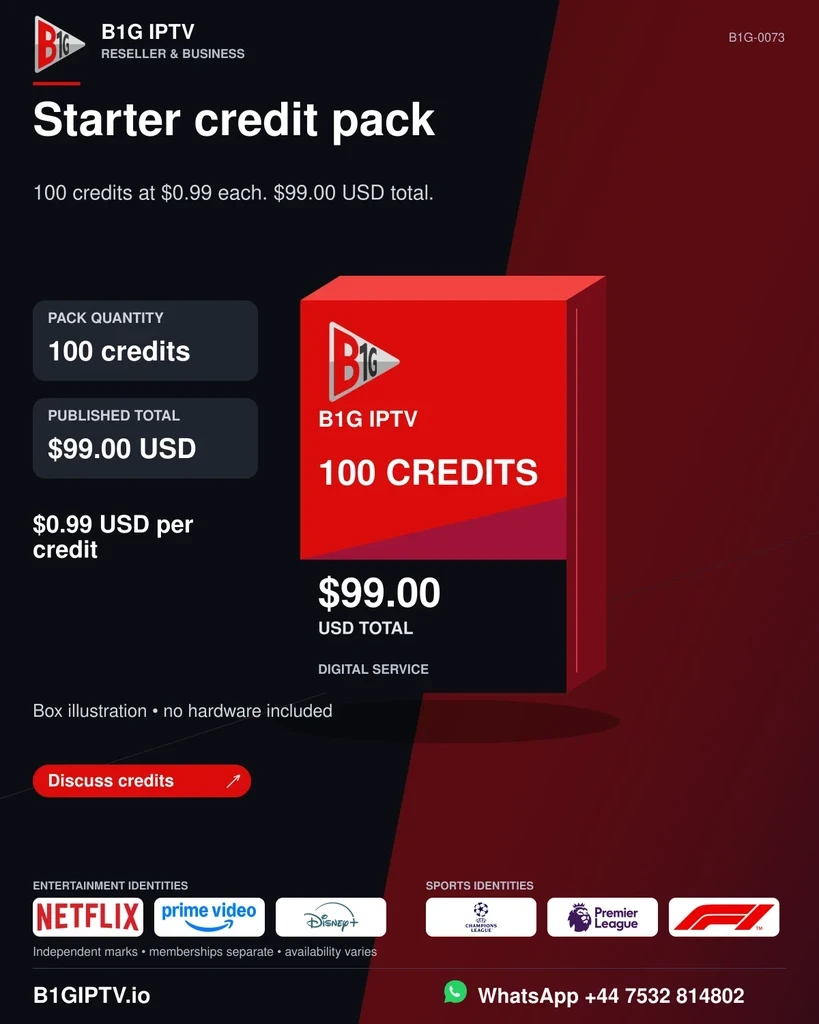
Check B1G IPTV subscription termsThe smallest priced pack in this register holds 100 credits and costs $99.00 USD. The largest holds 1200 for $948.00 USD. Their displayed unit costs are $0.99 and $0.79 respectively. The published deduction for a standard twelve-month customer is 12 credits. Check the operator’s treatment of additional screens and renewals.
The image link identifies the exact file served by the provider.

Choose a matchup to see the actual currency, term and outcome.
Open the caption on a website-sourced image to see its original. The remaining captions identify material supplied with the provider archive.