
provider
Crystal IPTV
Identify the actual app and seller support route for the viewing device before submitting an order.
crystaliptv.app · Check exact market
Open the official Crystal IPTV websiteThe 1 month plan is listed at $8.99 USD. The operator also lists 4 reseller pack sizes.

crystaliptv.app
The 1 month plan is listed at $8.99 USD. The operator also lists 4 reseller pack sizes.
The 1 month plan is listed at $8.99 USD. The operator also lists 4 reseller pack sizes.
Identify the actual app and seller support route for the viewing device before submitting an order.
crystaliptv.app · Check exact market
Open the official Crystal IPTV websiteCrystal IPTV maintains the site at crystaliptv.app. Check who issues the invoice and who replaces the access if the app or TV changes. The buyer needs both answers before paying for a long term.
Document review · November 19, 2026. Playback performance, service rights and ZIP-level access require separate evidence.
The 1 month plan is listed at $8.99 USD. The operator also lists 4 reseller pack sizes.

crystaliptv.app
Two three-month Crystal subscriptions at the listed price would cost $49.98. A full year is $49.99. It is tempting to say the year therefore makes obvious sense. Look at the six-month line first. Crystal lists six months for $34.99. For a buyer who genuinely needs half a year, choosing the annual plan means paying fifteen dollars more than the available six-month option. A comparison can be mathematically correct and still compare the wrong two purchases.
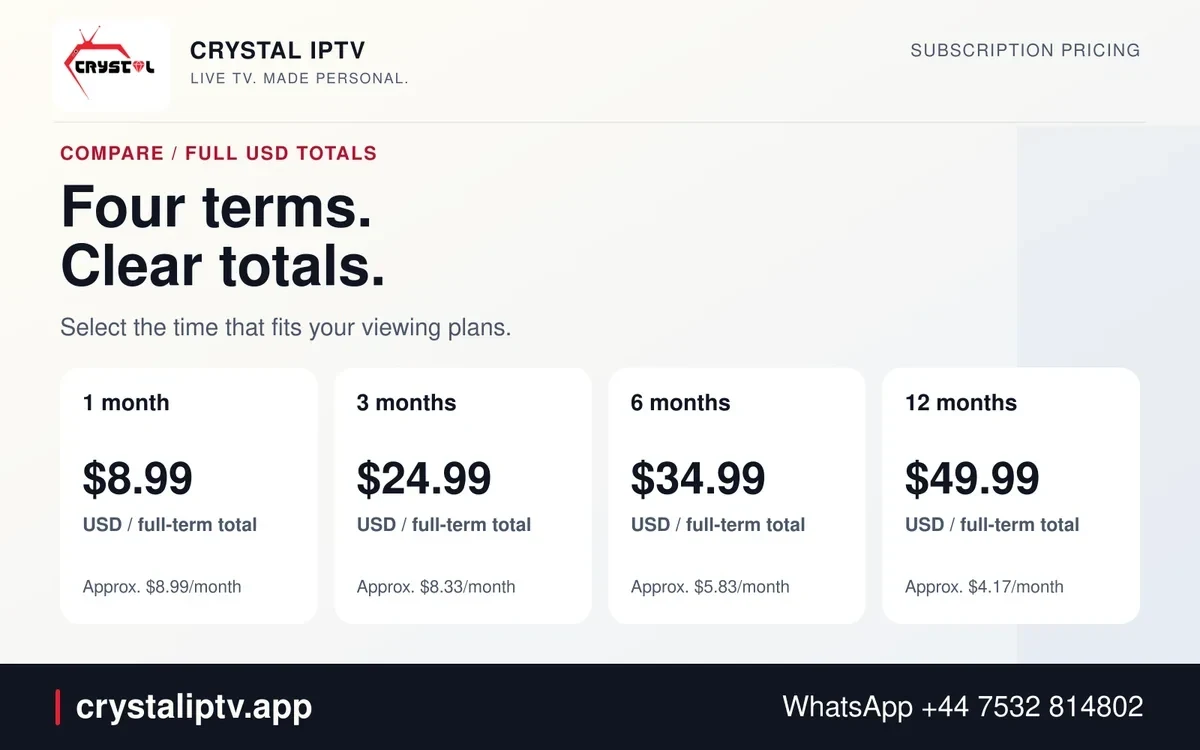
The current English USD edition of Crystal's own pricing page lists $8.99 for one month, $24.99 for three, $34.99 for six and $49.99 for twelve. Those figures are the totals for each term. Older indexed copies and promotional material can show different currencies and amounts. For a U.S. purchase, match the plan name, payable currency and total on the current order enquiry with what the seller confirms before payment. This profile uses the USD schedule checked on November 19, 2026.
Crystal's reseller schedule contains a second interesting detail. Its published deductions are one tenth of a credit for a month, three tenths for a quarter, six tenths for six months and one whole credit for a year. One annual assignment therefore uses fewer credits than twelve separate one-month assignments. A consumer choosing a viewing term and a merchant planning to supply one are both making a timing decision. They need different numbers to do it well.
Take a household that knows it will occupy its current apartment for the next four months. At the recorded prices, one quarter plus a single month comes to $33.98 if renewals can be applied consecutively at the same rates. A six-month purchase costs $34.99, only $1.01 more. If moving house would end the family's eligibility, those two extra months might never be useful. If Crystal confirms service at the next address and the family expects to continue, spending that additional dollar could be attractive. The address question changes the value of the apparent deal.
A different household knows it will need seven months. Six months followed by one would cost $43.98 as a retail calculation. A year costs $6.01 more. If the household needs eight months, six plus two monthly terms would cost $52.97 and the annual price is $2.98 lower. These figures assume prices, account allowance and any separately charged items stay constant. They do not establish that unused days carry forward, that advance terms can be stacked, or that an independently licensed app renews on the same schedule.
For someone who needs only two months, two successive $8.99 months come to $17.98. The quarter at $24.99 asks for $7.01 more over that window. At exactly three months, the quarter is $1.98 lower than three months purchased separately for $26.97. A buyer with a firm two-month commitment is answering a different question from one with a firm three-month commitment. The word “quarterly” on a price card should describe the service period, not decide it on the buyer's behalf.
Build the same comparison for the family budget in actual payment dates. Someone may be able to manage $8.99 this month while needing the remainder of their budget for the internet bill. A longer offer's monthly equivalent cannot pay either invoice now. If a household cannot name a program it intends to watch, a player it can actually install and a time when it will use the account, a lower average price is a poor substitute for an afternoon spent checking those facts.
An order enquiry should leave the buyer with more certainty than the price card alone. Name the Crystal plan, full term and the USD total you see. Identify the viewing area and device. If another adult wants to watch from a second room at the same time, say that plainly. The published retail schedule tells families to confirm their connection allowance. Installing the same app on two devices is not evidence that the account covers simultaneous viewing on both.
A simple message for a six-month buyer might say that the pricing page shows $34.99 USD, the household has one main television, and a particular local-language evening bulletin needs to be available at the service address. Ask for the final amount including any separately charged item, the permitted connection arrangement, the start of the term and where to raise a billing question. The seller can now respond to an actual purchase. A request reading only “best offer?” may attract a price while leaving every important operating detail unresolved.
Crystal's order page prepares an enquiry for the chosen plan. Check the selected product when moving from a viewing page to the order route. A request for a reseller Starter pack refers to a business balance, while the one-month selection refers to a viewing term. The difference is material at $109.99 versus $8.99 before other costs. Reading back the product, number, unit and currency catches errors a matching provider logo will never reveal.
Keep the final agreed quote and the receipt together. If a seller quotes a different currency, ask which current edition and terms apply. Do not infer an exchange rate from the number printed on an older image. A buyer paying with a card or account denominated in another currency should check the actual payment provider's conversion and fees before deciding what will leave their account. The store's USD retail table cannot promise a home-currency charge or a future renewal price.
Crystal's sequence begins with identifying the screen, installing a compatible player and requesting a one-day trial through its published contact. Plan the household test before asking the operator to start the clock. If one family member normally watches news after dinner and another watches a morning program with captions, try to include both periods. A test conducted entirely during the installer's afternoon visit leaves two of the family's most important questions unanswered.
Give the evening viewer a task they recognize. Locate the exact local station, compare its current program against the broadcaster's schedule, watch long enough to hear dialogue and check whether the guide shows the next program at the expected local time. A national feed with the same network logo may not carry the local bulletin. Ask the seller about the station and service area when it matters. A directory or flag identifies an area of interest and cannot establish current carriage for this account.
The next morning, hand over the same remote to the person who uses captions. Ask them to reach the channel without being coached, activate the caption control and return after leaving the player. Several independent details emerge. The station may offer caption data, the player may expose it, the text may or may not be readable from the usual seat, and the preference may or may not persist. Recording each result is more helpful than a single “captions worked” tick.
If the trial uses an account arrangement different from the intended paid subscription, ask which observations transfer. A test permitting more screens than the standard offer cannot establish the paid concurrent allowance. A locally working app remains useful evidence if the paid account uses the same supported format. A successful program on one particular evening cannot guarantee permanent availability or future rights. Keep the time, device, tested item and unanswered requirement together so the person paying for the term can see what the trial actually settled.
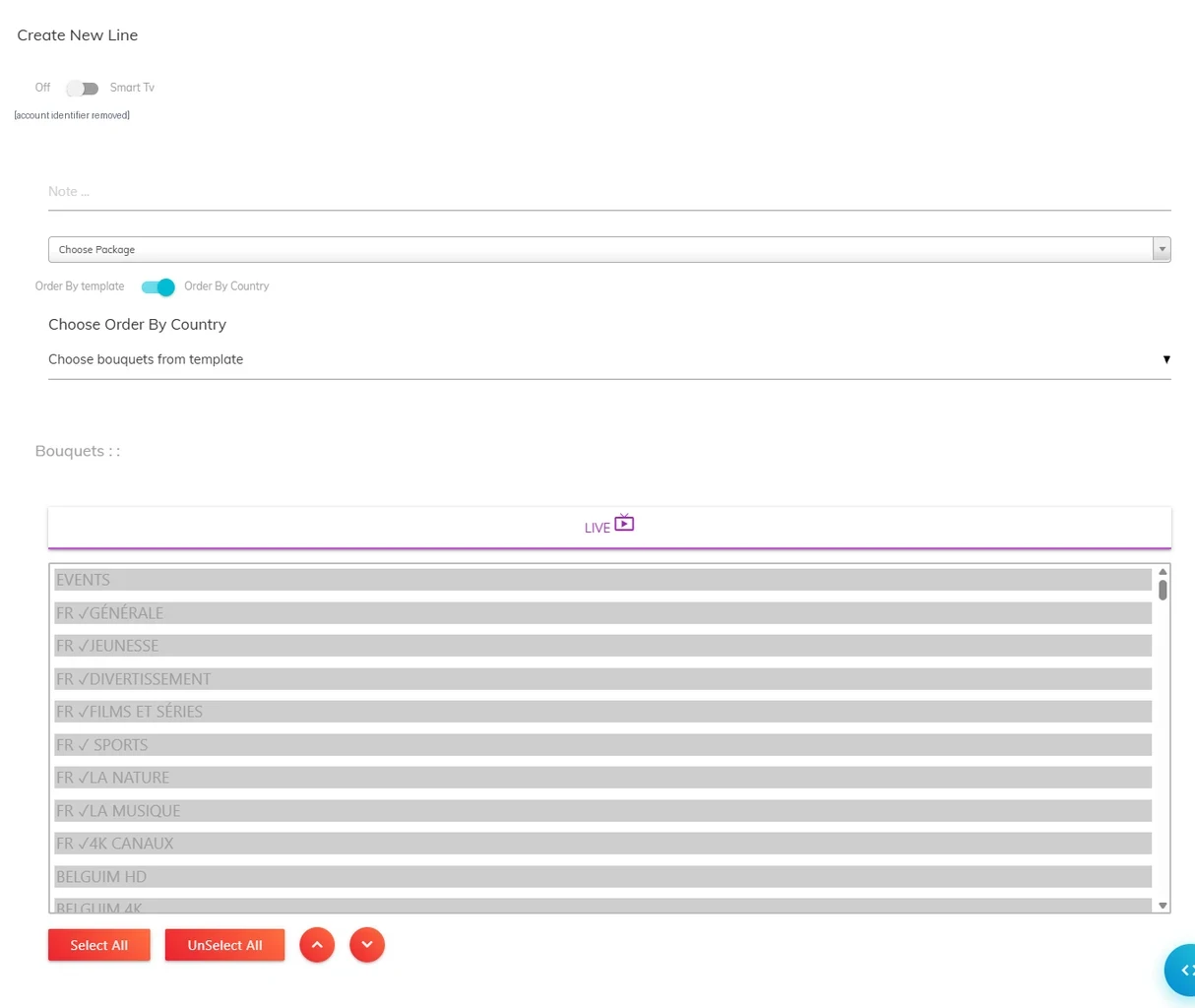
Crystal's device directory distinguishes Fire TV variants, Android TV and Google TV among other routes. The first useful piece of information is the hardware running the application. A television with an external box has at least two settings interfaces, two possible app stores and potentially two remotes. If the box supplies the picture on an HDMI input, its operating system determines the player route. The television's panel brand remains relevant to audio, display and remote behavior, but does not define the software available on the external box.
Read the model from the system information screen or device label. Give support the model generation and current operating-system version where shown. An application guide written for one Fire TV variant is not a guarantee for another variant on a different system. Similarly, seeing a familiar Google TV home screen does not establish that a specific player's store listing is available in the configured market. Ask for the supported version and currently available storefront on the device you own.
If the native television and external box both have possible players, compare the installed routes without assuming you can watch simultaneously. Choose a permitted account method, close playback on the first device where required and test the other. Note how many remote actions it takes to reach the regular program, where captions can be selected and which route recovers after ordinary sleep. A family may value the simpler navigation of the television even if the external box has more features, or the better accessibility of the box even if it requires an input change.
The presence of an app on a device does not show that a family already has viewing credentials. The software publisher may also charge separately, including on a device the household believes was fully paid for. Record app purchase terms alongside the model and version. If the viewer receives a prompt after buying Crystal's term, read who generated it. The developer, operating-system store and viewing account issuer can each handle a different part of what appears to the viewer as a single television service.
| Requested standard customer term | Published Crystal deduction |
|---|---|
| One month | 0.1 credit |
| Three months | 0.3 credit |
| Six months | 0.6 credit |
| Twelve months | 1.0 credit |
There is no rule here that says any duration costs one tenth of a credit per month indefinitely. The four explicit values happen to look linear for the first three offered durations. The twelve-month line breaks that pattern. If a customer asks for nine months, do not invent a 0.9-credit product. Ask which terms the panel actually supports, whether successive assignments are possible and how the expiry changes when they are combined. Published deductions and permitted operations are different pieces of evidence.
For ten customer accounts each receiving one annual term, the published standard calculation is ten credits in total. If instead each customer receives twelve separately authorized one-month assignments, the combined debit over the period would be twelve credits. That example assumes every monthly action uses the published 0.1 and the assigned panel allows those successive operations. It does not mean a reseller can activate ten annual accounts in advance and then collect monthly payments from customers without taking on the risk of their remaining terms.
A reseller planning to sell monthly should investigate what happens if a household stops after two months. Reserving a whole annual credit for that household may reduce the unit cost of a full year, but it also commits more duration before the customer has promised to stay. Separate an actual annual order from a prediction that twelve monthly renewals will happen. One costs a full credit now and carries an obligation. The other consists of a series of individual decisions, each with its own permission and transaction.
Check whether the operator has different rules for an extra simultaneous connection, trial, suspension, extension or adjustment. The published table covers the named standard durations. It does not establish how every exceptional action is treated or whether an expired account follows the same procedure as an active one. Add a separate row to the shop's internal reference only when the assigned operator supplies a clear applicable rule. A blank for an unconfirmed operation is more accurate than copying a nearby figure that happens to fit.
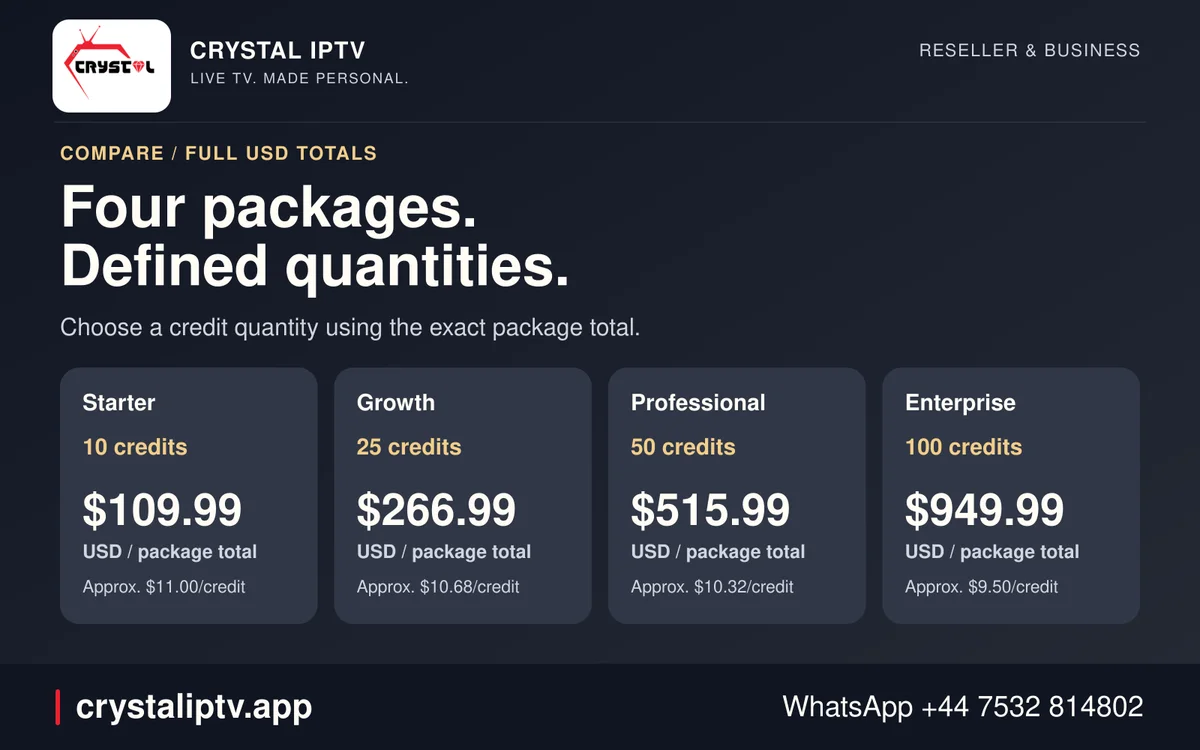
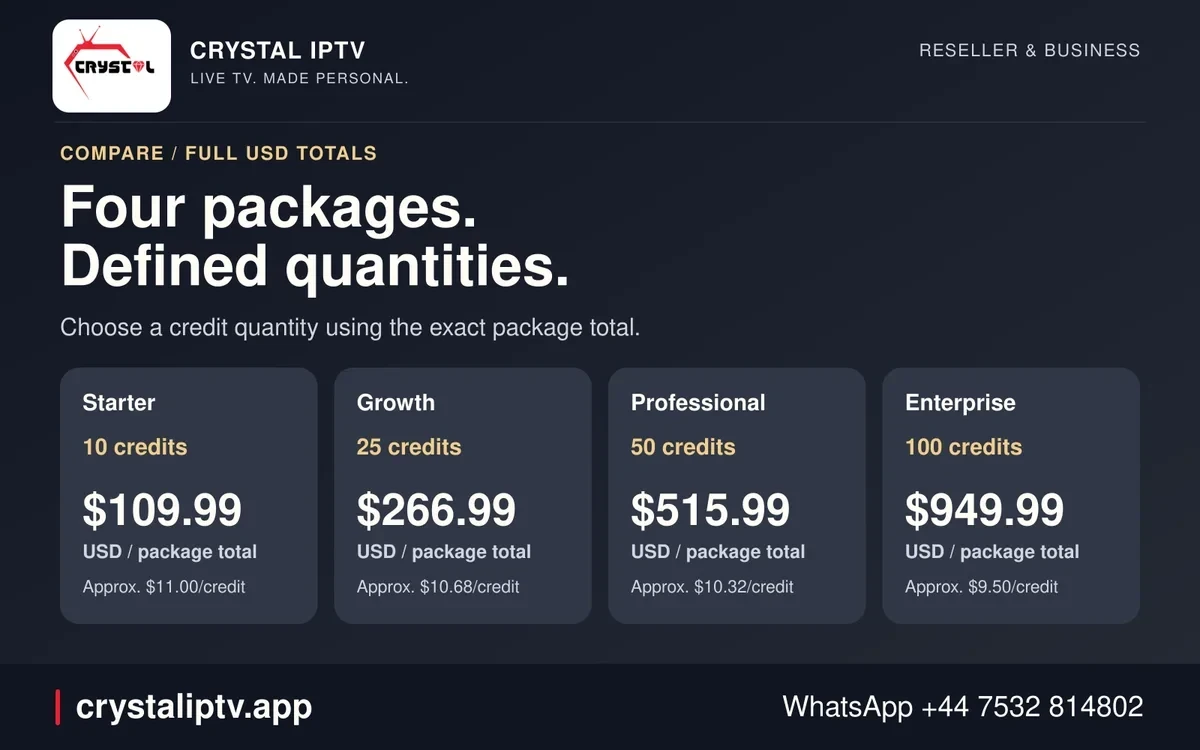
The published U.S.-dollar reseller pack totals are $109.99 for ten credits, $266.99 for twenty-five, $515.99 for fifty and $949.99 for one hundred. Divide the actual invoice by the actual credited quantity when allocating cost. If you round the unit price first, then multiply it back by the pack size, you will sometimes miss the invoice. The Starter average, for example, is $10.999 per credit. Rounding it to $11 for display and multiplying by ten yields $110.00, one cent above the $109.99 pack total.
| Pack | Full USD total | One-month cost allocation | Three months | Six months | Twelve months |
|---|---|---|---|---|---|
| 10 credits | $109.99 | $1.10 | $3.30 | $6.60 | $11.00 |
| 25 credits | $266.99 | $1.07 | $3.20 | $6.41 | $10.68 |
| 50 credits | $515.99 | $1.03 | $3.10 | $6.19 | $10.32 |
| 100 credits | $949.99 | $0.95 | $2.85 | $5.70 | $9.50 |
Each cell rounds only after multiplying the unrounded cost of a credit by the published term deduction. The numbers allocate reseller stock to one supported action. None is a consumer price, a guarantee about margin or a claim that the operator sells individual activations at those dollar amounts. The customer buying a one-month retail subscription sees $8.99 on the dated retail schedule. The business buying the ten-credit pack still needs $109.99 to acquire that stock before it can use a tenth of a credit.
Take the twenty-five-credit example. Its exact average is $10.6796. A six-month term uses 0.6, so the arithmetic before rounding gives $6.40776, or $6.41. A twelve-month term at 1.0 gives $10.6796, or $10.68. If a business quotes two separate six-month service periods, the two underlying deductions add to 1.2. That is a different stock commitment from one annual assignment at 1.0, even if the customer expects to watch for the same total span.
A reseller should also ask which costs the pack does not include. An independently purchased player, the reseller's support labor, applicable payment charges and the cost of handling reversals can all influence a commercial budget. Keep those items as documented amounts in their own columns. Adding an arbitrary percentage and calling the result guaranteed profit makes the stock calculation less useful. The operator gives the buyer a debit schedule and pack total. The business still has to learn how much it costs to serve its own customers.
Suppose four households authorize one-month terms, three request quarters, two request six months and one commits to a year. Under the published standard rules the debit is four tenths plus nine tenths plus twelve tenths plus one whole credit. Altogether that is 3.5 credits. Starting with a ten-credit pack, the expected closing balance is 6.5. At the exact Starter acquisition average the allocated service cost for the ten orders is $38.4965, which rounds to $38.50 when presented once for the group.
Look at why the group has ten customers but uses only 3.5 credits. The number of household records tells the operator how many people might call for help. The term distribution tells the operator how much stock is used. Ten households all on annual assignments would also produce ten records but a ten-credit debit. Staffing and inventory respond to different aspects of the same order book. A store can run short of phone support while still having ample credits or exhaust stock while handling only a few individual enquiries.
Now change just one order. The customer originally requesting a quarter decides on a full year before any activation occurs. Replace the 0.3 debit with 1.0. The total increases by 0.7 to 4.2, leaving 5.8 of the initial ten. If the quarter had already been activated, the operation is no longer the same. Ask whether the operator permits a change, applies an additional term from a later date or treats it as an entirely new action. Do not promise the customer that only 0.7 will be charged in a post-activation correction.
On a real desk, record when the customer authorized the change and which term actually appeared at the confirmation step. A record of the prospective term can be useful for sales planning, but it must be visibly distinct from the record of a completed action. Otherwise the stock reconciliation will seem to prove that a quarter was delivered even when the operator processed a year. The definitive evidence for fulfillment is the actual permitted account record and confirmed new ending date.
Write the credit quantity to one decimal place in the internal ledger when that suits the operator's actual rules. A pack of ten can be represented as one hundred tenths. A one-month assignment then consumes one tenth, a quarter three, a half-year six and an annual ten. This is merely a convenient internal representation. It does not change Crystal's published units, grant permission to subdivide transactions arbitrarily or create a new customer product.
The representation helps explain a puzzling balance. Suppose the desk starts with 8.3 credits, handles one annual assignment, two six-month assignments and four monthly ones. Those operations consume 1.0 plus 1.2 plus 0.4, or 2.6. A correct close in this illustration is 5.7. In tenths the same calculation is eighty-three minus ten, twelve and four, giving fifty-seven tenths. Comparing the two views catches a misplaced decimal far more quickly than guessing whether the missing amount is a rounding adjustment.
Record both the account term and the true start and end dates. An operator can have the right closing balance and still have assigned the correct number of credits to the wrong account. A second person checking the ledger should be able to trace the commercial order number to the intended account, verify its dates and then see the matching debit. They should not need a viewing password to perform this check. Separate sensitive account configuration from the limited record needed for stock and billing.
If a screenshot is used in an approval routine, crop it to the relevant nonsecret details and keep it in a private business record. A general forum can host a question such as why two six-month assignments consume more than one year. It should not be the place where an employee tries to reconcile identifiable customer references or attach a panel screen showing credentials. The math is explainable with a quantity, term and anonymized example. Keep the people's account information with the people authorized to handle it.
A new installer wants enough Crystal credit for eight customers each committing to one annual term and four customers each taking one quarter. That is 8.0 plus 1.2, or 9.2 credits. The smallest ten-credit pack covers the current work with 0.8 remaining. A twenty-five-credit pack buys a lower unit cost while requiring $157 more upfront. The larger purchase needs a reason beyond eight tenths of a spare credit. A credible renewal pipeline or further signed orders could provide one.
Consider an existing business with fifty annual customers already in its renewal window. One fifty-credit pack costs $515.99. Buying two twenty-five-credit packs would cost $533.98, a difference of $17.99 at the recorded prices. One one-hundred-credit purchase costs $949.99, which is $434 more than the fifty-credit pack and leaves fifty additional units after fulfilling the known orders. The larger stock is only commercially useful if the business can allocate it under the operator's actual time and account conditions.
Consider also the business that has many monthly customers but only a few hours a week for support. A ten-credit balance could theoretically cover one hundred one-month assignments under the standard rule. It would take one hundred correctly authorized and verified account actions to use it that way. That task is operationally different from ten annual assignments consuming the same stock. The family contact time, billing questions and missed renewals may dominate the business case even when unit calculations are easy.
Ask the operator about credit expiry and permissions before assigning a value to idle stock. A remaining balance may have restrictions that do not apply to cash in an ordinary business account. Confirm how the business can see its transactions, who may make corrections and how service interruptions are escalated. For a first transaction, pick one customer whose confirmed need matches the operator's documented account rules, and reconcile it before scaling to a long list. A successful one-order workflow is a more convincing basis for expansion than a large round pack size.
A family selecting Crystal for a bilingual household can turn an ambiguous request into three separate tests. Does the user interface offer a language the viewer can navigate? Does the named live program offer an appropriate audio track in the viewing area? Does the selected program carry captions in the language or format the viewer needs? A seller saying that a broad category exists addresses none of those questions in full. Ask about the exact program or station; watch a permitted instance during the trial if available.
A station's second audio track may carry an alternative language for some programs and carry the main language for others. A viewer who checks only the presence of a track in a menu can still be disappointed that the desired program plays differently later. Describe what was actually heard and when. Where the account includes both a live program and another version of the same material, test the item the family expects to use most often. Do not assume an on-demand version has the same audio or caption metadata as a live station.
Check the visual side of captions as well. Is the text large enough from the usual seat? Does the background make it legible against a bright picture? Can the viewer reach the setting after leaving a station? Some choices may belong to the operating system and others to the player. Record which setting altered what appeared on the actual screen. If the household cannot find a satisfactory combination, ask the seller and app publisher which part they can support before committing to a long term.
If the family watches independently in two languages at the same time, the question returns to connection allowance. A household with two compatible devices and the right language tracks still needs the appropriate simultaneous arrangement. Get the full total for that actual arrangement and compare it with other options on the same basis. A source describing an attractive single-term amount cannot establish the bill for a more demanding household until the seller has confirmed the scope.
Crystal provides a wholesale enquiry route for a business with a volume brief and a distribution enquiry route for a proposed role and territory. A reseller asking for more credits can present its confirmed term mix, expected quantity and delivery window. A business proposing to manage other sellers, use branded material in its own market or coordinate a territory has a different set of permissions to discuss. The existence of a distribution page does not itself make the enquirer a distributor.
Write down the activities requested in ordinary language. For example, the business wants to issue accounts to its own retail customers in a named market and handle first-line support. A separate activity might be assigning stock to a second reseller. A third might be using a particular trademark in the business's advertising. Ask which of these activities the proposed agreement covers, who can authorize them and what operating restrictions apply. A unit price can be exactly correct while those permissions remain unresolved.
Where an organization plans to display programming in a public venue, actual authorization for the proposed use requires separate confirmation from the appropriate rights holder or authorized supplier. A household viewing account, illustrated competition mark or set of reseller credits does not establish that permission. Tell the supplier what the venue intends to do and ask for the right agreement before budgeting the installation. The same discipline applies to an organization seeking to distribute its own video feed: managing and delivering live media is a separate infrastructure purchase.
The business can compare a private quotation with a public pack once the unit, term rules, territory, support obligations and payment currency match. Keep the date and conditions beside the quoted total. Custom pricing given for a minimum annual volume should not be advertised as a price any visitor can obtain for one retail account. A published pack remains one source of evidence. A negotiated agreement becomes another whose conditions belong to the two parties who made it.
On a Crystal order there may be a clock for the player's own license or evaluation period, a clock for the one-day service trial and a clock for the eventual viewing subscription. A household can install a suitable player on Monday, trial the viewing service on Thursday and choose a retailer's term on Saturday. There is no reason to assume the three start times coincide. Ask each party which event starts its own period and keep the answer beside the relevant receipt or activation message.
Consider the viewer who sees a warning on Thursday evening that the application is likely to expire soon, even though Crystal's trial only began that afternoon. The dates may both be honest. The application may be counting time from Monday and the viewing account may still be valid. Read the issuer named in the warning, compare the app's displayed license state with the service account's recorded expiry, and ask the party responsible for the expiring item. Paying for a second Crystal term would be an expensive way to discover the message came from the app.
The same issue arises when a household replaces the device. A remaining subscription term may still exist while the installed player or its device registration changes. Ask the viewing seller whether transfers are allowed and the player publisher what it requires on the new hardware. If the old device will be passed to someone else, remove the household's account details only after the move has been agreed and the purchaser has a private copy of its account records. A photo of a working lineup is no substitute for the information needed to restore authorized access.
For an early renewal, write down the old expiry before placing the new request. Ask whether the next term extends the existing expiry or begins at the moment of activation, and get the new date once the action is complete. Calendar months can have different numbers of days, and the operator's stated end date controls the account check. A spreadsheet that simply adds a fixed number of days to every order may disagree with the service even when the correct term was purchased. Resolve the difference by reference to the agreed dates.
If the family shares billing responsibility, put a reminder ahead of the next decision and label it with the correct product. “Check Crystal viewing expiry” and “check television player license” tell the next person exactly which receipt to open. An instruction reading only “pay TV” invites a duplicate payment, particularly if the family has moved devices in the meantime. Keep sensitive login details elsewhere. A calendar entry needs the next action, the seller's name and the relevant private order reference, rather than the account password.
A particularly easy mistake occurs when an operator prepares a three-month order and the customer changes their mind before payment. On the residential side, the invoice should move from $24.99 to $34.99 if the buyer now selects six months at the listed schedule. That is a ten-dollar change in the retail commitment. On the reseller side the corresponding standard debit changes from 0.3 to 0.6 credits for an unsubmitted new order. The money change and the stock change live in different units and on different records.
For a customer switching from six months to twelve before the order is submitted, the retail schedule rises from $34.99 to $49.99, a fifteen-dollar difference. The underlying standard deduction changes from 0.6 to 1.0, a difference of four tenths of a credit. Entering five tenths because the retail price rose by fifteen dollars would mix two unrelated calculations. The price schedule answers what the household is asked to pay. The credit lookup describes what a particular reseller account operation uses. One is never obtained by moving the decimal point in the other.
If a change is requested after the term already started, capture the existing account status first. A buyer may intend an upgrade effective today, an extension after expiry or a future renewal reminder. Those three requests can look like the same sentence in a short message. Ask what the customer wants to happen to remaining days, and ask the operator whether its panel supports that outcome. Quote only an operation the seller can deliver. Written customer consent should refer to the actual revised term and resulting dates.
The closing confirmation should tell the household the viewing period and the reseller the stock consequence. For the household, that could mean the full agreed total, one effective date, the expiry supplied by the seller and the device on which to check access. For the business, it means the prior credit balance, exact completed action, debit, closing balance and private account reference. A household has no need to see the merchant's stock records. An employee checking stock need not know a viewer's private login or favorite programs.
A concise closing test for the Crystal buyer is to finish two sentences. The amount leaving my account today is the full total for the chosen viewing term, with these separately agreed items. The result I expect to see on this particular television is the following program, in the agreed viewing area and with the needed access features. For a business buyer, substitute the pack quantity, exact standard deduction and first authorized customer action. If the buyer cannot complete one sentence, that missing information is probably worth more than another visit to a promotional card.
Current Crystal USD viewing schedule · Provider order enquiry · One-day trial · Device and platform routes · Four published reseller packs · Explicit credit lookup · Wholesale enquiry · Distribution enquiry.
Suppose you expect to watch for six months. At the listed single-month amount, six separate purchases would total $53.94 USD. The six-month offer asks for $34.99 USD up front. That comparison assumes every new month is available at the listed amount. Check renewal separately before relying on it.
| Viewing period | Separate monthly purchases | Single matching term | Difference | Monthly purchases to reach term price |
|---|---|---|---|---|
| 3 months | $26.97 USD | $24.99 USD | $1.98 USD | 3 |
| 6 months | $53.94 USD | $34.99 USD | $18.95 USD | 4 |
| 12 months | $107.88 USD | $49.99 USD | $57.89 USD | 6 |
Read the final column as a spending threshold. If you expect to cancel sooner, compare the shorter commitment with the cash you would have paid up front. The figures exclude fees the seller has not confirmed.
Check Crystal IPTV subscription termsThe smallest priced pack in this register holds 10 credits and costs $109.99 USD. The largest holds 100 for $949.99 USD. Their displayed unit costs are $11.00 and $9.50 respectively. The published deduction for a standard twelve-month customer is 1 credits. Check the operator’s treatment of additional screens and renewals.
The image link identifies the exact file served by the provider.
Choose a matchup to see the actual currency, term and outcome.
Open the caption on a website-sourced image to see its original. The remaining captions identify material supplied with the provider archive.