provider
Golden OTT
Confirm the retailer, account type and current terms if a link uses a different Golden OTT path.
goldenott.app · Check exact market
Open the official Golden OTT websiteThe 1 month plan is listed at $8.99 USD. The operator also lists 4 reseller pack sizes.

goldenott.app
The 1 month plan is listed at $8.99 USD. The operator also lists 4 reseller pack sizes.
The 1 month plan is listed at $8.99 USD. The operator also lists 4 reseller pack sizes.
Confirm the retailer, account type and current terms if a link uses a different Golden OTT path.
goldenott.app · Check exact market
Open the official Golden OTT websiteGolden OTT maintains the site at goldenott.app. Check who issues the invoice and who replaces the access if the app or TV changes. The buyer needs both answers before paying for a long term.
Document review · November 19, 2026. Playback performance, service rights and ZIP-level access require separate evidence.
The 1 month plan is listed at $8.99 USD. The operator also lists 4 reseller pack sizes.
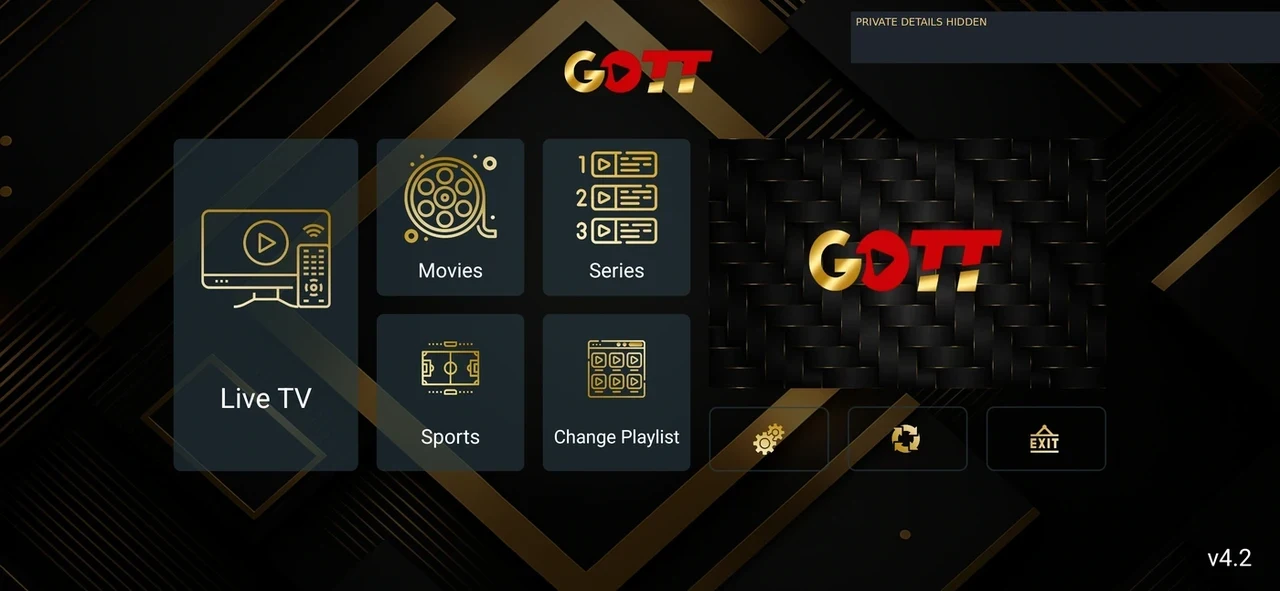

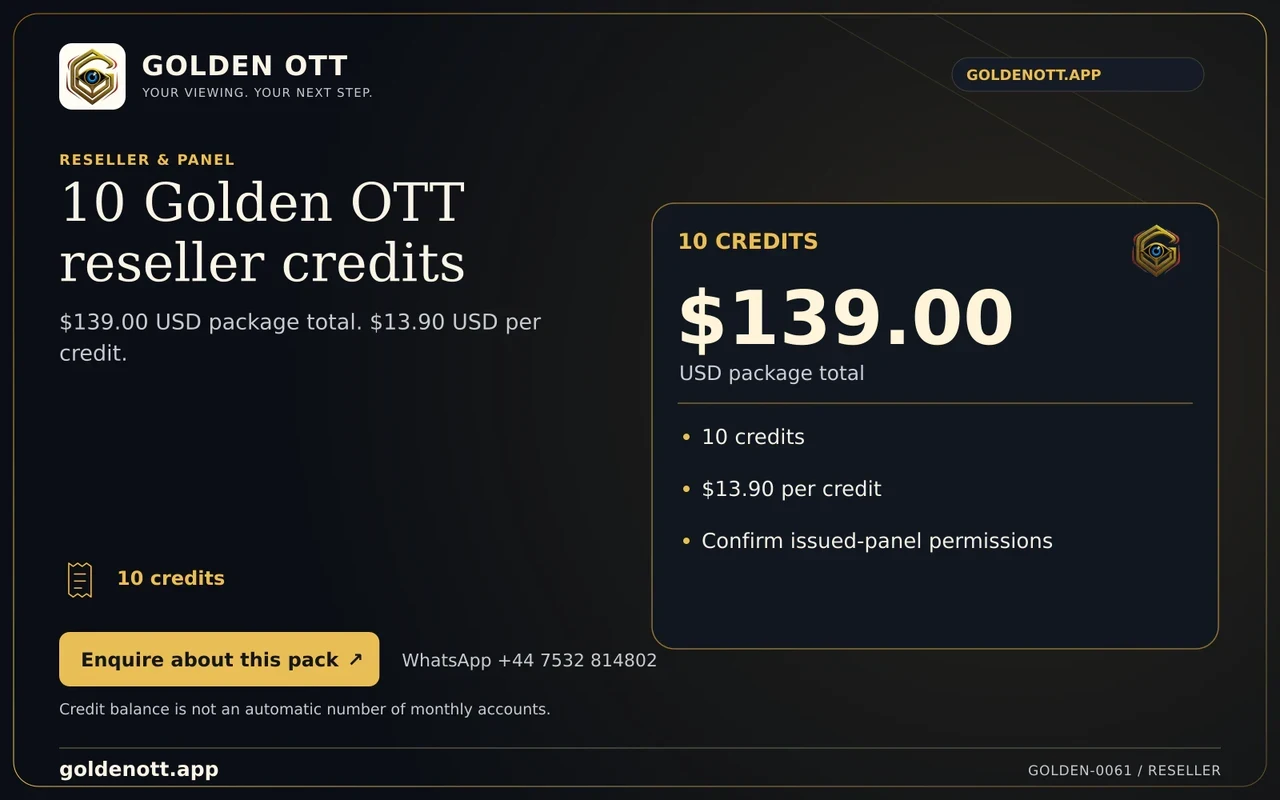
goldenott.app
Ten credits sound like ten months until you open Golden OTT's own calculator. A standard one-month activation deducts 0.1 credit. A year deducts one full credit. That makes the smallest published pack a sizeable purchase for someone setting up a reseller desk. It also explains why comparing two sellers by the price of “a credit” can produce a spectacularly wrong answer. The unit has a meaning inside this particular panel. Keep that meaning with the price wherever you write it down.
Start on the consumer side if the purchase is for one television at home. Golden OTT lists $8.99 for one month, $23.99 for three, $38.99 for six and $49.99 for twelve. The amounts are USD totals for a personal term. Buying a reseller panel is a different transaction with a different purpose. A person trying to watch on a second television should first ask about the allowance on the personal account. Buying business inventory to solve a household connection question would tie up at least $139 before that question had even been answered.
For an operator with actual customers, the useful opening question is more precise. How many months of service have people committed to, how do those months divide into terms, and when will the lines be issued? Ten people asking for a year have a different effect on stock from ten people considering a first month. A message saying “interested” has no effect on stock at all. Work with a list narrow enough that you can explain every entry to someone else who shares responsibility for the money.
This profile uses the four published consumer terms, the four published pack totals and Golden OTT's standard activation schedule. The examples below are calculations based on those figures. Customer counts, work patterns and support cases are illustrations. No customer outcome, sales forecast or promise of future prices is built into them.

| Personal term | Amount due for the term | Monthly equivalent, rounded | Cost of buying that many individual months |
|---|---|---|---|
| One month | $8.99 | $8.99 | $8.99 |
| Three months | $23.99 | $8.00 | $26.97 |
| Six months | $38.99 | $6.50 | $53.94 |
| Twelve months | $49.99 | $4.17 | $107.88 |
A useful detail in the last two lines is how little it costs to extend a six-month choice to twelve at the advertised price. The difference is $11. Anyone reasonably sure they want another six months should notice that. A student leaving a temporary apartment in five months may quite rationally keep the $11. More prepaid time has value only if the account will still be usable at the intended address, on the intended set, when the extra time arrives.
The table uses no promotion, player licence or extra screen. Where the chosen player costs money, that fee belongs in the amount required to get started. Put it on a separate line with the publisher and expiry date. The television might already have a paid player tied to a previous installation. Find the receipt before paying for it again. Equally, a bargain price on an app says little about the price of Golden OTT service. The two amounts can be due to different people.
Consider a household estimating its cost for exactly four months. A three-month term plus one month at the listed prices totals $32.98. Four individual months would total $35.96. A six-month term is $38.99. The arithmetic favors the combination if the account can be renewed in the required sequence and the second price still applies. Ask when the extra month would begin. Placing a fresh order for a new account while the existing term still has time on it could erase the small saving.
Record the whole term charge at the point of payment. A rounded monthly equivalent multiplied back up can differ slightly from the published total. It can also give the false impression that the seller will collect twelve smaller payments. If the business taking payment offers its own instalment arrangement, read those separate terms. In the absence of such an arrangement, the amount needed for the annual listing is $49.99 at the listed service price.
Golden OTT's standard personal offer describes one active connection, and its buying pages describe a one-day trial after the player is installed. Pick the screen that matters most. In many homes that is a television someone else uses with a physical remote. Testing a familiar phone while sitting beside that television answers a different question. Write down the TV brand, exact model, system version and any external box feeding the HDMI input. The box might run the player while the television simply displays its picture.
Agree the trial start with the seller. A one-day window is more useful if it includes the hour when the household normally watches. Before it begins, choose three checks. One might be a local bulletin with the right station identification. Another could be a Spanish audio track on a program the viewer knows. The last could be whether the person who usually operates the set can find that program again after exiting the guide. The checks should sound like the household that set them, not like a product brochure.
During a trial, a quick photograph of a remote arrangement can be more useful than a screenshot of a home menu. It identifies which of two remotes controls the player and which controls the television volume. Keep activation keys and personal details out of it. At the end, have the other viewer start from the set being off and reproduce the normal route to the program. If an adult needs help at every step, the cost of that help belongs in the choice, even if both picture and price were fine.
Choose a term after those checks. If the only unresolved question is how to edit favorites, one month can give the family a reasonable chance to learn. If the test failed the only broadcast requirement, an annual saving is beside the point. Ask the seller for a specific answer about that requirement. Keep the reply, the trial conditions and the exact account allowance together. A vague impression of the trial will be harder to act on than a pair of dated observations when the offer comes up for renewal.
| Published pack | Cash needed | Price per whole credit | Allocation to one standard month | Allocation to a standard year |
|---|---|---|---|---|
| 10 credits | $139.00 | $13.90 | $1.39 | $13.90 |
| 25 credits | $335.00 | $13.40 | $1.34 | $13.40 |
| 50 credits | $645.00 | $12.90 | $1.29 | $12.90 |
| 100 credits | $1,190.00 | $11.90 | $1.19 | $11.90 |
The one-month column is the arithmetic share of purchased stock consumed by an activation. Nobody can place a $1.19 order for the 100-credit package. That unit rate comes with a $1,190 outlay. A business needs both columns on the same sheet because the person funding the pack cares about the cash outlay, while the person pricing an activation cares about the stock consumed. The answers should agree when the ledger is added up.
Short terms on the published schedule use tenths of a credit per month up to six. A standard twelve-month term uses one credit. It follows that two separate six-month activations would consume 1.2 credits if issued at that schedule. One twelve-month activation would consume 1.0. The difference is 0.2 credits. At the ten-credit rate, that difference allocates to $2.78. The customer may still prefer six months. Do not assign a twelve-month term to make the stock sheet look tidier than what the customer ordered.
A comparison with another operator requires both debit schedules. Imagine the next seller quotes a much lower price for each credit but defines one credit as one customer-month. Write down the number required for the identical twelve-month, identical-connection product before judging value. If the second seller cannot specify the deduction, the comparison has one completed column and one unknown. A dollar value next to two different units does not close that gap.
Confirm account-specific exceptions with Golden OTT before you fund inventory. A published standard schedule is a sensible basis for a forecast. Your issued roles, territory, account type, credit validity, renewal deductions and replacement permissions determine what the business can actually deliver. Where a second active connection or different account class is involved, ask for the deduction for that precise configuration. A factor of two may sound plausible yet still be the wrong cost to quote a customer.
Suppose the current orders consist of four annual, three six-month, five three-month and six one-month personal lines. Under Golden OTT's standard schedule, the annual group requires 4 credits, the six-month group 1.8, the three-month group 1.5 and the single months 0.6. That is 7.9 credits for eighteen separate orders. A ten-credit pack would cover this particular mix and leave 2.1 credits. At $13.90 per credit, $109.81 of the $139 purchase would be allocated to those activations. The unused $29.19 remains tied to the panel balance.
Before buying, put a name or private order reference beside each row. If two of the annual customers have only asked what the product costs, move them to an enquiry list. Confirmed demand then drops to 5.9 credits. The same pack still covers it, but almost half the stock now lacks a committed purpose. A tidy spreadsheet with an uncertain source list is a poor reason to buy a larger lot.
| Group in the illustration | Lines | Debit each | Total credits | Allocated cost from 10-credit pack |
|---|---|---|---|---|
| Twelve months | 4 | 1.0 | 4.0 | $55.60 |
| Six months | 3 | 0.6 | 1.8 | $25.02 |
| Three months | 5 | 0.3 | 1.5 | $20.85 |
| One month | 6 | 0.1 | 0.6 | $8.34 |
The 2.1 credits left after the original example can cover seven standard quarters, twenty-one individual months or any other permitted mix totaling 2.1. That does not mean seven or twenty-one new customers will arrive. It means that when someone asks for a term you can check the balance quickly, promise only the permitted configuration, and know whether you need to order more stock. Do not publish that remaining balance as a measure of the business's current inventory. A worked example describes the arithmetic, never a live panel.
If two staff members can create lines, agree who owns each order before clicking. Keep one internal reference between payment, customer consent and panel action. A six-month line issued twice consumes 1.2 credits on the standard schedule, and the extra activation could create a customer service issue larger than the stock error. Write a short exception entry and ask the operator about its correction policy. Hiding the duplicate inside a later order will make the next reconciliation harder.
The 25-credit pack reduces the unit rate by fifty cents against the ten-credit pack. For someone with a real need for twenty-five credits, that difference deserves attention. Two ten-credit packs cannot cover the order. Three ten-credit packs would cost $417 for thirty credits, leaving five after issuing twenty-five. The 25-credit pack costs $335 and covers the demand exactly. The immediate difference in cash spent is $82. Part of the larger outlay in the three-pack approach buys five credits still on hand.
Now change the confirmed demand to eleven credits. Buying one 25-credit pack would tie up $335 and leave fourteen credits after the first eleven were issued. Two ten-credit packs, where another pack is available at the same price, would tie up $278 and leave nine. The 25-credit purchase spends $57 more immediately even though each individual credit costs less. Which is useful depends on future demand and the operator's stock rules. The smaller immediate bill may leave the business enough cash to handle a customer's refund or pay its own operating expenses.
A third approach is to delay the eleventh credit until the customer is ready, if that matches the promised start date. Not every expression of interest belongs in a single purchasing decision. Ask what the customer has actually agreed to. If the business has promised immediate activation, the planned stock must support that promise. If the person is checking prices for next month, there may be no reason to buy today's larger lot. A customer should not have to accommodate an inventory calculation they never agreed to.
It is easy to see why the biggest pack is seductive. The move from $13.90 to $11.90 per credit sounds like a $2 saving every time a credit is consumed. On ten known credits that saves $20 of cost allocation. Acquiring that rate requires $1,190 instead of $139 at the start and buys ninety additional credits. Put the full $1,051 difference beside the possible $20 allocation saving on the current ten. An operator with established repeat business may have a strong case for the larger pack. A new desk has to establish that case for itself.
One monthly line from the ten-credit pack allocates $1.39 of inventory. It might create the same initial setup work as an annual line consuming $13.90. Someone answers the first enquiry, checks the device, explains the app, confirms the start and handles the first sign-in question. If the customer renews monthly, someone may repeat a portion of the billing work. Treating credit consumption as the entire cost makes short terms look much easier to service than they often are.
Use your own time estimate. Suppose a business budgets twenty minutes for a first setup at its internal labor cost of $18 per hour. The time allowance is $6. Add the $1.39 credit share for a standard month and the provisional internal cost is $7.39 before any payment cost, tax treatment or further support. These numbers describe the example business, not Golden OTT's charges or a recommended resale price. Replace the inputs with actual figures before making a quote.
A returning customer whose player is already installed may need very little help. A customer receiving a new television may need several conversations. Keeping two columns for first issue and renewal gives an operator a better view than one average across every transaction. Check why a slow setup took time. Was the problem a model the desk had never seen? A missing app licence? A television in another time zone being set up by a relative? A useful improvement might be one more intake question, not a more expensive panel.
Ask the provider where its support begins and where yours ends. Golden OTT's wholesale and distributor pages provide enquiry routes. Those pages give a potential partner somewhere to document the proposed activity. A support role, appointment or territory still requires a clear reply for the specific business. An installer who can help a customer find a player is not automatically entitled to act for the operator in a billing dispute. Set that expectation before someone has already paid.
An ordinary renewal sounds simple until there is still a week on the existing line. Ask whether a renewal extends from existing expiry, begins when applied, or requires the operator to handle an exception. The answer affects what you tell the customer and whether it is reasonable to renew early. A purchase receipt with “six months” on it cannot tell you which date the panel will use. Keep the pre-renewal expiry and the new displayed expiry on the same private record.
Work through a customer's move from a three-month term to an annual term. On the standard schedule the new annual activation has a published baseline of one credit, but a line with unexpired time may be an extension or a change of entitlement. Confirm which action is appropriate. Ask whether the customer keeps their existing setup and favorites, and whether any time already paid for remains attached. If the seller gives a special deduction or different start, write that decision alongside the order before promising a date.
Replacement hardware creates another sort of “new” customer in a hurried inbox. The account holder may still have an active service term but no longer have the original television. Open the original order rather than charging for a new year out of habit. Establish whether the account can be moved, whether a player licence is tied to the old device and whether any change needs operator approval. The new TV's app menu will not reveal the answer to an account ownership question.
Give the operator enough information to identify the case privately. Send the order reference, term, device model and the exact change required through its proper support channel. Public forums can help readers distinguish an app fee from a subscription expiry. They cannot investigate a named customer's balance. Keep credentials, QR setup codes, account links and payment records outside a public screenshot. A short, redacted account of the resolution is usually more valuable to another reader than a wall of private details.
For a small installation business the person requesting a subscription and the person operating the remote may live in different houses. Ask who will watch most often. That person's language, typical programs and ability to navigate the interface determine whether the install is a success. Confirm the viewing location with the operator rather than silently using the payer's location as a substitute. A provider's national coverage page cannot settle what a specific household can receive at a given address.
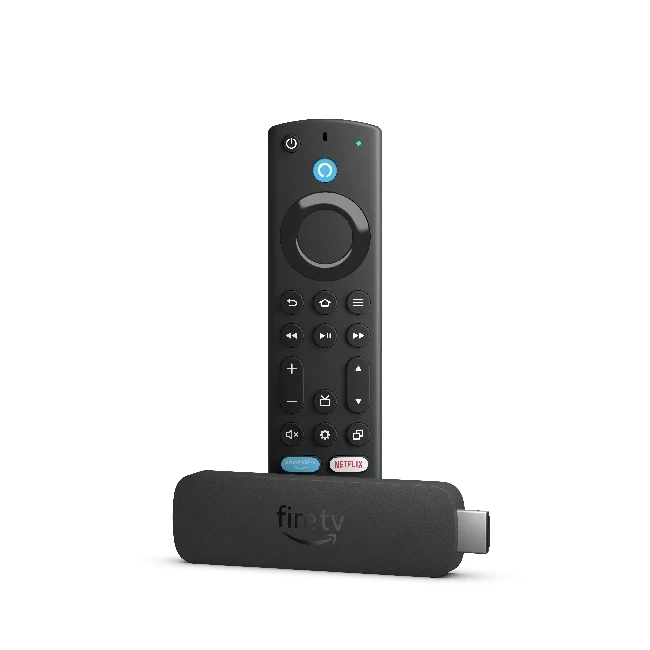
During the handover, have the regular viewer start from the television being off. Ask them to select the right input, open the confirmed player and find one familiar program. Let them make a couple of ordinary mistakes. If the guide opens on the wrong country grouping or the back button exits to the TV menu, you want to discover that while someone can still explain it. Where the model permits, show the viewer how to return to favorites and restore their preferred caption setting.
Leave a short note with three things the household can actually use. Write the input or app name, the route back to the guide and the support role to contact. Keep passwords and billing details in a separate private place controlled by the purchaser. If the household has two visually similar remotes, note which one controls what. Reaching a call center because the wrong remote is being used ties up the customer and the reseller with a problem that a single useful sentence could have solved.
A good handover includes the renewal responsibility. Show the payer the recorded expiry, tell them whether they need to initiate a renewal and explain what has to be confirmed before changing the term or device. Ask who should receive renewal notices and obtain their agreement before sending any. A household that wanted a short trial month should be able to let it end without a string of surprise messages. Clear ownership of the renewal is a practical part of the service being purchased.
Take the eighteen-order example on a Friday evening. Opening balance was 10.0 and expected closing balance after the agreed activations was 2.1. Suppose the recorded closing balance is 1.8. The difference is 0.3 credits. A standard quarter uses that amount, but the number alone does not prove someone mistakenly issued a quarter. Three ordinary monthly actions can create the same difference. An account adjustment or a correction could also explain it. Match actual actions to order references before drawing a conclusion.
Sort the transactions by operator time and include the time zone. A desk on the U.S. West Coast may finish its shift on a different calendar day from the one printed by the panel. If the closing clerk searches by local calendar day alone, a perfectly ordinary activation might appear to have vanished. Record the opening and closing times explicitly and use one time convention for the reconciliation. A customer-facing message can still display the time in the customer's own zone.
A retailer can do this with an uncomplicated sheet. Give each row an internal order reference, action, standard term or exception, authorized debit, actual debit, before and after balance and the staff member responsible. Restrict access to the sheet because these records can identify customers. The public support forum needs only the abstract problem, such as a difference of 0.3 credits after a renewal; the operator investigating it needs the actual reference privately.
When a discrepancy is resolved, leave an explanatory entry. If the operator returns 0.3 credits, show both the original event and the reversal. Deleting the first row can make a later balance look correct while leaving no explanation for the customer's account history. A small operator does not need a complicated accounting system to preserve that sequence. It needs a habit of recording the actual movement before people forget why they acted.
A Golden OTT retailer might offer help installing a third-party player, a fixed service term and an optional paid support visit. Put those components on separate lines. Identify who receives each payment and whether the corresponding charge recurs. If the player comes from another publisher's app store, tell the customer how to identify that publisher. If the installer charges a one-time visit fee, give the amount and the work included. Allow the customer to compare a plain subscription with an assisted setup on the same basis.
Specify the viewing need in everyday terms. A couple watching sequentially in the living room and bedroom has a different requirement from a family watching two programs at once. Golden OTT describes a single active connection on the standard personal offer. Ask the seller about changing devices and about simultaneous use as separate matters. Pricing a second activation before confirming the actual account policy can leave the customer paying more for a setup that still misses the requirement.
Use the seller's current response for extraordinary requests. A customer asking about a business waiting room, a public event or a distribution arrangement needs the operator to address the intended use, territory and rights. A retail subscription price or the ability to open a panel is insufficient evidence for that use. Describe the actual location, audience and intended activity in the enquiry. A written reply defining the allowed scope is more valuable than a generic “business plan” label.
At handover, ask the customer to repeat the price and term in their own words. It can feel unnecessarily formal until someone says they thought $4.17 would leave their account each month. Correct the misunderstanding before proceeding. The annual published term is $49.99; the monthly equivalent is just a way of comparing terms. The same principle applies on the trade side, where a $1.19 monthly allocation might otherwise be mistaken for the ability to purchase one customer's service at that amount.
A reseller can have perfectly accurate credit quantities and still give itself a misleading picture of cost. Imagine the ten-credit pack has 2.1 credits left when the business purchases a 25-credit pack at $335. The panel may simply show 27.1 credits. The old 2.1 credits were acquired at $13.90 each, while the new credits cost $13.40 each. Multiplying the whole balance by the newest rate would value the older credits fifty cents too low apiece. On a small balance the difference is modest. The habit matters as the business grows.
One way to manage an internal estimate is to keep the original lots visible. Write “old balance 2.1, allocated purchase amount $29.19” on one line and “new purchase 25, cash paid $335” on another. The combined purchase amount represented by those two balances is $364.19. Dividing by 27.1 gives about $13.44 per remaining credit as a blended working estimate. There is no need to assume that the operator's panel labels old and new credits individually. This is an internal explanation of where the business's money went.
Alternatively, track activations against the oldest purchased lot first for your internal cost sheet. A new annual line uses one published credit. Under that working approach the first such line draws $13.90 from the old lot, leaving 1.1 old credits. Under a blended estimate it uses about $13.44. Both approaches predict exactly the same change in quantity at the panel. Choose a consistent internal convention and have the person responsible for formal accounts apply the appropriate treatment for the business. Mixing the two approaches from one sale to the next hides the effect of a new purchase price.
Now suppose the operator changes the debit for a particular account class. Buying the new lot at a better rate would not hold the activation cost steady if the number deducted also changes. That is why the price per credit and the credits per term belong in different columns. On the customer record keep the debit accepted when the order was issued. On the stock record keep the lot price. A retailer reviewing an old question can then tell whether a difference came from a new debit, a different stock purchase or a simple entry error.
This example also explains why the merchant's cash account and panel balance should be reconciled separately. The business saw $335 leave its payment account when it bought the newer lot. It did not see that amount leave in a series of $13.40 payments every time it issued a full credit. Adding both the pack purchase and every allocated activation cost to cash spending would count the same inventory twice. Showing cash, credit units and allocations on different parts of one sheet is enough to prevent that particular mistake.
Assume a desk opens a month with a balance of 8.4 credits already paid for. Six customers renew for one month each, two take a quarter and one takes a full year. The standard deductions add to 0.6 plus 0.6 plus 1.0, or 2.2 credits. With no additions or reversals the expected closing quantity is 6.2. The example needs no new pack even though nine customers were served. A quiet period in customer receipts can look very different from a quiet period in inventory buying.
Use the quiet time to check upcoming expiries against customer permissions. Two lines ending on the same date do not necessarily deserve the same action. One customer may have asked to be reminded shortly before expiry. Another may have bought the service only for a visit and expects it to stop. A spreadsheet labeled “nine renewals due” describes a set of dates, not nine authorized sales. Treating every expiry as committed demand would distort the next pack calculation and make the renewal conversation needlessly awkward.
Consider a customer who previously bought six months for a seasonal stay and now wants only a month to finish that stay. On the standard Golden OTT schedule the next intended activation consumes 0.1 credit. Entering the previous six-month selection from habit would use 0.6, a difference of 0.5 credits. At the ten-credit rate that is $6.95 of excess stock allocated to the wrong action. The larger concern is that the customer received a term they never requested. Confirm the new term and account identity before touching the panel.
A quiet month also offers time to inspect the service documentation without rushing a paying customer. Pick a past case that created several messages. Reconstruct which details would have shortened it. Perhaps the contact form asked what television the customer owned but missed the model of the external streaming stick. Perhaps the buyer supplied a network name but nobody asked which local station feed mattered. Edit the intake questions so the next person can supply concrete answers. A lower operating cost can come from a clearer conversation with no change at all in credit prices.
For the next forecast, divide enquiries into three groups. Put confirmed start dates in the stock requirement. Put quotes awaiting an answer in a follow-up list with a date and permission to contact. Put unresolved service or territory questions in a separate list owned by someone who can obtain an operator decision. A full inbox can contain mostly the latter two groups. When the next pack purchase approaches, this small distinction makes the difference between purchasing for people ready to start and purchasing for attractive numbers on a dashboard.
| Item the buyer or operator can confirm | Enter the answer |
|---|---|
| Personal term or reseller program | |
| Buyer and actual viewing location, recorded privately | |
| Required active screens and exact model | |
| Trial start, finish and result for the regular viewer | |
| Published term price or whole-pack cash amount | |
| Additional player, service or payment charges | |
| Credits the confirmed orders require | |
| Remaining credits after issuing those orders | |
| Earliest renewal and who handles it | |
| Allowed use, operator approval and relevant exceptions | |
| Prepared by, checked by and date |
For a personal purchase, the rows about inventory can be left empty. Add the seller page and the final checkout amount. For a reseller, attach the standard deduction schedule and record the operator's answer to any exception. Signing a working sheet records who checked the figures. It grants no status from Golden OTT and gives no authority beyond what the operator has actually agreed.
A sensible reason to proceed with the 10-credit example is a documented batch of orders requiring 7.9 credits, a confirmed permitted territory and a customer support arrangement the desk is able to deliver. A sensible reason to wait is that most of the 7.9 credits came from tentative conversations. Both decisions use the same $139 price. What changes is the evidence of demand. The operator can revisit the decision when an enquiry becomes an order.
If the reason for choosing the largest pack fits on a line reading “cheapest credit,” extend the sheet by one row. Write what will use the remaining ninety credits after the first ten, when that work is expected and who will service it. If the answer is already in an existing order book, the lower unit rate can be considered on its merits. If the answer is unknown, the current price sheet has done its job by showing what the risk actually costs in cash.
Suppose you expect to watch for six months. At the listed single-month amount, six separate purchases would total $53.94 USD. The six-month offer asks for $38.99 USD up front. That comparison assumes every new month is available at the listed amount. Check renewal separately before relying on it.
| Viewing period | Separate monthly purchases | Single matching term | Difference | Monthly purchases to reach term price |
|---|---|---|---|---|
| 3 months | $26.97 USD | $23.99 USD | $2.98 USD | 3 |
| 6 months | $53.94 USD | $38.99 USD | $14.95 USD | 5 |
| 12 months | $107.88 USD | $49.99 USD | $57.89 USD | 6 |
Read the final column as a spending threshold. If you expect to cancel sooner, compare the shorter commitment with the cash you would have paid up front. The figures exclude fees the seller has not confirmed.
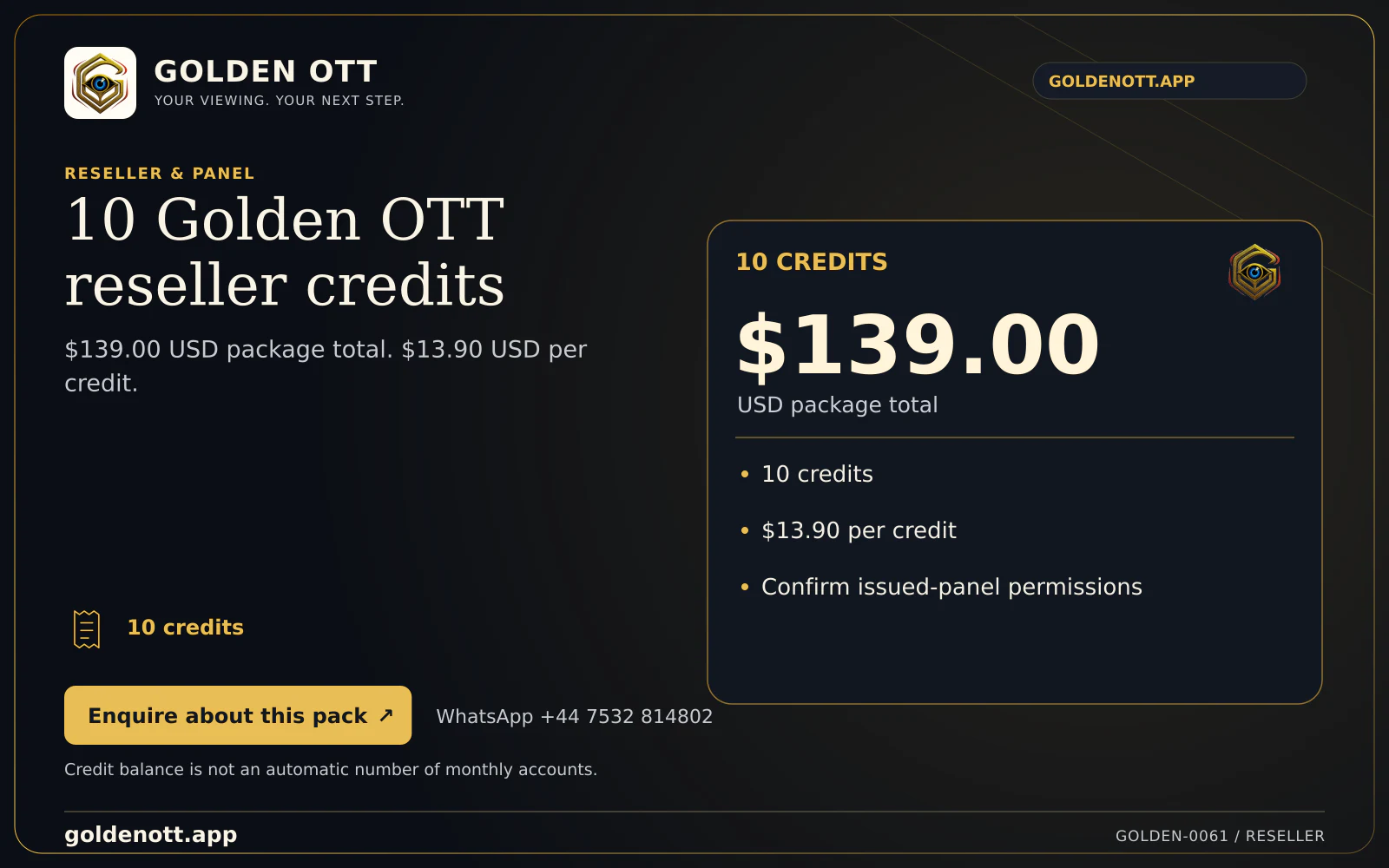
Check Golden OTT subscription termsThe smallest priced pack in this register holds 10 credits and costs $139.00 USD. The largest holds 100 for $1,190.00 USD. Their displayed unit costs are $13.90 and $11.90 respectively. The published deduction for a standard twelve-month customer is 1 credits. Check the operator’s treatment of additional screens and renewals.
The image link identifies the exact file served by the provider.

Choose a matchup to see the actual currency, term and outcome.
Open the caption on a website-sourced image to see its original. The remaining captions identify material supplied with the provider archive.