provider
IPTV Europe
Confirm the euro total and relevant language track for the exact regional service in the quote.
iptveurope.net · Check exact market
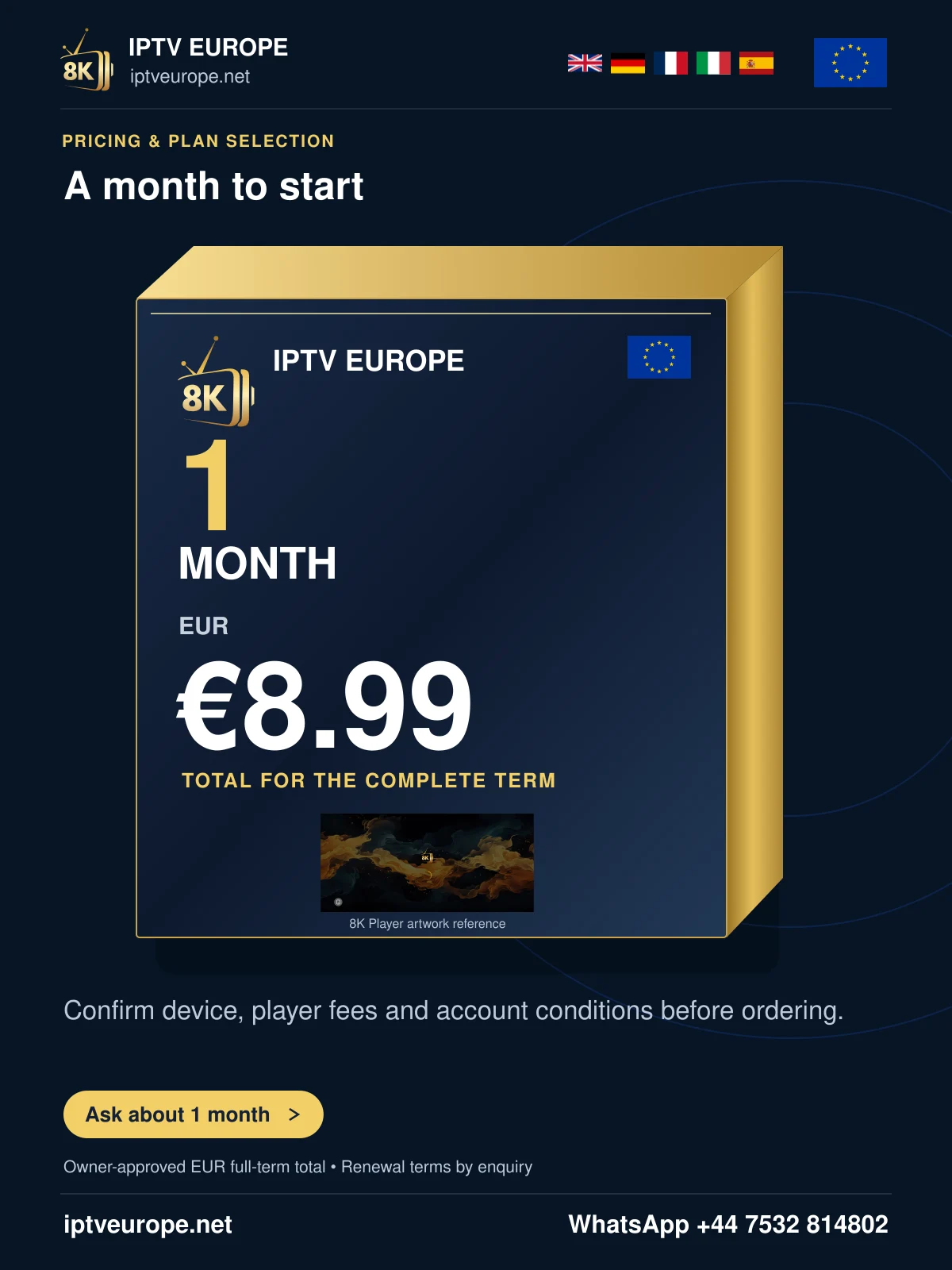
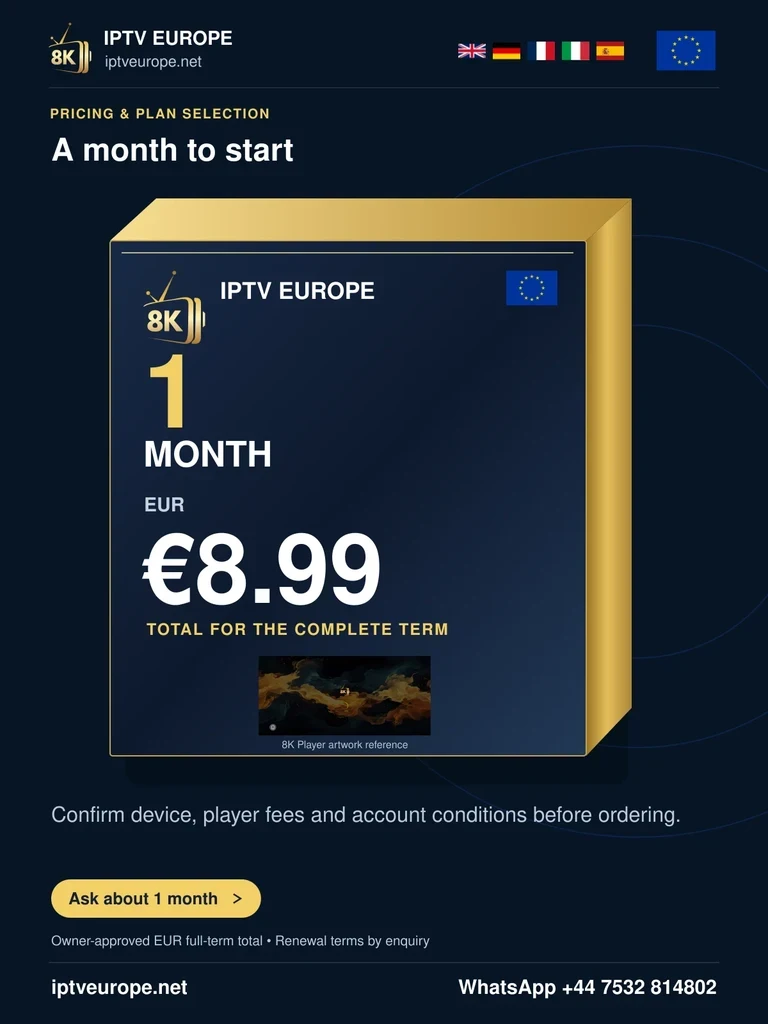
Open the official IPTV Europe websiteThe 1 month plan is listed at €8.99 EUR. Check the account and app terms before choosing a longer term.

iptveurope.net
The 1 month plan is listed at €8.99 EUR. Check the account and app terms before choosing a longer term.
The 1 month plan is listed at €8.99 EUR. Check the account and app terms before choosing a longer term.
Confirm the euro total and relevant language track for the exact regional service in the quote.
iptveurope.net · Check exact market
Open the official IPTV Europe websiteIPTV Europe maintains the site at iptveurope.net. Check who issues the invoice and who replaces the access if the app or TV changes. The buyer needs both answers before paying for a long term.
Document review · November 19, 2026. Playback performance, service rights and ZIP-level access require separate evidence.
The 1 month plan is listed at €8.99 EUR. Check the account and app terms before choosing a longer term.

iptveurope.net
A household in America wants European television. One person means an evening bulletin from Lisbon. Another means live football with a Spanish commentator. A third wants French and German documentaries with English subtitles. A fourth simply likes an English-language news service based in Germany. The requests overlap on a map and barely overlap on a television. Put the programme, edition, audio and date beside each person's name before opening a continent-wide catalogue.
IPTV Europe's personal prices on iptveurope.net are €8.99 for one month, €21.99 for three, €35.99 for six and €49.99 for twelve. These are euros for the complete listed terms. The euro amount tells an American payer which currency to compare. It does not mean that every country in Europe uses the euro, that every national broadcaster is included or that a domestic service follows a subscriber around the world. The buyer still needs an answer for the programme and the actual U.S. location.
Begin with the one thing that would make the subscription worth buying. Suppose the family wants a particular ARTE documentary in its original language with English subtitles, available after work in Chicago. A title, language, territory, device and preferred time make that a solvable enquiry. “European documentaries” could yield several legitimate options and none may carry the precise edition the family wants. A good answer can be narrow. If the rights holder already supplies that programme directly in the desired form, an independent subscription ought to offer something further before the family pays for a year.
| Requirement | Example of a precise answer to look for |
|---|---|
| Original programme audio | The specific French, German, Irish or other language in the programme itself |
| Alternate audio | A separate track in the language the household wants |
| Subtitles or captions | The required written language and accessibility needs on this edition |
| Navigation | Search, programme descriptions and player menus usable by the regular viewer |
A setting marked English in an app can change every menu while leaving the programme in a language nobody in the room understands. An English-dubbed soundtrack can make a drama easy to follow for one person while disappointing a learner who wants to hear original dialogue. Captions that identify speakers and sounds can be important to a viewer with hearing loss. A general promise about “multi-language content” cannot answer all four columns. Give the seller the programme title in its original language where possible.
ARTE explains that original language choices depend on the rights and versions available for the individual programme. It also explains why videos can be available in some countries and unavailable in others. Use the broadcaster's own programme and help pages to decide which version to ask about. Do not infer that a selectable language on ARTE's own service automatically appears on another player's linear feed. The player and distribution route can expose different audio or subtitle options.
For a multilingual household, run the test with two viewers. Let one start the original audio and turn on the required captions. Let the other leave the programme, reopen it and restore their own preference. If the app saves settings globally, one viewer's change may affect everyone. A player that remembers a preference per programme or profile may suit them better, if that behaviour is actually verified on the owned device. Record the menu language, track labels and result separately. The notes remain useful even if the family later changes subscriptions.
A Spanish viewer might want TVE Internacional. RTVE explains how its international television is distributed, including operator carriage in some countries. That source identifies a particular international service. A buyer should avoid treating it as an exact copy of the domestic Spanish schedule. Ask which named feed, region and time the subscription seller supplies at the address, then check the corresponding schedule. A domestic title unavailable on the international feed is a rights and programming question, not a fault that changing the device clock will fix.
An Irish-language learner might start with TG4. The broadcaster says its player can be used worldwide while some individual material is restricted to the island of Ireland. A platform being accessible at the U.S. location is therefore only the first check. Look up the exact programme, episode and availability, then check the subtitle and audio options on the intended device. If an official path covers the learner's complete need, that discovery belongs in the household's budget. If it covers part of the need, list what the seller would add.
For a German-based international news service, Deutsche Welle publishes a monthly English television schedule. The word German might refer to where the broadcaster is based while the selected service itself is in English. A person trying to practise German could choose the wrong feed by relying on a country's flag alone. Ask for the exact service and language. A person seeking an English-language bulletin about European affairs may make the opposite error by dismissing the service solely because its originating country is Germany.
These examples are reference points for shopping. They do not build an IPTV Europe lineup by inference. A broadcaster can publish a guide, a regulator can identify a channel and a provider can host a promotional image. The seller still has to establish what it can supply at this address and the viewer still has to determine whether that specific programme fits their schedule. Keeping the three roles clear is often more productive than asking for an ever longer sample list.
For a hypothetical programme starting at 8 p.m. in each named source city on November 19, 2026, the table gives the corresponding U.S. times. The examples use cities rather than the phrase “European time.” Different source areas can share a language and follow different clocks.
| European source at 8 p.m. that date | New York | Chicago | Los Angeles |
|---|---|---|---|
| Lisbon or Dublin | 3 p.m. | 2 p.m. | Noon |
| Paris, Madrid, Berlin or Rome | 2 p.m. | 1 p.m. | 11 a.m. |
| Athens or Helsinki | 1 p.m. | Noon | 10 a.m. |
| Canary Islands | 3 p.m. | 2 p.m. | Noon |
A programme advertised to a Spanish viewer can have a mainland or Canary Islands time cue. A person who sees a familiar Spanish title should not assume every number in the guide uses Madrid time. Look for the published source time zone and whether the website has already localized the schedule. If a website displayed in Chicago has already converted the listing to local time, applying the Paris-to-Chicago difference again will produce a false guide complaint.
For a weekly reminder, enter the source city's named time zone instead of a fixed American offset. Europe and the United States do not always change their clocks on the same Sunday. Also check whether the programme's own schedule changes for a holiday, sporting event or new season. A calendar can convert the original source time correctly and still alert the viewer to a programme the broadcaster moved by thirty minutes. The broadcaster's dated listing and the household's converted reminder answer separate questions.
Late-night publishing can change the date. A programme available at 00:30 in Paris on November 20 corresponds to 6:30 p.m. in New York on November 19. Searching only under “Friday evening” in an American replay list may miss an item filed under its European source date. Save both dates when a programme straddles midnight across the Atlantic. If the guide uses the source date and the family calendar uses the watching date, give the viewer a favourite label or note that connects the two.
| Personal term | Full EUR total | Rounded monthly comparison |
|---|---|---|
| One month | €8.99 | €8.99 |
| Three months | €21.99 | €7.33 |
| Six months | €35.99 | €6.00 |
| Twelve months | €49.99 | €4.17 |
Three single months at the listed rate total €26.97. A quarter costs €21.99, a saving of €4.98 for three months of confirmed viewing. Two quarters would be €43.98; a half-year at €35.99 saves €7.99 against that arrangement. Two half-years would cost €71.98 and a year is €49.99, a difference of €21.99. A buyer with a reliable viewing habit can use these figures to choose a term. Someone still trying to identify the right regional service should not treat the annual saving as an answer to that separate question.
Consider an exchange student spending four months with an American host family. A quarter plus one month totals €30.98 if a normal renewal at the listed price is available. A half-year costs €35.99. The €5.01 difference may be worth keeping if the stay has a definite end. Five months change the calculation. A quarter and two single months would cost €39.97, which is €3.98 more than the half-year. The choice that fit the four-month calendar is no longer the least expensive listed way of covering five months.
For someone staying seven months, six plus one costs €44.98. At eight months a half-year and two single months total €53.97, higher than €49.99 for the year. These are calculations using a dated schedule and constant account conditions. Ask whether an early renewal adds to the existing term, whether the seller can keep the account on the same permitted device, and which expiry date will appear in the account. A family who loses unused days by buying the replacement at the wrong time can give back the apparent saving.
A U.S. credit or debit card statement may show dollars even if the seller quotes euros. Write the agreed EUR amount on the purchase record and check who performs conversion. If checkout offers a dollar amount, use that specific quote in a dollar comparison. A different provider charging GBP or CAD needs its own settled quote. Ranking bare numbers across currencies would be like comparing a journey measured in kilometres with one measured in miles and picking the smaller number as the shorter trip.
The European Audiovisual Observatory maintains MAVISE, a database of audiovisual services and their jurisdiction. It can help distinguish identically named channels or identify the service an operator is referring to. A service may be associated with a regulatory jurisdiction different from the language of its output or a market in which a family remembers seeing it. That is exactly the sort of ambiguity a register can resolve. It cannot answer whether a U.S. viewer will receive a particular programme through a particular seller.
Try a practical lookup. Begin with the full channel name or a plausible spelling from the family, then inspect the operator and service identity in the register. Look up the broadcaster's own programme listing independently. Now make a short statement with the two results. “I am asking about this named service and this programme on this date.” Send that to the subscription seller together with the actual viewing location. A reply about a similarly named regional feed should trigger a follow-up, not an automatic assumption that the two are interchangeable.
Keep an eye on time. A historic entry might identify a service that changed name, ceased transmitting or moved its distribution. A recent programme may have been promoted under an older international title. If the register and the broadcaster appear to disagree, record the dates and exact names instead of choosing whichever one suits the order. A seller that knows what it carries should be able to identify its own current feed label and the edition it intends to provide.
An official licence record in Europe says something important about the service identified by that record. It does not give a household or a reseller permission to rebroadcast the programme. Procurement for a venue or commercial audience needs its own rights and territory agreement with the appropriate parties. The family purchasing personal viewing can keep its question much simpler. It wants to know whether the named service, title and required tracks are offered for authorized personal use at the stated U.S. location.
IPTV Europe's material links to Apple TV platform information. Identify the hardware before assuming what the word Apple describes. An Apple TV box attached to a television is a potential platform on which a compatible player may be installed. The Apple TV app on an existing smart television is a different application. A paid streaming subscription from an unrelated publisher is a different bill again. Tell the seller the exact model and which device's store you intend to use.

A good first test on the owned device is searching for a title with its original spelling. Try any accents or special letters the family uses in everyday speech. If the on-screen keyboard is cumbersome, find out whether alternative titles or a saved favourite make future access easier. A programme that can be opened from a link on a phone is of limited value to a relative who wants to find it independently on the television every week. Test the method they will actually use.
Now try the speaker and subtitle settings through the usual sound system. A television may send audio to a receiver or soundbar through a separate connection. Dialogue can seem absent on one track even when the app has selected it. Compare the ordinary television speakers with the normal sound system before diagnosing a provider fault. If the right track is unavailable on both, report the service, title, episode, language, date, player and observed result. That is enough for a meaningful support enquiry without disclosing a private account.
If the required languages vary between two viewers, try a switch in both directions. A grandparent may want Dutch audio with no subtitles while another family member wants an English subtitle track on the same programme. The availability of those tracks depends on the specific legally distributed version. The navigation and persistence of preferences also depend on the player. Only a test that returns control to the regular viewers checks both the rights question and the usability question.
The seller describes a one-day trial. Ask which locations, players and account conditions the present trial covers and when its clock begins. A household trying to compare three source countries has limited time. Pick one indispensable programme, one contrasting language task and one ordinary device restart. A trial spent opening dozens of unrelated national flags may produce a good-looking list with no evidence about the requirement that prompted the purchase.
For the first task, arrange a time when the wanted European programme or an identifiable comparable slot actually appears. Record the source city, the date printed on the broadcaster's website and the American viewing time. If the buyer wants the programme after work, also check the particular authorized replay route and its window. Do not infer replay rights from the presence of a guide entry. A programme listing can remain in an electronic schedule after its playback window has closed or without ever carrying a replay link.
For the second task, use a known language requirement. Perhaps the exact edition needs French original sound and English subtitles, or an Irish-language programme needs a caption setting suitable for an older viewer. Inspect the actual on-screen choices while the programme plays. An app's generic list of preferred languages is only a preference mechanism. The programme must carry the track. Note the difference between text already baked into the image and a selectable subtitle track. Either might meet the viewer's need, but they have different size and language controls.
Before the trial ends, let the device sleep and then hand the remote to the member of the family who knows the least about the setup. Ask them to return to the selected service from the ordinary TV home screen, change one preference and return to their usual programme source. A successful test shows the setup works for the household as it is. A failed test can suggest a new favourite or simpler player, or make the family reconsider a long-term payment before the trial closes.
A buyer could live in the U.S., pay in dollars through a card issued elsewhere and want French-language television while visiting a relative in Belgium. Each detail plays a different role. The payment currency determines settlement. The programme language determines whether it suits the viewer. The viewing location and operator's territory agreement determine what can be supplied there. A European billing amount does not turn a U.S. subscription into a passport for content on every trip.
Give the provider an honest itinerary when travel matters. State the regular home location, timing of the visit, intended device, destination and whether anybody will continue watching at home. A person carrying one tablet for occasional viewing needs a different answer from two households trying to use two televisions at the same time. Ask whether switching devices is allowed, what happens to active sessions and whether the same channel or replay selection applies in the destination. Preserve the reply beside the order confirmation.
At a hotel, the network may require a browser sign-in and the television may restrict access to its inputs. These are accommodation questions before they are IPTV questions. Ask whether the accommodation allows personal media devices and how its guest network supports them. Do not enter personal provider credentials into an unfamiliar public screen unless you understand the device, have permission and can sign out securely. An allowed personal tablet may be the simpler option where the specific account and territory permit it.
Returning to the American home deserves its own check. Has the player restored the right time zone? Does it still use the correct language? Has the account released any permitted travelling session? If the provider changed the available programming during travel, check the expected U.S. version before reporting a lasting loss. Use actual programme names and dates, not a comparison with a folder that appeared while the device was abroad.
IPTV Europe's business page identifies 60, 120, 300 and 600 as quantities to discuss. It explicitly treats them as enquiries. No payable price, customer-term conversion or expected margin follows from those four labels. A real business quote needs the euro pack total or other agreed currency, the deduction schedule, customer location, panel permissions, expiry, support duties and scope of rights. A generic industry example from another operator has no authority over this seller's balance.
Prepare the sales forecast in terms of the service the prospective customer needs. Suppose the business expects three annual accounts requiring a French-language programme, ten quarterly accounts for households wanting Spanish coverage, and five single months for visitors. That is 36 plus 30 plus five customer months. It describes 71 months of intended viewing and identifies three types of support demand. It does not equal 71 IPTV Europe credits unless the operator provides a rule that makes it so. A separate connection allowance can further change the quote.
Ask which party must resolve a particular issue. A customer reports a lost subtitle track. Which player and feed details can the reseller collect? Who can verify programme rights or a permitted alternate feed? When can the reseller issue a replacement, and what becomes of the original credit debit? A business that supports three languages has to know which operator can answer an escalation in practice. Without this agreement, a cheap headline price would leave the reseller promising service it cannot deliver.
Account records can stay useful without exposing customers. Keep the internal order reference, supplier reference, private activation result, term, deduction and support case together in the business system. The public forum can discuss the general method of tracing a guide or language issue. Other users should never have to see a private playlist, receipt, operator panel or identifiable customer details. The reseller agreement should determine the authorized private route for any information needed to resolve the actual account.
Consider one family whose priority is a local French-language news bulletin from Belgium. Consider another whose priority is a French-language film with English subtitles. Both have searched for a French service; the first needs a particular newsroom and territory, the second a particular work, edition and rights window. A seller answering only “yes, French channels” has addressed neither. Name the local outlet and programme in the first enquiry. Give the film's original release title and edition in the second.
For the news family, check where the programme originates and which local stories and public service information it covers. The fact that a French national bulletin is in the right language does not make it the Belgian edition. A picture of Brussels in a national programme does not identify a Brussels local service either. Ask for the station label and a named local segment the family can recognize. Compare it with the broadcaster's own schedule, then test the appropriate account during a permitted window.
For the film family, a channel logo is less important than the actual showing or on-demand copy. Ask whether the title carries the French original or another language, which subtitle tracks are selectable and how long the relevant window lasts. Check whether the programme title in the app is translated. A search under only the English title can miss an existing French listing, while a similarly translated title can lead to a completely different film. A year of daily news access does little for someone seeking a single film that is absent.
If the two households share an American address, the seller may still need to quote simultaneous use. One viewer might need the local bulletin while the other plays the film on a tablet. Describe the overlap and the location of each screen. A single account that can move between permitted devices may meet the two needs when watched at different times. It may be insufficient when both must play at once. The appropriate account is the one that fits this actual schedule and allowance.
Choose a minute of a permitted programme containing both speech and a visible speaker change. Write the title, episode, rough elapsed time, player, selected audio and selected subtitle language. Listen for the language itself and watch whether the timing lets the viewer follow the exchange. A caption can be correctly labelled but refer to a different cut, or a rewind can start a replay in a different position. The buyer need not identify the technical cause to report the observation accurately.
For original-language learning, listen to a minute before turning on translated captions. Make sure the soundtrack is the original the learner asked for. Then enable the selected text and repeat the passage through the app's permitted controls. If the learner needs captions in the same language as the speech, an English translation may be less useful than expected. A phrase such as “French audio and French text on this exact episode” gives the seller or programme publisher a better chance of answering than “does it support French?”
Someone using captions for access can also check how non-speech information is represented and whether speakers can be distinguished. The broadcaster's own accessibility page and programme information may say what it supplies on its service. A third-party player can still present it differently. Check subtitle size and contrast on the regular display and whether the usual remote can open the options quickly. A household that needs a screen reader or audio description should ask for the exact feature and programme. The caption icon alone answers a different question.
If a fault appears, try one other item known to have the same required track through the authorized route. If neither item exposes the track, identify the common player, account and device. If only one item fails, write down its edition and timestamp. Submit an account-specific question to the appropriate private operator or broadcaster. Public forum readers need the output of the test, not a copy of the film or an account address. A short description can be sufficient for somebody else to recognize the pattern and suggest the next check.
A football supporter in the U.S. can ask for an event, the local language commentary and a production familiar from a particular European broadcaster. A fixture name alone leaves all three unresolved. Ask who holds the relevant U.S. rights for the match and whether the desired commentary is part of an authorized offering. An international highlights show, a studio discussion and live match coverage may all use the same club marks. Only one might meet the family's requirement on match day.
Write down the competition, opponents, date, venue, broadcaster territory and intended U.S. location. Then identify whether a national, local or international broadcaster will produce the desired commentary. If the game moves in the schedule, recheck the local kickoff with the organizer or broadcaster. An old fixture graphic can remain online after a date changes. For a late-night replay, give the event's European source date and the American date on which the viewer will look for it. That avoids confusion when two matches occur on adjacent days.
A household thinking of subscribing for one competition can compare the duration of the term with the actual rounds it wants. If the opening match and final are more than a month apart, one monthly period may not cover both even if a seller confirms every fixture. If the account activates immediately on payment, buying days too early can push the deciding match past expiry. Obtain the activation trigger and exact end time as well as the carriage answer. The useful date is when the account will still be valid for the specific production.
For shared viewing in a pub, office, club or other venue, ordinary household rights and public display permissions are different. Tell the appropriate operator or rightsholder the premises, audience, territory and intended event and obtain the terms that apply to that use. A regular personal account may be straightforward for a family living room yet unsuitable for showing a match to patrons. Asking before taking reservations is far cheaper than discovering on match day that a private account cannot support the event.
A small accommodation business might believe it needs a reseller panel simply because guests come from several European countries. Its real need could be a permitted hospitality distribution agreement, a device-management solution or clear instructions for guests to use their own authorized services. These are not interchangeable. Start with the number of rooms, country of operation, type of shared or private display, languages desired, and who will supply and clear any issued content. Give that description to the parties able to provide the relevant agreement.
Ask which part of the proposed quote covers programming and which covers technical delivery. A per-room licence, a managed distribution system, an input encoder and a pack of retail reseller credits are different units. Converting a published personal €49.99 annual amount into a hotel budget by multiplying it by room count would assume rights and service functions never established by that figure. A useful written answer identifies the rights and the actual operator before it offers a price.
If guests can use their own accounts under their respective terms, the property must still have an orderly sign-out process for any shared device. Ask what information remains when a guest checks out and who is authorized to clear it. A private customer login must not become the next guest's welcome screen. A property managing its own licensed channels has different support duties, including which languages to display in the guide and how reception staff report an outage without disclosing credentials. A business quote must assign those duties as well as the monthly cost.
For an ordinary U.S. household, this hotel example is useful mainly because it clarifies the boundaries. The family can buy or enquire about an authorized personal programme, let the term expire and change its player. It gains no automatic right to provision customers, distribute the content to guest rooms or present a subscription service under its own name. A business enquiry can explore those possibilities without pretending that a packaged personal account already provides them.
At the end of the trial, give each essential programme one short row. Include its original title, broadcaster, feed, local viewing location, date and clock, audio, subtitle requirement and confirmed result. Add what the individual paid term would cost in euros, any associated player purchase and the next decision date. A changed exchange rate may alter a later U.S. payment without changing the euro listing. A changed rights window may alter an episode even if the price never moves. Keeping the two observations separate makes renewal a rational decision.
Give a frequently used programme a recognizable favourite and record the original service label as well. A guide update can rename a favourite while preserving its underlying service, or preserve a name while changing the mapped feed. Checking the actual programme at a known time distinguishes those outcomes. A relative setting up a new television months later can use the same station identity and language notes with whichever seller the family chooses next.
A household that settles on €8.99 for an initial month has paid to evaluate a known need. A household that chooses the longer term after answering its programme, territory, device and support questions has a defensible reason for the larger commitment. A household that finds all its desired programmes through existing official routes has an equally good reason to pass. “Europe” is where the shopping began. A particular person watching a particular programme in a particular language is where the decision finishes.
Before saving a programme in a family calendar, record the title exactly as the broadcaster prints it and the English title anyone in the household uses to search. Add the series or episode number if it is available. Translations can compress two different titles into the same short English phrase, and an accented letter can defeat an otherwise sensible player search. Saving both forms beside the dated broadcaster listing gives the next viewer another way to find the right programme after a guide update. It also gives seller support a defensible reference when a translated description appears beside the wrong film or soundtrack.
Suppose you expect to watch for six months. At the listed single-month amount, six separate purchases would total €53.94 EUR. The six-month offer asks for €35.99 EUR up front. That comparison assumes every new month is available at the listed amount. Check renewal separately before relying on it.
| Viewing period | Separate monthly purchases | Single matching term | Difference | Monthly purchases to reach term price |
|---|---|---|---|---|
| 3 months | €26.97 EUR | €21.99 EUR | €4.98 EUR | 3 |
| 6 months | €53.94 EUR | €35.99 EUR | €17.95 EUR | 5 |
| 12 months | €107.88 EUR | €49.99 EUR | €57.89 EUR | 6 |
Read the final column as a spending threshold. If you expect to cancel sooner, compare the shorter commitment with the cash you would have paid up front. The figures exclude fees the seller has not confirmed.
Check IPTV Europe subscription termsThe image link identifies the exact file served by the provider.

Choose a matchup to see the actual currency, term and outcome.
Open the caption on a website-sourced image to see its original. The remaining captions identify material supplied with the provider archive.