
provider
IPTV USA
Use the current pricing page and request the exact station or event for the household’s ZIP code.
iptvusa.app · Check exact market
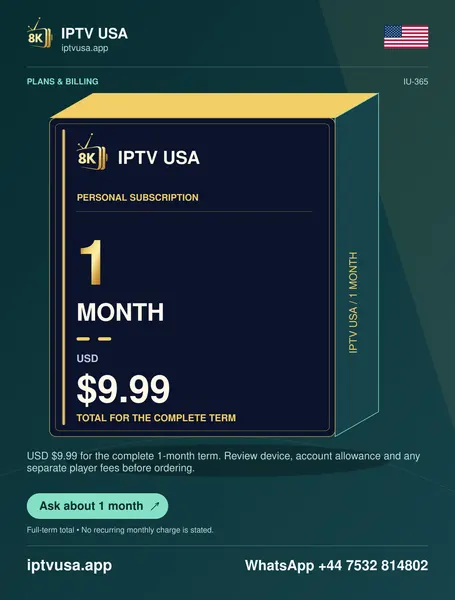
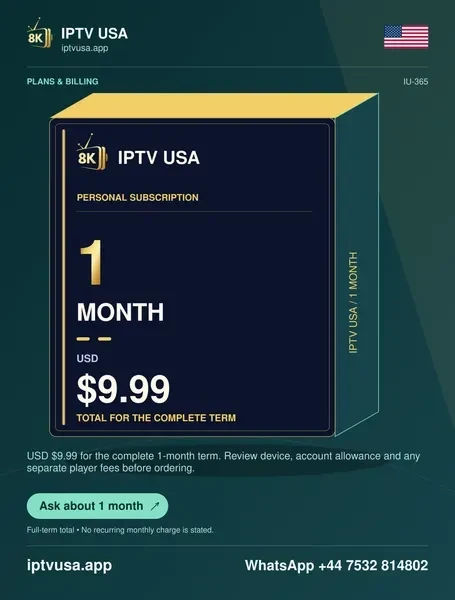
Open the official IPTV USA websiteThe 1 month plan is listed at $9.99 USD. The operator also lists 4 reseller pack sizes.

iptvusa.app
The 1 month plan is listed at $9.99 USD. The operator also lists 4 reseller pack sizes.
The 1 month plan is listed at $9.99 USD. The operator also lists 4 reseller pack sizes.
Use the current pricing page and request the exact station or event for the household’s ZIP code.
iptvusa.app · Check exact market
Open the official IPTV USA websiteIPTV USA maintains the site at iptvusa.app. Check who issues the invoice and who replaces the access if the app or TV changes. The buyer needs both answers before paying for a long term.
Document review · November 19, 2026. Playback performance, service rights and ZIP-level access require separate evidence.
The 1 month plan is listed at $9.99 USD. The operator also lists 4 reseller pack sizes.

iptvusa.app
At IPTV USA the personal counter sells a period of viewing. The reseller counter discusses inventory and the responsibility of issuing accounts. Both counters display prices in U.S. dollars. The resemblance ends there. A personal twelve-month card costs $54.99 on the operator's published schedule. A sixty-credit reseller card costs $111.00. It would be a mistake to divide sixty by twelve and conclude that the second purchase includes five households for a year. The provider expressly separates credits from customer subscriptions and does not publish that conversion on the reviewed pack page.
The buyer's task is to leave the right counter with a usable receipt. For a home, that means a named seller, term, full amount, approved viewing location, number of active screens, player, activation and renewal terms. For a business it means a written operator agreement, a pack quantity and price, a deduction schedule, the permitted customers and territory, and a route for correcting an unsuccessful activation. One business can invoice in dollars and still be selling completely different things to the people in those two queues.
IPTVs.us is the store listing these offers. IPTV USA's own site is iptvusa.app. The two names are easy to confuse in a browser with several tabs open. Check the order handoff and the merchant name at the point of payment. Keep the receipt under the party that took the order and the provider's official support address beside it. A store guide can explain how to compare the offer. It cannot look up a private provider account simply because both sites have “USA” in the title.
| IPTV USA personal term | Full listed USD charge | Rounded cost per month |
|---|---|---|
| One month | $9.99 | $9.99 |
| Three months | $24.99 | $8.33 |
| Six months | $39.99 | $6.67 |
| Twelve months | $54.99 | $4.58 |
This schedule was reviewed on November 19, 2026. The last column is arithmetic for comparison. The annual card calls for $54.99 for the designated term. A household that sets aside $4.58 this month has not funded that charge. Ask whether the checkout amount includes required fees, whether a third-party player carries a separate charge and whether the next term requires another order. The answers can differ across accounts and payment methods.
For a three-month need, three separate monthly purchases at $9.99 would total $29.97. The quarter saves $4.98. Six monthly terms at the recorded rate total $59.94. The six-month purchase at $39.99 saves $19.95 against that sequence. Two quarters would total $49.98 and two half-years would total $79.98. Against the last figure, the annual term saves $24.99 for a buyer who genuinely expects to need all twelve months and can use the documented account for the entire period.
Look at an awkward period instead of a round year. Someone needs television in a temporary apartment for four months. One quarter and one month cost $34.98 at the listed rates. Buying four separate months costs $39.96. Six months prepaid costs $39.99. The quarter-plus-month sequence is $5.01 below the half-year term, provided the second purchase extends the account without cutting off unused days and the then-current price stays the same. A person unsure whether they will even stay the first quarter might sensibly pay for one month to begin.
A caretaker visiting for seven months faces another choice. A half-year and one month would be $49.98, against $54.99 for the year. The difference is only $5.01. If the caretaker leaves at month seven and no one else uses the account, paying the extra buys unused time. If another authorized member of the household will continue watching, the same five dollars and one cent can cover a useful extension. Put the people, dates and confirmed viewer permissions into the comparison. The monthly equivalent alone will not make the decision.
“Do you have my locals?” sounds clear until the seller has to act on it. A ZIP may cover more than one expectation about local news, sports or regional schedules. Provide the ZIP or area through the seller's appropriate channel, name the station or broadcaster and specify the programme you would recognise. Say whether an out-of-market national feed would be acceptable. A seller can answer precisely when the household has identified the difference it cares about.
A local weather bulletin, a national evening newscast and a regional sports production are three different tests. For local news, identify the city, newsroom and ordinary broadcast time. For national news, ask which feed and schedule the guide uses. For sports, give the specific fixture, date and commentary requirement. National league and broadcaster rules can vary by location and event. A trial showing a studio discussion or an unrelated game should be recorded as that result, with the actual fixture still open until its authorized viewing route is known.
Use a public station identity or the broadcaster's own website to settle an ambiguous name. A channel number remembered from cable at a different address may now identify a different service. The FCC's reception map concerns predicted over-the-air reception; the seller's internet lineup is a separate distribution question. A buyer with a working antenna can use it to identify a bulletin or independently compare programme times. An antenna result says nothing on its own about a reseller's right to supply the same feed over the internet.
A U.S. household may already use its local PBS station or hold a PBS Passport member benefit. PBS explains how a member selects the participating station associated with that benefit. An IPTV USA label mentioning public television does not make the household a PBS member or necessarily provide the same on-demand access. Check the station and programme through the proper official route. A viewer who only wants a particular public-affairs series may already have what they need.
Start with two people at home at seven in the evening. One watches the living-room screen and the other watches a tablet. Those are two potential playback sessions. Contrast that with a person who turns the living-room screen off and moves alone to the den. There can be two registered devices in both examples but different simultaneous viewing needs. The provider's card requires the buyer to confirm the account allowance. Write the scenario into the question instead of asking for a vague multi-device promise.
The household can use its permitted trial to check ordinary device switching without deliberately exceeding the allowed number of streams. Close playback on the first device, make a note of the time, then start the same authorized account on the second if the seller permits it. A short delay in releasing the first session may matter to a family that moves rooms during the news. The seller can explain the expected behaviour. A second sign-in prompt can instead belong to the player or app store, and the precise screen title helps distinguish the two.
If two simultaneous streams are essential, request a complete quote for that configuration and its term. Multiplying the single-screen list price by two may not match the actual offer. The operator may require a separate account, have different conditions, or have no suitable arrangement. A published annual tie with another single-screen offer cannot settle a household comparison until both sellers quote the same two-screen scope. Keeping the quote open is more useful than pricing an account that does not exist.
The guest-room television can add an independent player licence even when a seller permits the second device. Ask whether the player licence belongs to the device or an app-store account and whether the person who owns it agrees to keep paying. Two separate receipts can be good evidence of two distinct purchases. They are not proof that the second device can play at the same time. Keep the seller's written allowance with the player receipt so a helper can see the complete arrangement later.
IPTV USA describes a one-day trial. Ask whether it is available today for the household's address, intended player and screen allowance. Get the time zone of the activation and the expiry. A “day” that starts when credentials are issued can be mostly gone by the time a family gets home from work. Request a window around the actual viewing task and have the equipment ready. The point is to settle an ordinary household question, not to collect the largest possible list of station names.
Make a five-line note. First, name the service and programme. Second, state the device, player publisher and version. Third, give the location and the viewer's clock. Fourth, describe the picture, sound and caption result. Fifth, record the unresolved item and who can answer it. A household might learn that the correct newscast starts, captions work on the television, and a weekend sports fixture still needs confirmation. That is already a useful, honest trial result. It leaves a reason to choose a short term or delay the order.
Use the regular network, seats and remotes. If a technical relative races through the menus on a newly purchased player while the actual viewer watches passively, the test answers whether that relative can operate the setup. Give the remote back. Ask the viewer to find one favourite, turn the sound or captions to their usual setting and return to regular television. Note where help was needed. A known two-button recovery is often all the family needs, while an app that repeatedly discards its favourites may change the value of a long subscription.
Close the trial by comparing what was promised with what was observed. A clean picture on one evening cannot verify a year of service or a guaranteed resolution. An absent channel in a short window cannot establish every subscriber's lineup either. The family can still decide whether its essential conditions are met. A dated, specific observation is more useful than an enthusiastic star rating attributed to an anonymous viewer.
The provider's Fire TV guide refers to Fire TV and Fire OS. In a real home that might be a stick attached to HDMI or a set with the platform built in. Find the exact model on the device or its system information screen. Tell the seller which device will run the player. A Fire TV remote controlling power and volume on another manufacturer's television does not turn that television's built-in operating system into Fire OS.
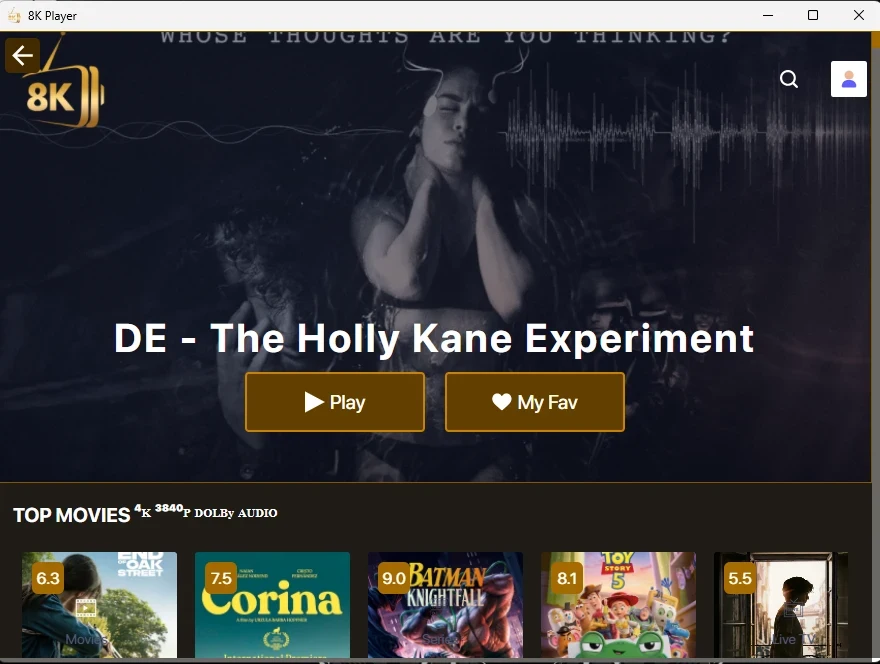
For a television that already receives local channels through an antenna, preserve that input. An internet player and an antenna can coexist on one set. Someone using the provider account for selected permitted programmes may continue taking local news from the tuner. During setup, document how to switch between the two and which remote controls each. That detail can matter far more to the household than the number of imported guide entries. Avoid unnecessarily rescanning antenna channels while diagnosing a player login.
If the screen says no signal, check the active HDMI source and whether the external box is awake. If the box home screen opens but one app will not launch, identify the app and its version. If the app launches and displays an account expiry, compare the expiry with the seller receipt. If the account shows an active term and one station fails, record which other permitted station played. This sequence narrows the question without having to erase an account, remove the application or expose its login.
When local weather is the reason the household wants a particular station, make a separate plan for official alerts. The U.S. National Weather Service explains the purpose of NOAA Weather Radio All Hazards. A household may select weather alerts or other official local warning routes suited to its area independently of its entertainment service. An internet television term can deliver useful news when working. Its successful trial is no demonstration that the home will receive an official warning during a power, network or provider interruption.
A support queue often receives a message that covers four different purchases. The house pays an internet carrier, it bought an external device, a software publisher may charge for a player and a named seller handles the television term. Each can have a valid receipt. When something asks for payment on the screen, photograph or transcribe the app name and exact message with personal information removed. Then find the party that issued the related receipt. Paying the television seller again will not ordinarily renew an independent player's licence.
An active paid term and a missing sign-in can also coexist. An app update, device change or cleared local storage can remove a saved profile while leaving the operator's account active. Contact the right private support route with the order reference and the stage at which the app stops. Do not post a full service URL, account token or payment image in the forum. A public helper can explain the difference between a blank app and a denied account without ever having access to the private details.
If checkout and the listing disagree, pause at the displayed total. Check that the term, dollar currency, merchant, connection allowance and selected optional extras match the intended purchase. A buyer who sees the correct $39.99 six-month price but accidentally selects another screen option can still face a different bill. Save the agreed amount and any explanation of fees. A comparison table on a storefront is a reference for the quote. The receipt is the record of this particular transaction.
For a renewal, ask whether the existing expiry is extended or replaced, whether an early purchase uses the remaining days and how the operator identifies the current account. If a family buys a new account when it meant to extend an old one, it may wind up with two simultaneous terms and lose the familiar guide state. Give the seller the original reference and request a written new expiry. Check the actual account after the operation and before discarding the old confirmation.
| Credit quantity | Published full USD pack price | Published USD cost per credit |
|---|---|---|
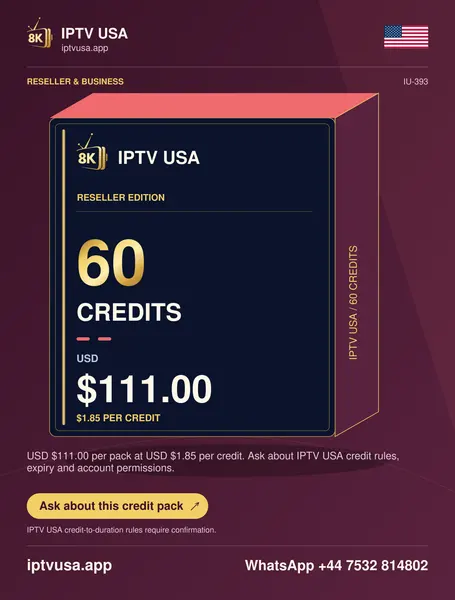
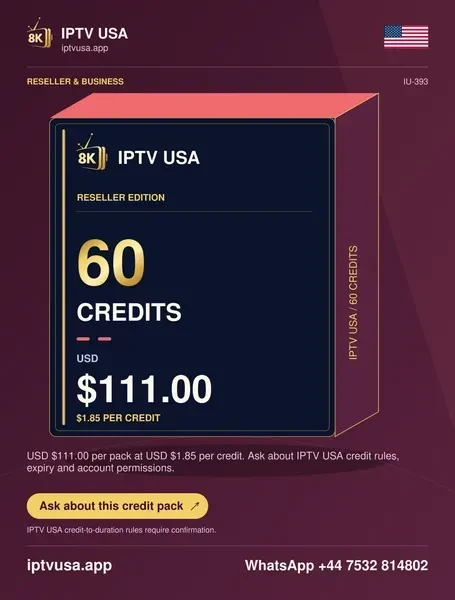
| 60 | $111.00 | $1.85 |
| 120 | $214.80 | $1.79 |
| 300 | $507.00 | $1.69 |
| 600 | $954.00 | $1.59 |
A reseller can check these four prices accurately and still be unable to quote a twelve-month customer allocation. The arithmetic $954 divided by 600 equals $1.59 for each unit purchased. Another piece of evidence has to say how many units an eligible customer account consumes. IPTV USA's pack page explicitly calls out that separation. Terms for another operator, even one with the same 60- or 600-credit labels, are no substitute. Put “operator deduction required” in the customer quote until the relevant rule is confirmed.
Compare the packs without crossing that boundary. Two 60-credit purchases cost $222 for 120 credits, compared with $214.80 for a single 120-credit purchase. The difference is $7.20 if both small purchases remain at the listed price. Two 300-credit purchases amount to $1,014, compared with $954 for 600. The $60 difference buys the flexibility to buy half the stock now and decide later whether to buy the rest. It does not establish that the bigger pack is the right first purchase or that unsold credits can be returned.
For a forecast of 240 actual credit units, two 120 packs would cost $429.60. Four 60 packs cost $444. A 300 pack at $507 would leave sixty units unused against that forecast. The smallest cash outlay covering exactly 240 at these listed quantities is two 120 packs, assuming multiple packs can be bought, their balances combine and the price does not change. If an operator restricts top-ups or whether packs can share an account, the comparison must change. Ask that question while the money is still in the business bank account.
A business expecting 600 actual credits might compare $954 paid once with smaller staged purchases. Ten packs of 60 would total $1,110. Five packs of 120 would total $1,074. Two packs of 300 would total $1,014. Those differences are real at the published prices. So is the uncertainty of demand. A contact interested in a plan is not an already sold activation. Separate confirmed credits, conditional renewals and speculative enquiries when deciding whether a higher initial payment is justified.
First, identify which operator issues the account and what agreement permits the proposed reseller activity. The private business relationship must cover the intended territory and type of customer. Second, obtain the actual price and quantity for the selected pack with its currency and applicable fees. Third, ask for the debit schedule by term, account class and active-screen allowance, including renewals and trials. These are different facts even if one reply supplies all three.
Fourth, establish the process for a failed provisioning attempt. Does the panel debit before or after activation, how does a reseller confirm the result, who can correct a transaction and what private reference should be quoted? A balance decreasing by five is not automatically evidence that a customer got a working account. A customer who already got a working account must also not be provisioned twice while staff look for a receipt. The operator's written workflow should cover both cases.
Fifth, work out who receives the customer's support request and who has authority over billing or a refund. A family may initially report a device issue that turns out to concern an independent app licence. A reseller can handle first-line identification and still need the player publisher or operator to resolve the cause. Agree what facts may be shared upstream and how to protect customer privacy. A public panel screenshot is a particularly poor substitute for this private support chain.
The wholesale and distributor enquiry routes are places to discuss a commercial relationship with additional scope. They are not advertised prices for hosting a live event or managing an encoding service. A business that wants to publish its own authorized programming needs information about ingest, source quality, encoding, audience, data transfer and delivery rights. A labelled reseller package gives a price for inventory. It supplies no evidence that the operator is selling those separate technical services.
The difficult billing enquiry often begins with a perfectly reasonable assertion. “I saw a lower number on your site.” The buyer may be looking at a rounded monthly equivalent, an older promotional snapshot, a price for a different duration, a unit cost on a reseller card or a payment in another country's currency. Match the evidence by exact seller domain, date, term, unit and billing currency. A dated $4.58 monthly comparison on the annual schedule and a $9.99 month are both accurate statements about different purchasing choices.
Make a small side-by-side record. On the left, write what you meant to buy, the public offer address and the total visible at the time. On the right, write the actual checkout configuration, any separately selected option, merchant name and full charge. If both columns describe an identical term and checkout still differs, ask for the final amount and explanation before paying. A buyer who assumes the provider will fix the difference later has taken on a support task that could have been settled at the counter.
A familiar logo can appear on a distributor page, an independent store, an app listing and the operator's own website. For price and refund questions, the identity on the received order matters. A third-party comparison can help the buyer find the original pricing schedule. It generally cannot change the record kept by the business that took payment. Quote the seller's order reference privately and keep the disputed difference in dollars, with the exact term. A screenshot of another website's monthly price with no address in view is an especially weak starting point.
At the end of the exchange, record the outcome in ordinary words. The seller might provide a corrected quote, explain an extra screen fee, offer a different term or confirm that an old price has ended. That answer can resolve the issue without any sale. If the household goes ahead, put the final agreed amount and account expiry with the newly issued receipt. A price comparison is useful even when it leads to declining the purchase.
Imagine a viewer who paid for a quarter and sees a request to activate again six weeks later. Begin at the screen that displays the request. Does it name the player, an app store, the television operating system or IPTV USA? Does another authorized device on the same account show the term as active? Do not use someone else's account to test a theory. The customer can often identify the component just by reading the application title and the wording of the message.
Next inspect the dates. Compare the provider's agreed issue date and expiry with the app's reported date, paying attention to time zones. If the app reports an expired software trial but the provider confirms the customer term remains active, the correct question is about the player licence. If the software is active but the seller's account expiry fell short of the quarter, the provider should review the order. If the account opens but a specific programme is unavailable, that is a different content or carriage question. Each path has its own potential outcome.
The customer can write a concise private message. Give the term, order reference, intended screen, exact message and the last time it worked. State whether any app update, hardware change or approved move occurred. Omit bank details beyond what the merchant actually needs to locate the order. The first support person may ask a follow-up question, and the customer can judge it against the responsible party. A player publisher does not need a television account password to explain its software activation terms.
Finally, test the remedy. If an expiry is corrected, open the account and confirm that the intended end date now appears. If the remedy is a player purchase, open the particular permitted station and then close and reopen the app normally. If the answer concerns regional absence, decide whether the remaining account still serves the household. Mark the problem as solved in the forum only after the relevant symptom has been checked. A seller reply and a working television are related events, but they are not the same evidence.
Suppose the family buys the year at $54.99 while living in Ohio, then learns about a move to Colorado. It has a number on the annual receipt but several practical questions. Is the account usable at the new address, and does the proposed local lineup change? Can the same app and device move? Does the seller require advance notice or a permitted reset? Is there a date on which the old address must stop using the service? Put the two addresses, approximate moving date and screen arrangement in the appropriate private request.
Distinguish the move itself from a desired change in television. If the family wants Ohio local news from Colorado, say that explicitly. A person expecting Colorado news from the Colorado address must name the new market. An operator might have different answers depending on the service, broadcaster and region. A travel permission for temporary use away from the household does not prove that the old home's local feed follows a long-term move. Check the specific programme before the van leaves if it matters to the buying decision.
Use a simple test sequence after the move. Check the new internet connection with an ordinary permitted service, allow the device to adopt its true local time, start the player's home screen and check the account term. Only then diagnose a missing local station. A guide still displaying yesterday's Ohio time zone and an account valid only at the old address can look similar to a confused viewer. Reporting the actual clock, new area and current station label makes it easier for the operator to distinguish them.
If two addresses temporarily overlap, ask about the proposed use at each. Family members packing the old house might still watch there while another person unpacks the new one. One physical family can now be operating two simultaneous locations. Knowing this before trying a second stream protects everyone from treating a limit as a service failure. Record the date on which the old screen is signed out, then verify the permitted new arrangement with the operator.
A hypothetical business opens a day with 120 credits and purchases another 60 at the listed $111.00. Provided the operator combines the balances, the inventory before customer activity is 180 credits. Suppose the panel's own transaction records explicitly show three successful debits of 7, 9 and 11 units for three particular authorized operations. Those deliberately hypothetical numbers are arithmetic examples. They are not IPTV USA's term deductions. The expected close is 153 if no other activity occurred.
What should the operator do if the close is 149? The difference is four units. Check the timestamp and all account actions since the opening balance. A trial, a second staff action, an operator correction or a failed request may explain it if the written terms and actual ledger say so. Resist the temptation to create a four-unit miscellaneous expense simply to make the day balance. Label the difference as pending, preserve the transaction references and request an explanation through the appropriate private operator route.
The bookkeeping has three different units. The purchase invoice is $111.00, the increase in stock is 60 credits and the number of successfully activated customer accounts is a count of people or account records. A business can buy 60 credits on a day when it activates nobody. Conversely, accounts may be activated on a day with no new stock purchase. A good report gives each of the three values its own field. That is how an accountant can reconcile cash while an operator reconciles credits and support checks whether a customer can actually watch.
Use a minimal customer-facing record alongside the private ledger. It should state what the customer purchased, when access begins and ends, which support route to use and any mandatory app fee already disclosed. Keep another reseller's price, administration screens and other accounts outside that record. If staff must hand over a case, give the next authorized person the internal reference and unresolved question. A customer should never have to post private account credentials in a forum to prove they have paid.
The published IPTV USA annual total matches Team 8K's observed $54.99 schedule on the comparison page for these two operators. The quarter does not match. IPTV USA lists $24.99 against $23.99 for Team 8K. The monthly amounts are $9.99 and $9.59 respectively, while the half-year is $39.99 on each schedule. A household wanting exactly one screen for three months can include the one-dollar listed difference in its decision. A household wanting twelve months has to look for a different deciding fact.
One person may already own a player that supports the account format a seller confirms. Another needs a specific local feed, a usable support path for a screen reader or an additional permitted connection. Check those conditions on each account in writing before treating the annual tie as evidence of equal value. A provider can offer exactly the same yearly price while serving the household's actual requirement much better or worse. A single trial session can establish fit for that particular setup while leaving general service reliability an open question.
It can be perfectly reasonable to buy neither offer immediately. Perhaps the only programme that matters is available legitimately through the household's existing local station. Perhaps neither seller can confirm the desired secondary audio or exact fixture. Perhaps two members are about to move into different homes and no operator has quoted the resulting arrangement. State the unanswered condition and decide when it will be possible to check. That turns waiting into a concrete purchasing decision rather than another month of confused browsing.
A one-page order record can carry the final result. Name the operator, term, total due, billing currency, number of active screens, authorised location, device, programme checked and expiry. Add the payer's reminder to revisit the price and permissions before renewal. The household can now tell precisely why it chose IPTV USA, why it chose a different operator or why it kept its money for another month.
Before buying a personal term for another household, ask who will own the account and when the paid days begin. A relative who gives the annual card in November for a television arriving in December may unintentionally use part of the term before the viewer can try the screen. A present intended for someone living elsewhere also requires the recipient's genuine viewing area and applicable account permissions. Put those in the enquiry even if the payer lives in a different state and receives the invoice at a different address.
Keep the financial and operating instructions apart. The recipient needs the confirmed start and end dates, supported player, practical remote steps and private support route. The purchaser keeps the payment reference and the decision about any future charge. If the gift is for a fixed period, check whether the order ends by itself or expects another payment. A buyer who meant to give one quarter should not leave the recipient guessing about an automatic charge or how to decline it.
A useful gift includes a small return path. After the first week, ask the actual viewer to tell you which local service they watched, what the station is called in the player and whether they could find it again without a call. A precise answer lets the purchaser know whether the subscription is delivering the particular benefit that made it a worthwhile gift. If the answer reveals a missing feature, take that question to the seller while the receipt and activation details are easy to locate.
Suppose you expect to watch for six months. At the listed single-month amount, six separate purchases would total $59.94 USD. The six-month offer asks for $39.99 USD up front. That comparison assumes every new month is available at the listed amount. Check renewal separately before relying on it.
| Viewing period | Separate monthly purchases | Single matching term | Difference | Monthly purchases to reach term price |
|---|---|---|---|---|
| 3 months | $29.97 USD | $24.99 USD | $4.98 USD | 3 |
| 6 months | $59.94 USD | $39.99 USD | $19.95 USD | 5 |
| 12 months | $119.88 USD | $54.99 USD | $64.89 USD | 6 |
Read the final column as a spending threshold. If you expect to cancel sooner, compare the shorter commitment with the cash you would have paid up front. The figures exclude fees the seller has not confirmed.
Check IPTV USA subscription termsThe smallest priced pack in this register holds 60 credits and costs $111.00 USD. The largest holds 600 for $954.00 USD. Their displayed unit costs are $1.85 and $1.59 respectively. A written deduction schedule is needed to turn those units into customer months.
The image link identifies the exact file served by the provider.
Choose a matchup to see the actual currency, term and outcome.
Open the caption on a website-sourced image to see its original. The remaining captions identify material supplied with the provider archive.