
provider
Pro Max 4K OTT
Check the Pro Max panel’s fractional credit deduction before comparing term costs.
promax4k.tv · Check exact market
Open the official Pro Max 4K OTT websiteThe 1 month plan is listed at $9.99 USD. The operator also lists 4 reseller pack sizes.

promax4k.tv
The 1 month plan is listed at $9.99 USD. The operator also lists 4 reseller pack sizes.
The 1 month plan is listed at $9.99 USD. The operator also lists 4 reseller pack sizes.
Check the Pro Max panel’s fractional credit deduction before comparing term costs.
promax4k.tv · Check exact market
Open the official Pro Max 4K OTT websitePro Max 4K OTT maintains the site at promax4k.tv. Check who issues the invoice and who replaces the access if the app or TV changes. The buyer needs both answers before paying for a long term.
Document review · November 19, 2026. Playback performance, service rights and ZIP-level access require separate evidence.
The 1 month plan is listed at $9.99 USD. The operator also lists 4 reseller pack sizes.

promax4k.tv
The first Pro Max reseller box holds ten credits and costs $228.90. Someone familiar with an operator whose credits represent customer-months might read that as a very expensive way to buy ten months. Someone familiar with yearly credits might conclude that it can serve ten households for a full year. On the standard Pro Max schedule, the second calculation works for annual terms, while the same pack can support a very different number of short terms. The unit is defined by Pro Max’s own deduction table.
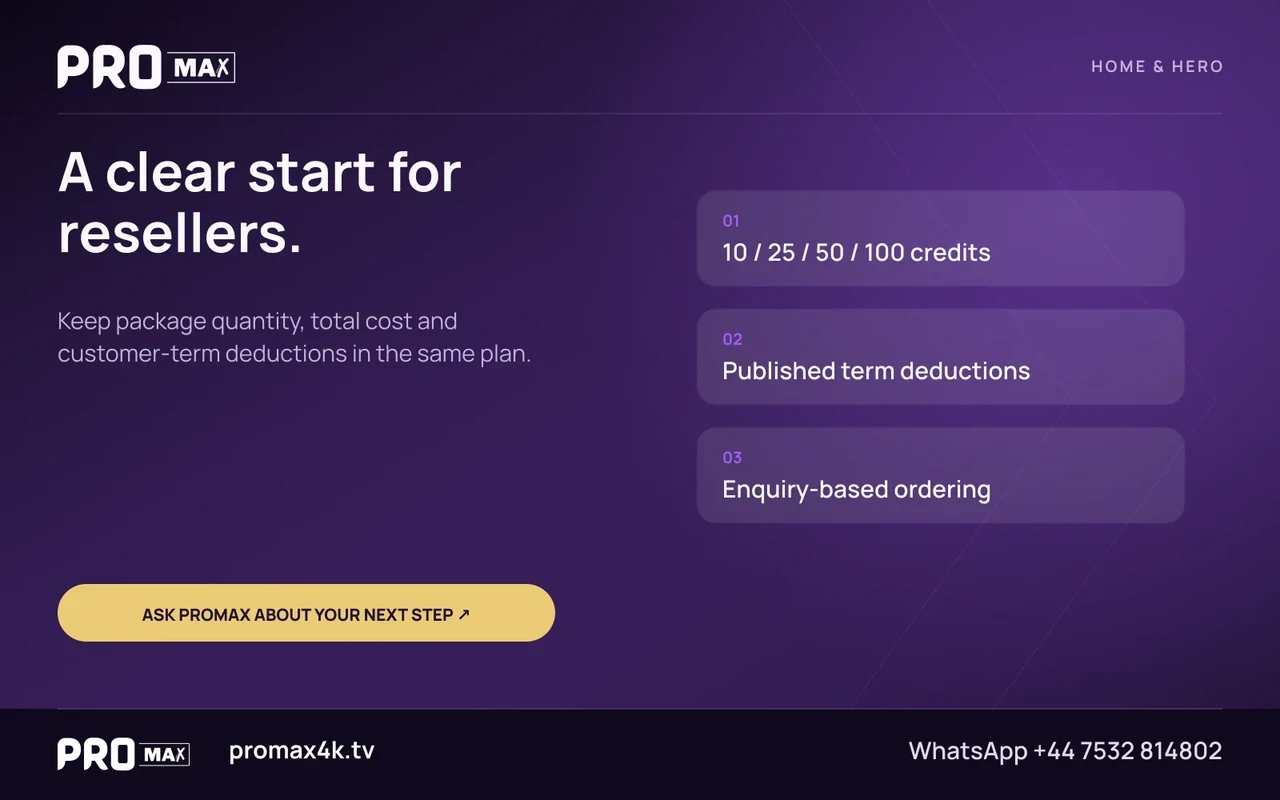
The operator publishes four pack prices, four deductions and several small planning tools. That gives a prospective reseller enough information to do the arithmetic independently. It does not settle whether a new reseller may distribute in a particular territory, how unused inventory expires, what response times a household can expect or what profit a business will make. Bring the numbers to a commercial conversation rather than treating them as a substitute for one.
For a household, the starting figures are much smaller. A month is $9.99 and a year is $54.99 on the November 19, 2026 public schedule. The provider asks buyers to install a compatible player before requesting a one-day trial and to confirm simultaneous playback requirements with support. Pro Max’s order route prepares an enquiry for the seller. Pressing the button does not complete a payment or create a usable account automatically.
This guide follows one practical question through the different prices. How much must someone spend today, and exactly what result should be visible afterward? A reseller needs a funded balance, correct permissions, a documented customer debit and a resulting expiry. A household needs the right account on a usable player for the agreed term. A person purchasing an independent app licence needs the software features the publisher actually sold. Each of those outcomes has its own owner and proof.
| Standard customer term | Pro Max credit deduction | Number of identical terms from a ten-credit Starter pack |
|---|---|---|
| 1 month | 0.1 | 100 |
| 3 months | 0.3 | 33, with 0.1 credit remaining |
| 6 months | 0.6 | 16, with 0.4 remaining |
| 12 months | 1.0 | 10 |
A customer quarter consumes three tenths of a credit. Two six-month periods consume 1.2 credits in total, while one twelve-month term consumes one credit. That means a change in the mix of customer terms can alter the credit requirements even when the total number of viewing months stays the same. Take twelve customers wanting one month apiece. They require 1.2 credits. One customer wanting twelve months requires one. The distinction comes directly from the published mapping.
Working in tenths reduces mistakes. On an internal planning sheet, describe a ten-credit Starter balance as 100 tenths. A monthly start uses one tenth, a quarter uses three, six months use six, and a year uses ten. Add the tenths first, then divide by ten to present the result in Pro Max credits. Staff can check the sheet by eye without confusing 0.6 credits with six whole months of inventory on another supplier’s system.
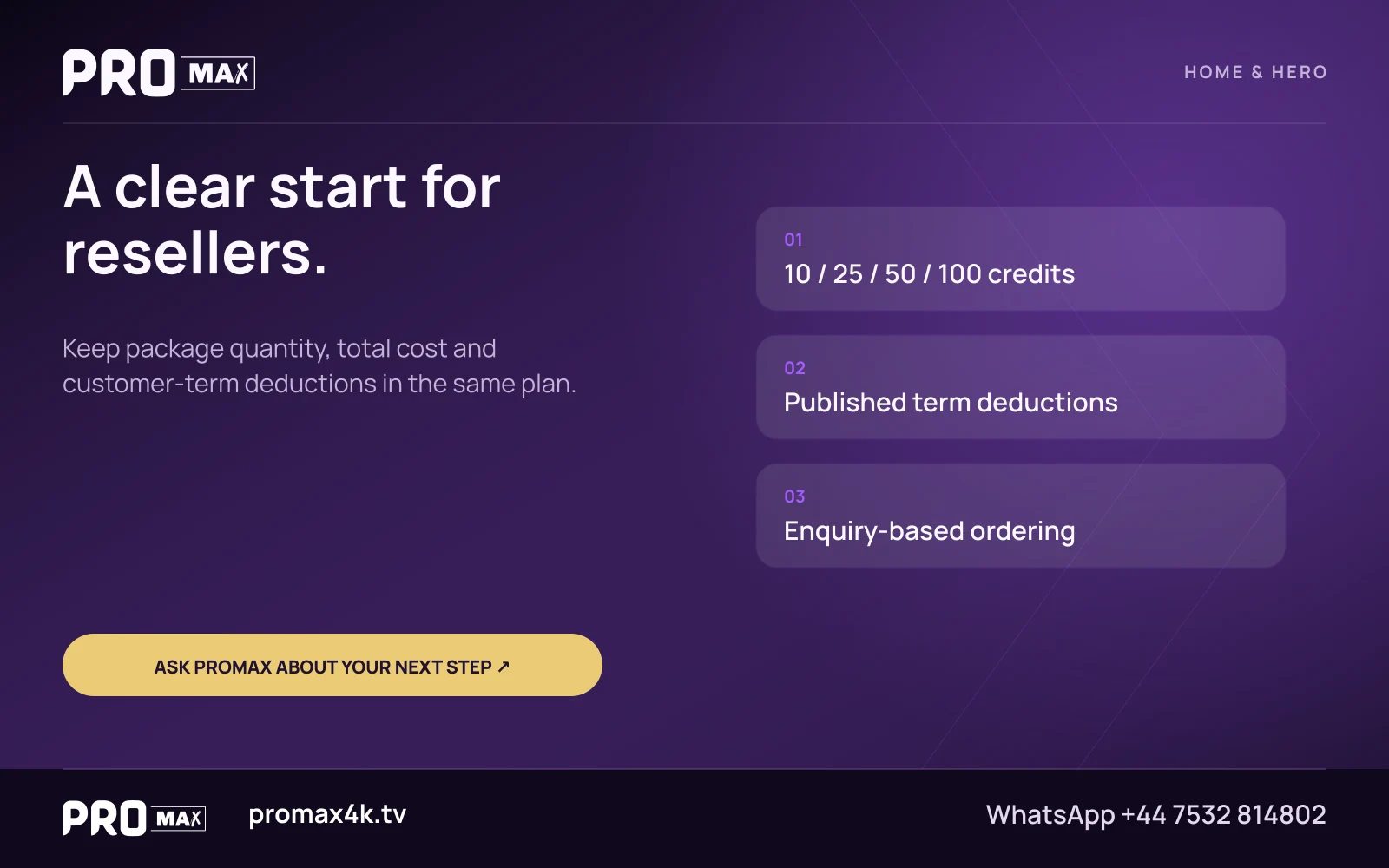
A decimal in the operator’s schedule does not imply that a reseller may purchase any decimal quantity. Pro Max lists whole packs of 10, 25, 50 and 100 credits. A half-credit remaining after a batch of customer accounts is usable according to the operator’s rules for issuance. It is not a claim that a prospective buyer can open a panel by paying for half a credit. Keep pack purchase and subsequent credit consumption in separate parts of the order form.
Term changes also require attention. A customer who buys a three-month term may return after two weeks asking to upgrade to a year. It is tempting to subtract 0.3 from 1 and predict a further 0.7 debit. The published table describes standard terms. It does not specify prorated upgrades, amendments, refunds or preservation of remaining days for that case. Ask the operator how it will apply the proposed change, then record the actual debit and new expiry.
If another supplier is on the same spreadsheet, label each row with its exact domain. Pro Max 4K OTT at promax4k.tv is the seller covered here. A related-looking brand name, familiar box style or coincidentally equal household price does not establish that a credit purchased from another operator can fund a Pro Max account. Inventory should reconcile to the specific panel where it can actually be spent.
| Pro Max pack | Full price | Unit acquisition cost | Direct cost of a three-month term | Direct cost of a six-month term |
|---|---|---|---|---|
| Starter, 10 credits | $228.90 | $22.89 | $6.87 | $13.73 |
| Growth, 25 credits | $547.50 | $21.90 | $6.57 | $13.14 |
| Professional, 50 credits | $1,024.50 | $20.49 | $6.15 | $12.29 |
| Enterprise, 100 credits | $1,899.00 | $18.99 | $5.70 | $11.39 |
The operator’s pack table lets a buyer verify every unit rate. Divide the full price by the number of credits, then multiply that exact unit rate by the published term debit. A Starter quarter uses 0.3 multiplied by $22.89, giving $6.867 before rounding to $6.87. A six-month term uses 0.6 multiplied by the same unit rate, giving $13.734 before rounding. The direct allocation displayed to cents is $13.73. The panel itself should still show the deduction in credits.
Rounding one term early can create a surprise in a batch. Ten single-month activations at the Starter rate allocate one complete credit because ten times 0.1 equals one. The exact aggregate is therefore $22.89. Displaying an individual monthly allocation as $2.29 and then adding ten displayed amounts gives $22.90 instead. The one-cent difference arises entirely from rounding. It does not imply a missing credit or an operator overcharge.
The same reasoning helps a reseller explain invoices to a colleague. The cost allocated to a customer year from Enterprise is $18.99, because a standard year uses one credit. Acquiring the Enterprise pack requires $1,899. Someone opening a business with only the cost of a single customer’s allocation has not acquired the stock. Conversely, charging the first customer for the entire $1,899 would assign the cost of inventory intended for many future customers to just one line.
If stock was acquired in more than one purchase, choose a documented internal cost method with the people responsible for the business accounts. The operator’s posted unit rate on a new Enterprise card does not revise the historic amount paid for an old Starter pack. Record each invoice, quantity, purchase date, currency and opening balance. When planning a new sale, clearly state whether the calculation uses the actual acquired stock cost or a current replacement-cost estimate.
The direct figures above exclude the work required to serve the customer. Answering setup questions, handling a device change, collection costs, taxes where applicable and unused inventory all affect a real business. A seller can calculate the difference between a chosen customer price and direct credit allocation. Calling that difference profit without accounting for the other obligations would give a newcomer an inaccurate picture of the work.
Suppose a reseller has confirmed orders for five annual terms, four six-month terms, three quarters and seven monthly starts. The annual customers consume 5.0 credits. The half-year group uses 2.4, the quarters use 0.9 and the monthly group uses 0.7. The total is exactly nine credits. A single Starter pack can cover the batch and leave one credit as long as its account permissions and the customers’ configurations match the standard schedule.
At $22.89 per credit, the direct allocation for nine credits is $206.01. The cash purchase is $228.90. The final one-credit balance carries $22.89 of the original acquisition cost. Write those three numbers on different lines in the working papers. A prospective reseller looking at the $206.01 allocation should not be surprised when the actual pack purchase screen asks for the complete $228.90.
There are 19 customer orders in the example. Dividing $206.01 by nineteen produces an average close to $10.84 per order, but the average can do more harm than good. Some customers received a year and others one month. Pricing or refund decisions based on the average hide the very different direct allocations and support obligations. Use aggregate cost to reconcile the batch, then return to the correct term when discussing an individual customer.
Now add two annual renewals owed next week. They require two more credits, while the first pack has only one available. A reseller can either arrange additional inventory on time, reserve a larger pack at the start or adjust which new work is promised. It cannot treat a positive one-credit closing balance as proof that two years remain available. A panel can look healthy and still be short against imminent obligations.
Try a different mix with the same nineteen customers. If all nineteen wanted annual terms, the batch would require nineteen credits. Two Starter packs would supply twenty for $457.80. One Growth pack would supply twenty-five for $547.50. The larger pack offers the lower unit rate and five more credits of capacity, but takes $89.70 more cash on the purchase date. The choice depends on the next confirmed demand and conditions on spare credits. A package comparison becomes meaningful once the orders are named by term.
Pro Max provides a pack comparison tool and explains the limits of its calculation. A row comparing multiples of one pack size can be useful, yet it can miss a combination containing different sizes. If the operator allows several packs or different pack types on the same panel, calculate those combinations explicitly. Ask about the permission before treating the lowest theoretical result as a way to place an actual order.
Consider a confirmed need of 33.4 credits. Four Starters would supply 40 credits for $915.60. A Growth plus a Starter would supply 35 for $776.40. One Professional would supply 50 for $1,024.50. The mixed option is $139.20 below the four-Starter spend and leaves 1.6 credits after the planned work. The whole-pack quantities, full outlay and leftovers should all stay visible. A table sorted only on price per credit would put Professional above both cheaper ways to cover this particular need.
At 48 credits the picture changes. Five Starters would give 50 credits for $1,144.50. Two Growth packs would give 50 for $1,095. A single Professional would give the same 50 for $1,024.50. With equal total capacity, the single Professional purchase costs $70.50 less than the two Growth packs and $120 less than the five Starters. The confirmed orders would leave two credits with any of the three methods. Conditions on expiry, top-up and delivery still need to match.
A larger example makes the capital requirement clearer. To cover 64.8 credits, one Professional plus two Starters would provide 70 for $1,482.30, leaving 5.2. A Professional plus a Growth would provide 75 for $1,572, leaving 10.2. An Enterprise pack would cost $1,899 and leave 35.2. The larger remaining balance can be valuable if the orders arrive and the inventory stays usable. Calling unused credits a saving before either condition is established turns speculation into an apparent business result.
Look outside the spreadsheet as well. Buying several packs in small instalments might delay activation if the supplier must confirm each top-up. One larger purchase may simplify reconciliation and reduce the chance of a weekend stock shortage. Ask when a paid top-up becomes available in the panel and who will investigate a mismatch between receipt and balance. These operational differences can outweigh a small price difference on a single customer batch.
Store the calculation with the dated source and assumptions. If an operator later offers a custom arrangement, add it as a separate row with the quote date, account permissions, total and credit conditions. Avoid overwriting the published pack data with a negotiated number, especially in a public comparison. Readers should be able to see why one customer or reseller received a particular recommendation without mistaking it for a general Pro Max price.
A new customer order has a term to start. An existing account also has a current expiry to protect. Pro Max asks the purchaser to identify whether the request is a new activation or a renewal and confirm the intended account before payment. In a small business, that simple distinction can be lost between sales and provisioning staff. A renewal issued as a new account may leave the customer with two sets of details and time stranded on the older one.
Write a private instruction that another staff member can execute without guesswork. Include an internal customer reference, current recorded expiry, agreed extension, allowed account configuration, expected credit deduction, who authorized the change and how to confirm completion. If a twelve-month standard renewal is due, the expected debit is one credit under the published schedule. The operator should also identify what happens to unused time when the extension is applied early.
Capture the state before the change and its result afterward. A customer who said yes to a quote, a payment that has cleared, a panel debit and a new account expiry are four distinct events. A sale can be stuck between any two of them. Mark each only when its evidence exists. A supplier’s payment receipt should not be used to mark customer access as delivered before checking the actual account state.
Suppose a Growth balance opens at 25 credits. Two customer years and three six-month terms should use 3.8 and leave 21.2 for these standard terms. The previous shift may already have received the payments, and the next shift may be responsible for customer confirmation. If the closing balance is 21.2 but one customer’s expiry has not changed, staff should inspect the specific operations. A correct overall balance is encouraging but cannot prove that every line went to the intended customer.
Allow for exceptions. A hardware change might require the buyer to consult the player publisher, while an account modification requires the service operator. A customer may request cancellation before the panel action is performed. A paid extension might be applied to an already expired account with a different start rule from a still-active one. Clear private records make it possible to answer each case without sharing passwords or working playlist addresses in a group support channel.
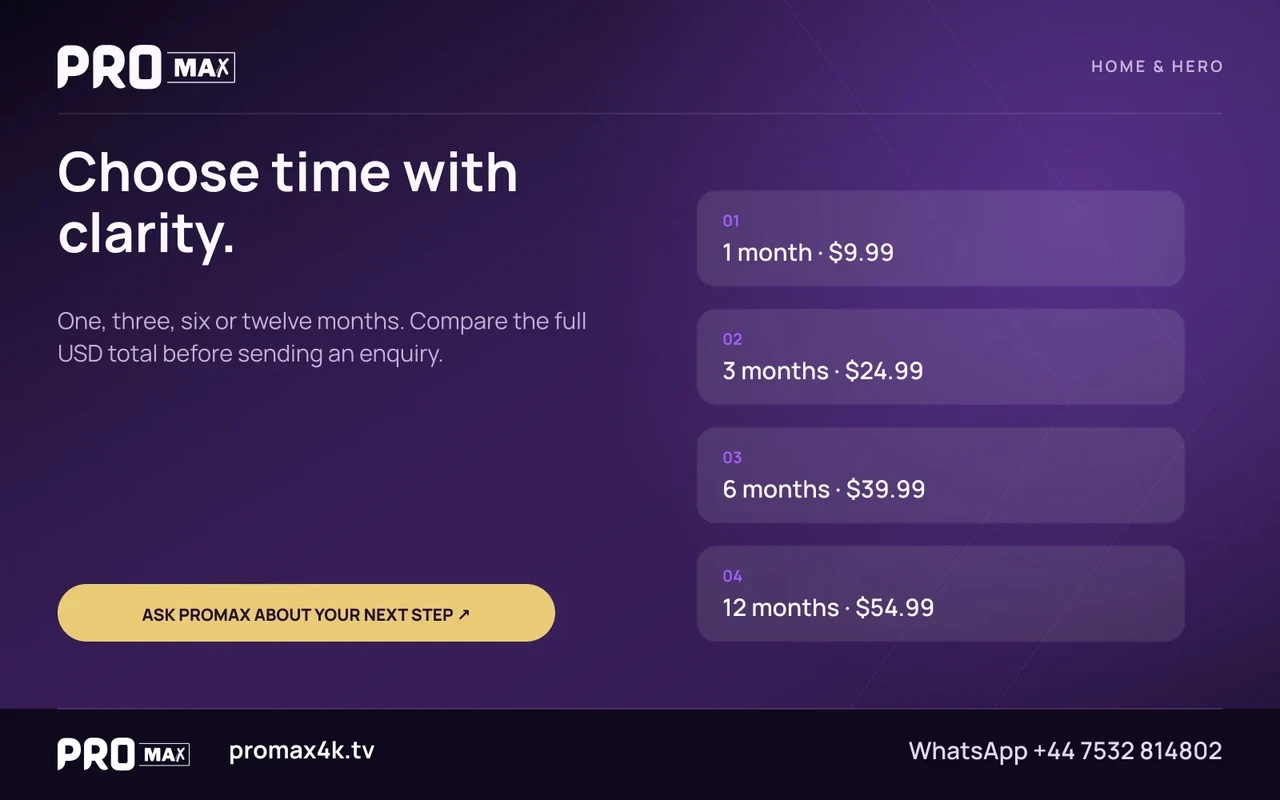
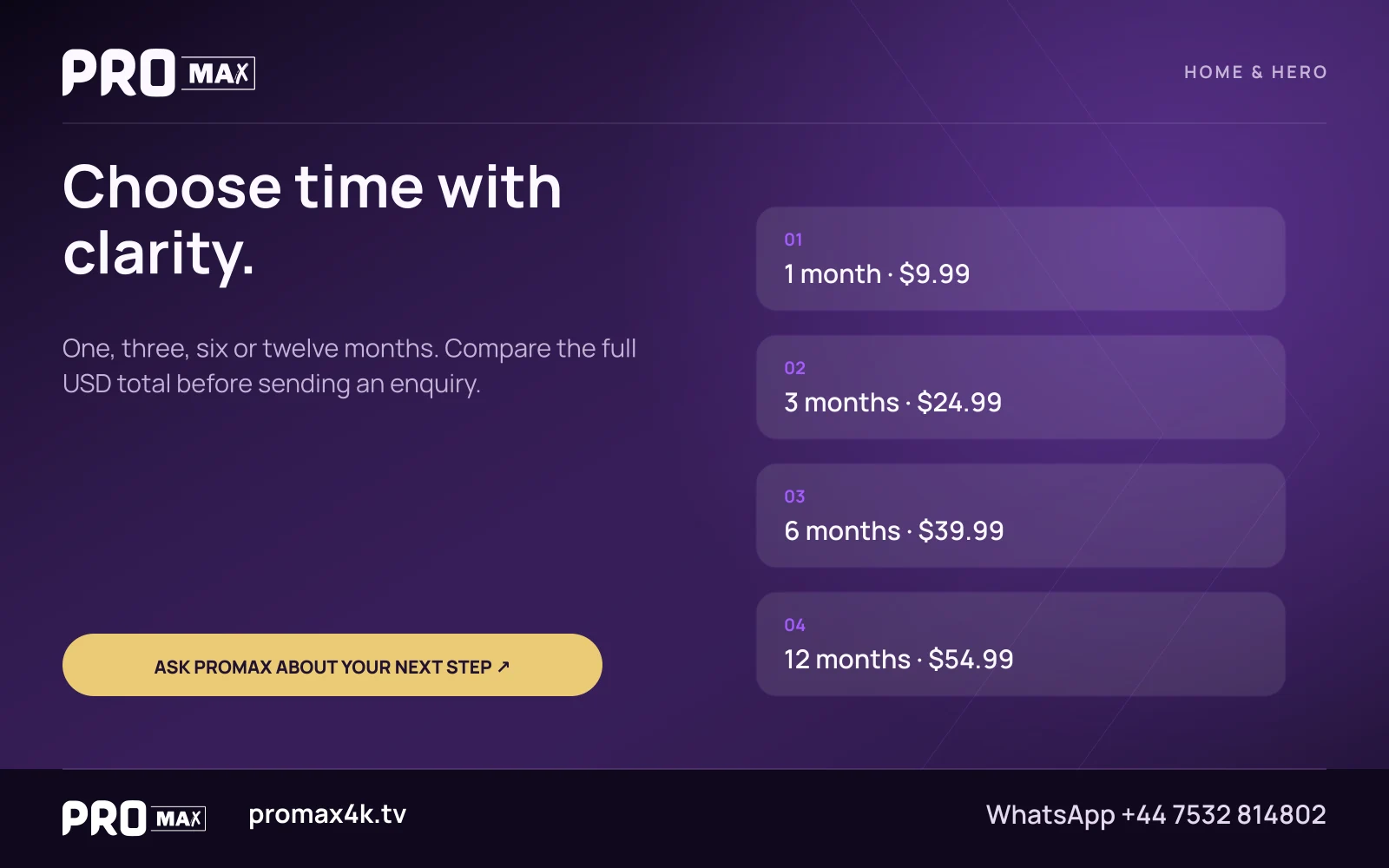
| Retail term | Pro Max full USD total | Rounded equivalent per month |
|---|---|---|
| 1 month | $9.99 | $9.99 |
| 3 months | $24.99 | $8.33 |
| 6 months | $39.99 | $6.67 |
| 12 months | $54.99 | $4.58 |
The retail and reseller figures share a provider name and a currency, which makes it particularly important to put units on a comparison. A customer buying a year at $54.99 receives the specified viewing term under the seller’s conditions. The $18.99 Enterprise annual allocation is part of an operator’s separate $1,899 acquisition and excludes its other costs. The public reseller price is not a discounted one-year retail checkout option for someone who needs a single household account.
A buyer choosing three months would pay $24.99 on the current schedule. Three separate months would total $29.97 if the monthly rate remained unchanged. The quarter saves $4.98, while paying month by month preserves two opportunities to stop early. For six months, two quarters would total $49.98, compared with $39.99 for one half-year. The extra $9.99 can be understood as the price of retaining a decision at the three-month mark when a move or change of equipment is expected.
The annual price is $15 above the six-month listing. Someone who expects to stay for seven months could consider a six-month term followed by a month for a total of $49.98, assuming the operator permits that renewal sequence and the later price holds. At eight months that combination becomes $59.97 with two monthly extensions, making the annual sticker $4.98 lower. The threshold changes if another suitable term combination is used, if the account allowance differs or if a separate fee applies at renewal.
Concurrency remains a decisive fact to ask about directly. The provider says the installed-device count and the number permitted to stream at once are separate, and its reseller questions do not publish a universal account allowance. Tell the seller whether two screens must play at once, in which location and on which devices. The website can give the standard term price. A suitable quote needs the allowance that will actually be attached to the proposed account.
Before paying, match the term, currency, merchant, private order reference and activation date. A buyer who reaches a prepared message should review it and wait for the seller’s actual purchase steps. The public Pro Max website describes a WhatsApp enquiry route. It does not collect a card payment on that offer screen or automatically provision an account from merely selecting the term. The evidence of a successful purchase comes later from the agreed seller and account.
Pro Max publishes a guide explaining player activation and viewing-account access. Those labels are easy to confuse because both processes can end with a screen that says “activated.” An app publisher may charge to unlock its player or assign a licence to a specific device. A service provider then supplies the viewing account for a selected term. A device-store account may also be involved just to obtain the app. Each transaction can have a different party, expiry and recovery path.
Take a viewer whose paid subscription appears to stop after changing television. If the provider confirms that the viewing account is active, check whether the chosen player licence transfers to the replacement device. The old service payment might still be valid while the app publisher requires a transfer or a new licence. Paying the service seller for another year before identifying which activation failed can leave the family with two service payments and the same locked app.
The reverse can happen as well. A player opens normally, remembers favourites and displays a polished home screen, but the content account has expired. Check the account expiry and actual error stage. A lifetime software licence, if a publisher sold one under its terms, does not establish that the viewing subscription lasts equally long. Keep the app purchase record and viewing receipt in separate folders or clearly labelled entries so either can be found without guesswork.
For a nontechnical household, make the answer visible without leaving secrets on the television stand. Write the name of the installed player, the named Pro Max seller and where the private receipts can be found. Record which contact handles an app-licence question and which handles the account term. A relative helping with the remote can then ask the right question without requesting a password simply to work out who sold what.
During the one-day trial, check where the account starts from a cold launch. Can the regular viewer reach the relevant input, open the chosen player, find the intended station or programme, set captions if required and return after closing the app? A successful test on one platform should be described as precisely that. A compatible Android box does little to establish availability in a television’s native app store, and a player that works on a laptop may still leave the family needing a usable TV remote.
The provider’s help material identifies its supplied Android APK as package com.promax.ott, version 3.9, with Android 6.0 given as the minimum version for that described file. Those are identifiers for the referenced package at the time of the source material. They do not amount to a security audit, a promise about future releases or confirmation that the app can be installed on every device with a similar product name. Recheck the provider’s current download page and the actual device before deciding whether the route fits.
A particularly useful detail is that the FAQ says a numeric Downloader code was not supplied for that Pro Max build. If the prospective buyer finds a code under a different player’s logo, the sensible response is to return to the provider’s current supported route or ask the named operator to identify the correct source. A short number carries no visible information about the package, publisher, version or destination. There is no need to guess one to judge the paid subscription.
Match the route to the television’s software. A Samsung Tizen television and an LG webOS television use their own platforms. An Android APK intended for a compatible Android system is a different format. Fire TV-branded hardware can have a model-specific operating system, and Apple TV has its own app route. Pro Max publishes device guidance for several common platforms. Read the model and system version actually printed in settings before following a diagram headed simply “TV.”
A household that already owns a compatible external box can evaluate whether that is a better practical route than trying to use a native television app. Connect it to an available supported input, identify which remote controls the interface, and ask the provider about the intended player and account format. Take the extra hardware and any separate licence into account. An interface that looks attractive in a screenshot can still be awkward for a viewer who must juggle several remotes.
An installer should document the source used, date, app version and platform. A shared support note can identify those details without containing a package download from an unverified mirror, client logins or private device-binding information. Later, if a customer updates the player or changes from a native app to an external device, staff can compare the old and new configuration and identify the component that actually changed.
A prepared order message is a convenient way to carry a product choice from an offer card into a conversation. Before sending, read the text as a buyer. Does it identify the correct provider, exact plan or pack, quantity where relevant, full currency and whether this is a new issue or renewal? A vague message asking for “the 4K plan” leaves room for disagreement when more than one account or commercial product has a similar name.
After the seller replies, identify the actual payment recipient, method, final total and activation steps. Keep that private response next to the original offer in the buyer’s records. Payment details should stay in an appropriate protected channel. A shopper does not need to post them in a public forum to obtain help interpreting a term or a discrepancy between two prices. If the recipient or price changes unexpectedly, seek clarification through the provider’s established contact route before treating an unfamiliar instruction as part of the same order.
When a household renews, ask the seller to identify which existing account it will extend and how it treats remaining days. When a reseller buys a pack, ask which existing panel receives the top-up and how quickly the operator expects it to appear. Those are parallel questions with distinct answers. Extending a household account cannot put credits in a panel, while adding credits does not automatically extend any customer until the relevant action is performed.
For a payment that appears completed but access has not changed, draw a short timeline. Record when the quote was accepted, when the payment was acknowledged, the term or pack ordered and the current account expiry or panel balance. Ask the person responsible for provisioning to match that transaction to the intended destination. Avoid sending the same purchase twice while the first remains untraced. A support record that preserves the original reference is more useful than a growing collection of unrelated screenshots.
Close the order when the intended tangible result exists. A household can check its term and access on the agreed device. A reseller can check the added balance, then record separate customer operations. Where the result is incomplete, write down the exact outstanding action and who can perform it. A store guide can describe the published process. Only the actual seller can confirm that a particular private order finished correctly.
Consider a business that has 2.4 Pro Max credits left on Thursday. It has promised a twelve-month extension to one customer and two six-month extensions to others on Saturday. Those three operations require 1.0, 0.6 and 0.6, a total of 2.2. The available balance exceeds the promise by two tenths. A casual look at a decimal point on a dashboard could persuade someone that there is room for several more sales. Only 0.2 credits are free after the existing commitments.
A walk-in customer wants a quarter. The standard quarter takes 0.3, so issuing it immediately would leave the desk one tenth short for the promised weekend renewals. The shortage is tiny when expressed as a direct allocation. On Starter stock a tenth allocates $2.289 before rounding. That amount does not establish a right to buy exactly one tenth from the operator. The business may face a whole-pack purchase or have to wait for an agreed top-up arrangement. A small decimal shortage can therefore produce a much larger cash and scheduling problem.
The sales answer should distinguish the household term from the stock situation. The reseller can say it is confirming when a new issue can be funded, then give a delivery window only when the operator has confirmed the supply. There is no need to expose a private panel balance or invent a service-wide outage to explain a delay. Existing customers who paid for the Saturday renewals should have a clear owner and confirmation route. The prospective customer should be able to decide whether the honest timing fits their needs.
Once new stock arrives, document the actual credit increase and the package purchased. Suppose a ten-credit top-up is confirmed, raising 2.4 to 12.4. Issue the quarter only with the customer's authorization and verify that the resulting debit leaves 12.1. The three promised renewals will then use 2.2 and leave 9.9. Separate the timestamps for the supplier top-up, new customer issue and each renewal. If a customer later queries the date, the person investigating can follow one operation without reconstructing the entire weekend.
A household considering a longer Pro Max term might ask whether it can take its remaining time, current favourites, player licence and login with it. Those are four different objects. The service operator controls the agreed viewing term and account. A player can hold local preferences and its publisher can control a device-specific licence. The account details the viewer uses may remain the same on an ordinary renewal or change under a replacement arrangement. Ask the seller to identify what the proposed transaction changes before saving over the last working configuration.
Suppose the viewer has two weeks left on a monthly account and wants to buy six months. At the published schedule a new six-month term is $39.99. The amount alone does not determine whether the six months begin today, after the remaining two weeks or after a separately agreed activation date. Write down the expiry currently shown, the date of the proposed charge and the promised new end date. A comparison between those dates gives the seller a concrete way to confirm or correct the order. Guessing that all terms stack in the same way can cost a household days of service.
Then decide whether to change the player as part of the transaction. If the existing player works, a renewal is easier to verify before adding a new television, app or device licence. If the old player is the reason for changing, ask for a compatible route and test it within the permitted account allowance. A family that changes the paid term, device and player on the same evening may struggle to tell which change caused a new problem. Separating the checks where practical reduces both expense and frustration.
If a shift supervisor wants to verify the conversion after it happens, let them check the original account reference, old expiry, paid extension and new expiry using the proper private records. A voucher, pack receipt or new app activation on the same day is evidence of a different transaction. A precise check may reveal that the correct service period was applied to a replacement account while the television still opens the old one. The remedy in that case is to identify the account the player should use, rather than issuing another paid extension.
The family should be able to describe the outcome in one sentence, such as which named seller confirmed what period on which device. Staff can close the ticket when the person responsible for the account agrees that the documented result is correct. Any issue belonging to a separate software licence remains a distinct follow-up with its own source and date.
At the end of a month, compare opening credits, all purchases, each group of standard term deductions, documented adjustments and closing balance. For a Professional opening balance of 50 credits, issuing twelve annual terms, ten six-month terms, ten quarters and thirty single months would use 12, 6, 3 and 3 credits. The total is 24, leaving 26. At the original Professional rate the directly allocated inventory costs $491.76. This is a 62-order workload with terms ranging from one month to a full year.
Try the same review in money without losing the credit units. Fifty credits originally cost $1,024.50. The 26 remaining credits at $20.49 represent $532.74 of the original cost. The two amounts add back to $1,024.50. If the ledger sums individually rounded single-month allocations, it may differ slightly from this exact aggregate. Reconcile against the underlying deductions and purchase rate first, then account for the display rounding separately.
Look beyond the financial columns. How many of those orders required device identification? How many customers had to purchase a separate player licence? How many renewals needed clarification because the previous expiry was missing? A growing support team may learn that an accurate one-page handover saves more money than chasing the lowest pack rate. A larger pack reduces one direct cost; it cannot repair unclear order records or make a vague service promise easier to honour.
If the business is considering distribution beyond direct customer accounts, use Pro Max’s wholesale and distributor enquiry routes for their separate purposes. A volume quote can cover acquisition price and allocation. A distribution relationship also needs permission, territory, customer ownership, complaint handling, support escalation and agreed use of the provider’s branding. Do not assume that a large Enterprise balance confers the right to appoint sub-resellers or advertise exclusivity.
The sound purchasing decision is the one the operator can explain to a colleague on the next shift. It should name the account or panel, purchased unit, exact cash amount, expected result and the evidence that will mark it complete. That works for a $9.99 household month, a $228.90 Starter pack and a $1,899 Enterprise order alike. The printed price becomes useful because somebody knows what to check after the money changes hands.
Suppose you expect to watch for six months. At the listed single-month amount, six separate purchases would total $59.94 USD. The six-month offer asks for $39.99 USD up front. That comparison assumes every new month is available at the listed amount. Check renewal separately before relying on it.
| Viewing period | Separate monthly purchases | Single matching term | Difference | Monthly purchases to reach term price |
|---|---|---|---|---|
| 3 months | $29.97 USD | $24.99 USD | $4.98 USD | 3 |
| 6 months | $59.94 USD | $39.99 USD | $19.95 USD | 5 |
| 12 months | $119.88 USD | $54.99 USD | $64.89 USD | 6 |
Read the final column as a spending threshold. If you expect to cancel sooner, compare the shorter commitment with the cash you would have paid up front. The figures exclude fees the seller has not confirmed.
Check Pro Max 4K OTT subscription termsThe smallest priced pack in this register holds 10 credits and costs $228.90 USD. The largest holds 100 for $1,899.00 USD. Their displayed unit costs are $22.89 and $18.99 respectively. The published deduction for a standard twelve-month customer is 1 credits. Check the operator’s treatment of additional screens and renewals.
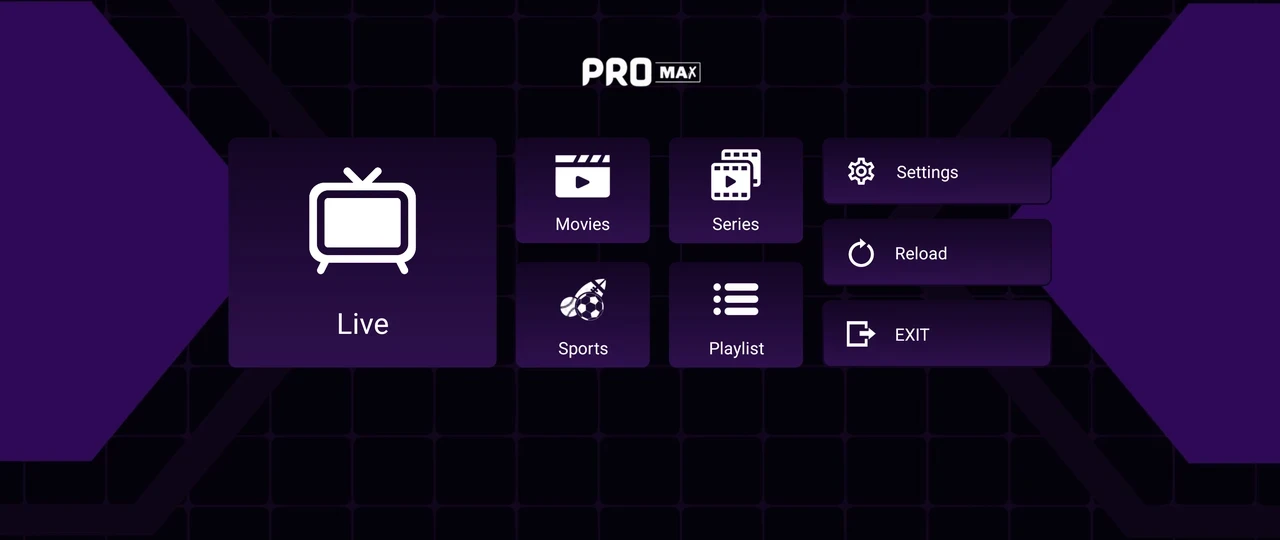
The image link identifies the exact file served by the provider.
Choose a matchup to see the actual currency, term and outcome.
Open the caption on a website-sourced image to see its original. The remaining captions identify material supplied with the provider archive.