provider
Rynex Play
Check the current app identity and activation route before relying on an older Rynex listing.
rynexplay.app · Check exact market
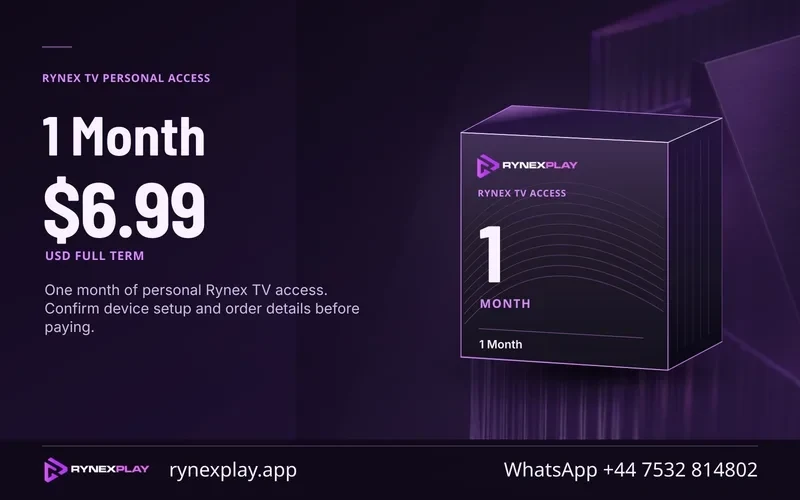
Open the official Rynex Play websiteThe 1 month plan is listed at $6.99 USD. The operator also lists 3 reseller pack sizes.

rynexplay.app
The 1 month plan is listed at $6.99 USD. The operator also lists 3 reseller pack sizes.
The 1 month plan is listed at $6.99 USD. The operator also lists 3 reseller pack sizes.
Check the current app identity and activation route before relying on an older Rynex listing.
rynexplay.app · Check exact market
Open the official Rynex Play websiteRynex Play maintains the site at rynexplay.app. Check who issues the invoice and who replaces the access if the app or TV changes. The buyer needs both answers before paying for a long term.
Document review · November 19, 2026. Playback performance, service rights and ZIP-level access require separate evidence.
The 1 month plan is listed at $6.99 USD. The operator also lists 3 reseller pack sizes.

rynexplay.app
A good way to evaluate Rynex Play is to hand the remote to the least interested member of the household. Ask for one familiar programme and leave the room quiet. Someone who knows the menu by heart can make almost any player look easy. The person who watches after work will tell you much more about whether the setup is worth keeping. When the trial clock is short, the best questions concern what happens on that particular screen, not how many categories a salesperson can fit on it.
Rynex uses its Rynex Play name on the website and refers to Rynex TV subscription plans. The service account authorizes access under the agreed terms. A player on the television accepts the account information and displays what is available. Installing the player by itself does not activate a Rynex viewing term. Its first-party material separates the screen, the app and the account, which is the right starting point for a family that wants a realistic price and a straightforward support route.
The November 19, 2026 listing showed $6.99, $16.99, $29.99 and $44.99 in U.S. dollars for one, three, six and twelve months respectively. A separate reseller business can purchase blocks of 200, 500 or 1,000 credits. A household buyer has no need to open a reseller panel to test the television. This casebook follows an ordinary installation from an empty home screen to a renewal, then looks at the different job of the person selling and supporting several accounts.
Stand close enough to the set to identify where the app will run. Some televisions have Google TV or Android TV built in. Others are ordinary displays connected to an external device. An HDMI input named “streaming” can hide a stick bought by a previous occupant. Find the actual model using the device's settings or its label. Put the platform and software version beside it. The make printed on the edge of the screen may have almost nothing to do with the store where the player is installed.
A U.S. buyer requesting a Rynex trial can send one useful line before anything is activated. Give the intended playback device, its operating system and the exact player and publisher available in the device's store. Describe the viewing market and the number of people who need to watch simultaneously. Keep login details out of that introductory message. The seller can then confirm whether it can issue account information in a form the proposed player supports and whether any separate charge applies.
Check that the remote, rather than a phone touchscreen, can perform all basic tasks. Can a user move the highlight to the app, select the intended account, open the guide and return from a full-screen picture? An app visible in search can still be awkward from a directional remote. Rynex's Android TV guide discusses remote operation, guide data, decoding and login methods. Treat each as a testable question for your own device. A gold-star rating from a stranger using a phone is much less relevant to this living room.
If the player is absent from the official store on the intended device, stop and identify the mismatch. It might concern the device generation, store region, app publisher or supported platform. Ask for the appropriate documented route rather than treating a similarly named app or unknown package as the same product. A useful pre-sale answer can be that the viewer should compare another supported device before starting the account trial.
Begin with the television asleep, the remote where the family normally leaves it and a printed note containing just the name of the programme. Watch the sequence. A viewer might press power, wait while the television opens its own home page, press input, select the external device, dismiss an advertisement and finally open the player. Each extra step is an opportunity for the wrong app to open. A stable service on a frustrating route can still be a poor household purchase.
Write the successful route in plain language that fits on a small card. “Power, HDMI 1, green Rynex viewing player, Favorites, local news” has a better chance of being useful than an exhaustive description of every possible setting. Use only the actual names and colors on this equipment. The example is a format for a household note, not an assertion that Rynex supplies a specific green player or uses that menu. If a button does something different depending on which remote is used, identify the remote first.
Try the reverse journey. Someone who has finished the programme should be able to return to the usual television input and turn the system off. Then ask a second person to reopen it from the normal starting state. If the player reopens the last station automatically, decide whether that is welcome. If it opens at an unfamiliar screen after an update, the viewer should at least know how to find the app again. A short trial needs time for this second attempt because a smooth installation can hide a poor daily routine.
A family can make a purchasing decision from this exercise. If the regular viewer has to call another person every evening to find the guide, the issue is much larger than the dollar difference between quarterly and monthly terms. A different supported player, a better arrangement of the home screen or a different provider may be worth considering before the family commits to a year.
There are four milestones in a Rynex setup that people easily collapse into one. First, the correct app is installed and opens. Second, the issued account is accepted. Third, the available guide or categories load. Fourth, the chosen programme plays correctly for the viewer. When something goes wrong, state the last successful milestone. This gives support a place to begin and often prevents an unnecessary repeat purchase or activation.
If the app fails before showing an account screen, check the exact app and platform. An independently purchased player may have its own sign-in or licence screen. A request for an app-store password is a very different prompt from a service account field. Identify the screen before entering anything. If the issued account is rejected, confirm that the selected entry method matches the instructions Rynex provided privately. Do not post account URLs, passwords or identifiers in a help thread.
If the account opens and the guide remains empty, note whether any other category loads, whether the device time is correct and whether this is the first refresh after entering the account. An empty guide and an empty channel library are distinct observations. A guide displaying times with no picture is another. Give the seller the model, player and time of the test, plus a description of the last working step. A cropped screenshot can help if it reveals no personal details or account information.
A programme that opens but has delayed audio requires yet another description. Note whether the delay appears with television speakers as well as a soundbar if you can compare, and whether it affects another permitted source. Avoid changing the player, the network and the television sound mode at the same time. A support case with one repeatable symptom and one clear comparison is more useful than a dozen screenshots of random menus.
Choose two programmes before asking for the advertised one-day trial. Give one choice to the person who usually arranges the technology and the other to the person who actually spends the most time with the television. They may have quite different priorities. Someone may choose a bright sporting event to see motion and sound. Another may choose a quiet regional news programme to judge captions, presenter speech and whether the local weather appears in the right feed.
Schedule the session around at least one real broadcast where possible. Record the intended station, programme title, date and local starting time. If a U.S. household wants a Spanish-language programme, note whether the requirement refers to spoken audio, subtitles, commentary or the presentation of the guide itself. Searching by language alone can produce many plausible entries without answering the family's precise need. Ask the provider about the exact named programme and availability at the viewing address.
Let both viewers score their own requirement in ordinary language. One might record that the action was watchable from the sofa but fast-moving scoreboard text became difficult to read. Another might record that captions existed but switched off when changing station. Those are good observations because someone can repeat them. They do not establish a universal output resolution, a service-wide fault or a guarantee that captions will behave the same on every feed. A family can decide on the basis of its own result without overstating it to other people.
What if the two viewers disagree? Identify whether the disagreement concerns the player interface, the specific source or the household's spending limit. A different supported player might solve a problem finding favorites. It cannot create an absent local entitlement. A longer term can lower the effective monthly price for people who continue using the service. It cannot make an unreadable caption track suitable for someone who relies on it. Resolve the actual disagreement before choosing the cheapest-looking monthly average.
| Household purchase | Full USD total | Calendar it naturally covers |
|---|---|---|
| One month | $6.99 | A first paid period or short stay |
| Three months | $16.99 | A defined quarter |
| Six months | $29.99 | A known half-year |
| Twelve months | $44.99 | A full year of confirmed use |
Imagine a family setting up the television in a temporary home for five months. One three-month term and two individual months would cost $30.97 if the prices stay the same and the seller allows consecutive renewals on those terms. The six-month term at $29.99 would cost 98 cents less and provide another month. Four or five separate receipts are not the only way to buy flexibility. Comparing all available lengths reveals a cheaper full purchase even when part of its final month might go unused.
For a four-month trip the arithmetic reverses. One quarter and one month would total $23.98. The six-month offer would cost $6.01 more and give two extra months. Whether that extra time has value depends on the departure date, who can keep using the household account and the seller's permitted use rules. A purchaser expecting to travel or relocate should ask what happens at the next address before counting future months as usable.
A family using the same setup for a full year could spend $59.98 on two six-month terms at the listed rates. The annual price is $44.99, a difference of $14.99. The shorter purchases preserve an opportunity to stop halfway. Put that $14.99 beside the household's confidence in the equipment, the seller and the required programs. When uncertainties remain, buying the opportunity to reconsider can be reasonable. When the family already trusts the arrangement and needs a full year, the savings are real enough to write into a budget.
Ask how an early renewal is applied to time already on the account. Save the existing expiry and the seller's answer. If a player has its own licence or a multi-screen arrangement carries a separate fee, show those costs alongside the subscription total. A household interested in the price actually leaving its bank account needs the entire bill, not just the number printed on a service card.
Start with the observation the viewer can make. Did the app fail to launch? Did it launch and lose the account? Did the live picture stop while guide menus still responded? Did a single programme pause while another played? The description changes the next step. A responsive menu proves the app can draw something on the screen. It does not prove the current source is ready to play. An unresponsive television remote may indicate a local control issue before the account enters the picture.
For a repeated pause, try another available source on the same device and write down the result. If possible, try one known working, authorized app on that device as a comparison. Note whether the test took place at the household's usual busy hour. If there was a large background transfer or someone was using another service at the same moment, record it as a condition. It may help explain what support should ask next. The occurrence of another download does not by itself prove that it caused the pause.
For sound trouble, identify the audio path. A television speaker, receiver or soundbar may handle different tracks differently. If another output is readily available, test one familiar programme with the same device and picture settings. Report whether the symptom is total silence, a wrong language, a delay or low dialogue volume. Those symptoms point to different categories of problem. A new set of account details is an unlikely first fix for a soundbar muted on one input.
When the problem is confined to the guide, concentrate on time and identity. Check the television's local time, the entry for a named programme and whether the same station name appears for several regions. A guide time for a different coast can look like an account problem. Sending the operator a dated, specific comparison lets it inspect the mapping without asking for irrelevant personal information. A viewer who keeps the original trial notes has a reference for what the same setup did when it first worked.
A Rynex customer can buy a viewing period while a different business charges for the player. There might be a receipt in the television's app store account and another in the purchaser's email or messages from the seller. Before the family relies on either product, identify who owns both records. A parent who depends on a television app purchased through a visiting relative's store account may find it difficult to recover after replacing the equipment.
Ask the player developer's store listing how licences work for the exact platform. An app purchased for a phone may or may not cover a television edition. A previous purchase on a different platform may require a separate decision. Do not treat a logo or the developer's name as proof of licence portability. If the provider recommends a paid player, ask whether it is required, what lower-cost alternatives are supported and where any bundled licence would appear on the consumer order.
This becomes important when a prompt says “expired.” Read which component has expired. An app account may be asking for renewal while the Rynex service period still has months left. Conversely, a fully licensed player can open normally while the viewing account has reached its end date. Check the correct receipt and account before paying a second time. A family can keep a copy of the purchase names and dates without storing passwords in plain text or sharing them with everyone who knows where the remote lives.
If the television is being set up for another person, complete the handover while everyone has time. Let the owner of the account confirm the expected expiry using the supported service route and identify the player purchase through their own store. Ask them to show how they would get help for each. The test is complete when the regular viewer can use the equipment and the purchaser can recover the records without relying on one technically confident relative.
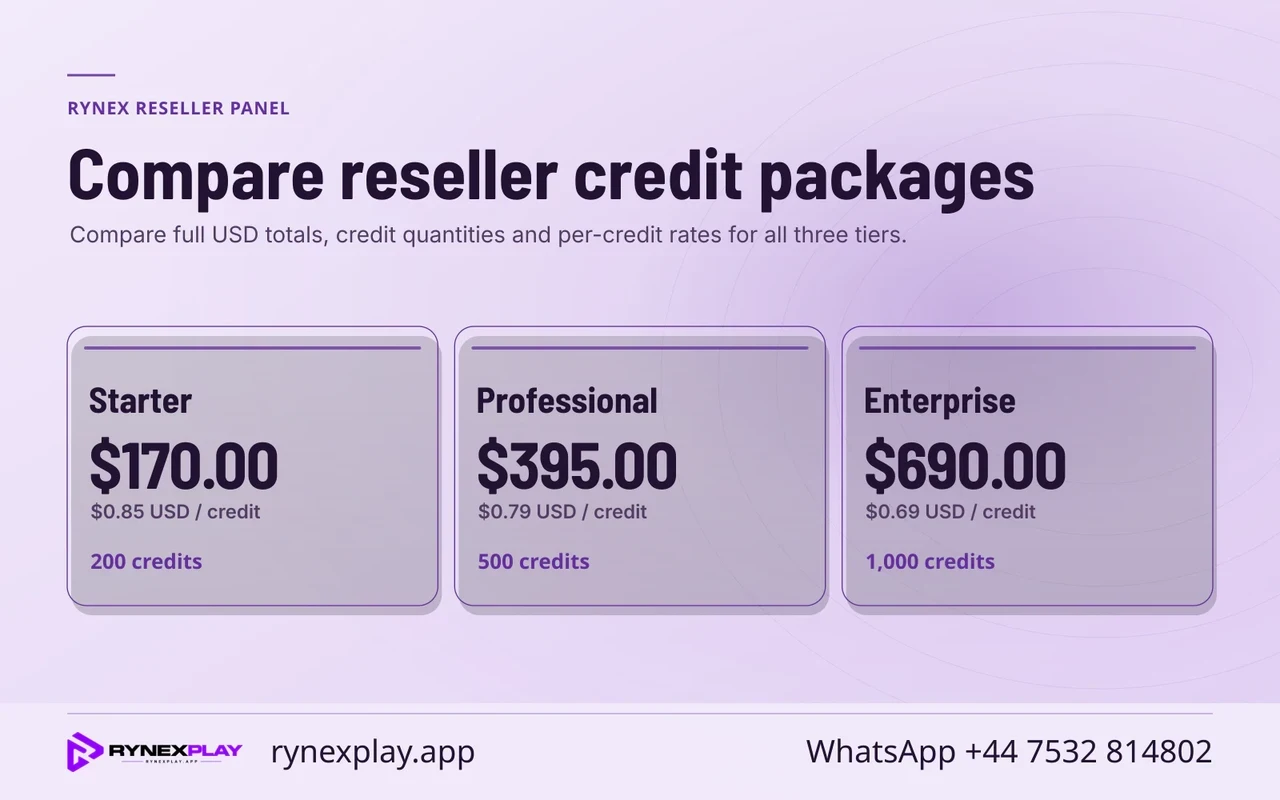
The Rynex reseller page describes one credit as one customer-month. Activating one, three, six or twelve months therefore uses one, three, six or twelve credits respectively under the published schedule. The quantities on sale are 200, 500 and 1,000 credits, with full purchase amounts of $170, $395 and $690. These are wholesale stock purchases in U.S. dollars. They are not household subscription totals and a new reseller should not confuse the smallest per-credit figure with a minimum cash deposit.
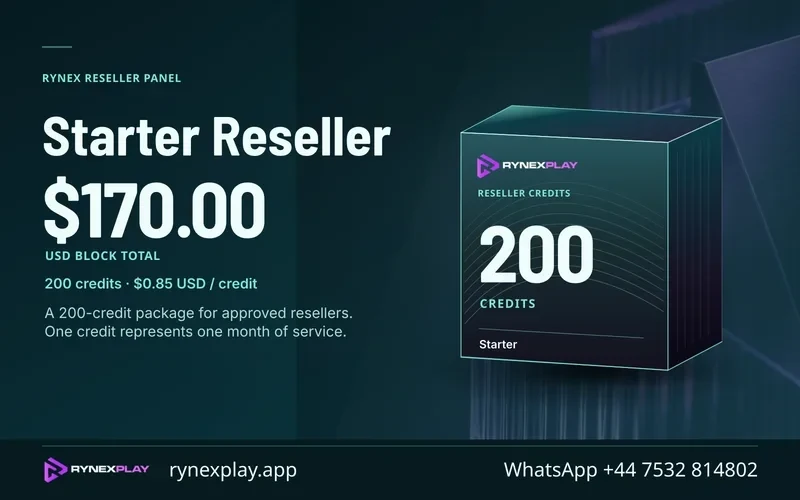
| Stock purchase | USD per credit | Material allocated to a quarter | Material allocated to a year |
|---|---|---|---|
| 200 for $170 | $0.85 | $2.55 | $10.20 |
| 500 for $395 | $0.79 | $2.37 | $9.48 |
| 1,000 for $690 | $0.69 | $2.07 | $8.28 |
The table puts only stock cost against those terms. A seller still has to provide whatever customer support it has agreed, handle payment costs, maintain accurate records and honor its obligations. A customer with an unfamiliar television may take longer to onboard than someone renewing the same account. Both can consume the same number of credits. Compare full pack totals with real working capital and price business services on a defensible understanding of what the operator permits and what the business actually delivers.
A 200-credit pack can fund sixteen annual accounts and leave eight credits. It cannot fund seventeen annual accounts from a zero starting balance because those would require 204. The desk might use the eight for a half-year plus two monthly accounts or for two quarters and two monthly accounts. Those are useful combinations only when customers actually request them. Selling a stranger a different term merely to empty the remainder is poor planning.
A reseller evaluating a distributor arrangement should distinguish a normal stock purchase from an agreement to appoint partners, use branding or operate in a new market. Rynex has separate wholesale and distributor enquiry routes. Those pages tell a prospective business where to ask. They do not confer territory, white-label rights, panel permissions or distribution rights for particular programming on everyone who buys 200 credits.
Consider a small reseller with thirteen annual renewals due across the coming week. Those accounts require 156 credits. Five quarterly renewals add 15, four half-year renewals add 24, and four monthly orders add another four. The confirmed total is 199. If all can be fulfilled under the agreed account conditions, one fresh starter block covers them with one credit left. The upfront stock purchase is $170. The stock allocated to the committed work is $169.15 at the starter rate.
This is a case where the remaining nominal balance deserves attention. One credit is sufficient for a further one-month order. It is not enough for a quarter even if the customer is prepared to pay immediately. An operator facing back-to-back appointments needs to make that distinction clearly to staff. The store should not display the last credit as general availability for every term. Ask a new customer for the intended duration before promising activation.
Change just one order in the scenario. If one of the confirmed monthly customers switches to a six-month term, the forecast increases by five credits from 199 to 204. There is a four-credit shortfall against the starter block. Rynex's published minimum block is 200 credits. The reseller should ask about permitted top-ups and timing rather than assuming the supplier will sell exactly four. Spending another $170 to solve that shortfall may be reasonable if further confirmed work exists, but the decision belongs in a cash plan.
Break the week's orders out by date as well as term. One desk may collect renewal payments before submitting account changes. Another may need to reserve stock for existing customers until they confirm. The stock still needs to be available when the operator must perform the activation. A weekly balance that looks sufficient can hide a first-day shortfall if the top-up arrives later. Record expected and confirmed replenishment separately, so staff never sell against a balance that has not appeared.
An internet shop with 200 new monthly accounts can use the same Rynex stock as one that activates sixteen annual accounts and has eight credits left for another mix of terms. The two operations have very different numbers of conversations, expiries and opportunities for setup errors. A sensible operator does a second forecast alongside the credit calculation. How many distinct households need help, how many devices are unfamiliar and how many renewals will occur on the same date next month?
A small desk can learn this from its own records. Divide the last set of support tickets into first installation, player licence, account activation, guide question, renewal and other. Count how often each requires a second exchange. Do this with general case descriptions, keeping login information out of the report. If installation questions dominate, improve the initial device question and the handover note. A larger stock purchase by itself cannot reduce the time spent explaining the same remote to every new family.
For a proposed business order, give Rynex the expected customer terms, markets, common device types and who handles first-line support. Ask which operator actions require escalation and who can authorize a correction. If the seller describes a branding or domain option, ask for the exact scope, minimum conditions and written approval for the intended use. A discussion of branding options on a supplier page is a reason to ask detailed questions. It cannot be treated as an automatic inclusion in every pack.
A useful staff rota reflects the actual types of work. The person who can identify why an Android TV player fails before login may not have authority to amend a reseller balance. The employee who can reverse an accounting error may not know which physical input the household uses. Assign the right owner and leave a concise record so the customer does not have to repeat the entire story. A lower per-credit cost matters less when a preventable handoff error costs a whole afternoon.
Before issuing an account renewal, locate the original order, existing expiry, requested term and provider-supported account reference. Note the expected credit deduction. After the action, compare the updated expiry and balance with the original record. If one change appears and the other does not, do not assume the panel is ready for a second activation. Check the action history or operator support process first. Timed-out requests and slow display updates can resemble failures from a busy operator's desk.
A confirmation to the customer can be short. Identify the viewing term, the new expiry, any action the viewer actually needs to take and the contact responsible if the account remains wrong. The household does not need to see the reseller's balance, unrelated customers or the operator login screen. If a screenshot is essential, crop it to the specific result and review what remains visible before sending it. A general forum thread is useful for understanding a symptom. A private account discrepancy belongs with the responsible operator.
Take the case of a customer whose viewing term is correct but a newly installed player has lost saved favorites. A second subscription renewal would spend credits without addressing the issue. Determine whether favorites were stored by that app locally, whether the supported method offers a backup and whether the customer is now using a different player or device. If the old set still works, it can provide a reference for rebuilding the short list with the viewer. Obtain help from the relevant player publisher where the issue belongs to the software.
When a customer leaves or sells a television, clarify any account transfer or cancellation conditions with the service operator. The former owner should remove private login details from the outgoing device using its own account controls. Keep the financial and stock ledgers accurate even if the household is no longer using the app. A service ending early by customer choice does not automatically return credits to a reseller balance. Record whatever adjustment the supplier actually confirms.
An installation record is useful only if the next person can understand it. Put the device model, installed player publisher, Rynex account order reference, agreed expiry and support route on one private record. Add the normal path from waking the device to reaching the guide. Avoid putting viewing passwords or account addresses on a card visible in a shared room. The handwritten instructions beside the television can be short and nonsensitive. The order details can stay with the person responsible for the bill.
Now imagine the installer is away and a prompt appears saying the app needs payment. The family member who opens the note should be able to tell whether the Rynex viewing term still has time. If it does, the next question concerns the player's own terms. If the service term ended, the family can confirm the correct published renewal arrangement. Without the record, the natural reaction is to pay the first prompt that makes the screen look familiar again. That can purchase a product the viewer does not need.
A documented end date also helps when the household moves. The viewer can ask whether the existing account arrangement will work at the new address, what device information should be updated, and whether any local feed changes apply. If the account must be used differently, the family can decide whether the remaining time still has value. A reseller can log that as a customer service enquiry without assuming that moving an account, replacing a box and renewing are the same panel action.
Finally, leave room for the result of one useful support case. “Guide wrong by one hour on this television, device zone corrected and local bulletin now agrees” tells another person what solved a reproducible problem. “Everything reset” records effort without a solution. A growing collection of two or three such notes can save the family time at the next software update without turning the living room into a technical project.
Suppose the reseller wants 400 credits available for a defined set of orders. Two 200-credit starter blocks would supply 400 at a combined $340. A 500-credit block costs $395 and leaves 100 credits after the planned work. Buying that extra balance costs another $55 in immediate cash. That can be a fair purchase if the business has confirmed additional work and the operator allows the account to use it on the required dates. The decision should refer to actual future orders, not the feeling that a Professional label carries more prestige.
Now take a desk with 1,000 funded customer-months on its calendar. Five starter packs would cost $850. Two 500-credit blocks would cost $790. A single 1,000-credit block is listed at $690. The differences are $160 and $100 respectively for the same nominal quantity, if those multiple-pack combinations are available under equal conditions. The full enterprise purchase has a clear cost advantage for the defined requirement. It can still be a poor cash decision for a reseller who will not need the last half until well into the next year or lacks permission to hold and use the stock in the intended way.
When comparing such schedules, ask how and when credits expire, when a top-up is reflected in the account, and what happens if supported activation procedures change. Avoid using a customer's future promised payment to make the supplier's money appear available today. The business can decide which customers require a deposit or confirmation under its own agreed terms. Its credit ledger should reflect actual supplier purchases and use, rather than customer intentions.
The right choice can be smaller than the next printed tier. If a reseller expects only three annual renewals and a handful of quarterly activations, check the actual existing balance before shopping for stock at all. A lower unit rate adds nothing to accounts already fully funded. Replenishment is a business operation serving a queue of named work. A stylish pack card should make the quantities and costs easy to compare without turning stock accumulation into a goal of its own.
When a family solves a Rynex issue, a concise public explanation can help someone with the same model. Name the device and player, describe the symptom and the one change that fixed it. “The guide loaded, but the TV remote could not move between stations. Installing the television edition from the device's own store resolved navigation on this model” is useful if that is what the family actually observed. A broad recommendation to install a particular app on every screen would exceed the evidence.
If the issue required operator action, identify the type of correction and its outcome without naming a customer's account or publishing private activation instructions. A post can say that the seller corrected the billed term and the viewer verified the expected expiry after reopening the account screen. It should leave out full receipts, payment references and identifiable images of account panels. Readers need to learn how to recognize the issue and which party handled it. They do not need access to your paid service.
A forum answer can also close with a limitation. Perhaps the setup opened and played local news, but the programme that motivated the trial aired after the account expired. Say that the particular event remained untested. That is a better answer than inferring access from a league mark on a page. The unresolved question can then return to the seller or another authorized source while the household decides whether a month at $6.99 is worth the additional test.
A shopper returning months later should be able to identify what was verified, when it happened, and whether their own circumstances match. A Rynex trial on a named Android TV in one home is evidence about that setup and date. The provider's published stock deductions establish a separate set of accounting facts. The best purchase decision uses both kinds of evidence where they belong, and leaves the rest open until someone with actual authority can answer.
Make one final visit to the original viewing device before deciding whether to keep a long term. Put the remote back where it lives, ask the regular viewer to open the app and have them choose the programme they originally named. Then ask the person paying the bill to identify the actual renewal amount and the party that handles an app licence. Getting both answers without assistance is a useful sign that installation and account handover succeeded together. If either person still needs help, record the single missing step while the buyer, installer and seller can still identify the original arrangement.
Rynex Play household prices · Reseller packs, panel and deductions · Android TV player buying guide · Rynex Play home and setup resources · Wholesale questions · Distributor enquiries.
Suppose you expect to watch for six months. At the listed single-month amount, six separate purchases would total $41.94 USD. The six-month offer asks for $29.99 USD up front. That comparison assumes every new month is available at the listed amount. Check renewal separately before relying on it.
| Viewing period | Separate monthly purchases | Single matching term | Difference | Monthly purchases to reach term price |
|---|---|---|---|---|
| 3 months | $20.97 USD | $16.99 USD | $3.98 USD | 3 |
| 6 months | $41.94 USD | $29.99 USD | $11.95 USD | 5 |
| 12 months | $83.88 USD | $44.99 USD | $38.89 USD | 7 |
Read the final column as a spending threshold. If you expect to cancel sooner, compare the shorter commitment with the cash you would have paid up front. The figures exclude fees the seller has not confirmed.
Check Rynex Play subscription termsThe smallest priced pack in this register holds 200 credits and costs $170.00 USD. The largest holds 1000 for $690.00 USD. Their displayed unit costs are $0.85 and $0.69 respectively. The published deduction for a standard twelve-month customer is 12 credits. Check the operator’s treatment of additional screens and renewals.
The image link identifies the exact file served by the provider.
Choose a matchup to see the actual currency, term and outcome.
Open the caption on a website-sourced image to see its original. The remaining captions identify material supplied with the provider archive.