
provider
Sky Glass IPTV
Compare the GBP pack total and ask which panel actions and account limits are included.
skyglassiptv.app · Check exact market
Open the official Sky Glass IPTV websiteThe 1 month plan is listed at £6.00 GBP. The operator also lists 7 reseller pack sizes.

skyglassiptv.app
The 1 month plan is listed at £6.00 GBP. The operator also lists 7 reseller pack sizes.
The 1 month plan is listed at £6.00 GBP. The operator also lists 7 reseller pack sizes.
Compare the GBP pack total and ask which panel actions and account limits are included.
skyglassiptv.app · Check exact market
Open the official Sky Glass IPTV websiteSky Glass IPTV maintains the site at skyglassiptv.app. Check who issues the invoice and who replaces the access if the app or TV changes. The buyer needs both answers before paying for a long term.
Document review · November 19, 2026. Playback performance, service rights and ZIP-level access require separate evidence.
The 1 month plan is listed at £6.00 GBP. The operator also lists 7 reseller pack sizes.

skyglassiptv.app
The question that matters first is what the buyer expects to receive. Sky Glass IPTV, the service listed at skyglassiptv.app, identifies itself as independent of Sky Group. Its own FAQ separates this internet viewing account from official Sky subscriptions and Sky Glass television hardware. Someone shopping for a physical television, a manufacturer warranty or a change to an existing official Sky account should identify the seller responsible for that product. The four prices below are for the independent service described on the exact domain.
For a household in the United States, this distinction changes the order conversation. The operator quotes British pounds. The viewer may follow a British programme but watch on a U.S. television at a U.S. address. The equipment, billing currency, time of the broadcast and territory all need their own answers. A GBP heading does not place the television in Britain, and an English-language channel name does not identify the specific feed offered at the viewer's location. Give the seller the actual situation before asking which term to buy.
As recorded on November 19, 2026, the household options were £6 for one month, £15 for three, £25 for six and £40 for a year. The service also identifies a one-day trial and publishes a separate reseller schedule. Most of the complications arise when somebody confuses one of these items with another. The rest of this guide shows how to put each question in front of the person who can answer it, and how to compare the commercial figures without assuming a quantity discount the published table does not actually give.
Suppose a family message reads, “Get Sky Glass for the television in the spare room.” That could mean purchase a television carrying the Sky Glass name, arrange a television subscription from another company or install a supported player for an account supplied by skyglassiptv.app. Those orders have different sellers and wildly different prices. Ask the family member what they expect to happen after payment. Is a box arriving, is an existing subscription changing, or will a seller issue viewing account details for a player on equipment already owned?
The independent provider's description makes the third path the relevant one here. The hardware remains the television or box the household owns. The software is the chosen player from its publisher. The account is issued under the confirmed service terms. A single seller might offer help with all three steps, yet it does not follow that one purchase includes the price of the player or replaces the television's existing support arrangement. Put the three items on separate lines in the budget. Leave an amount blank until you know who charges it.
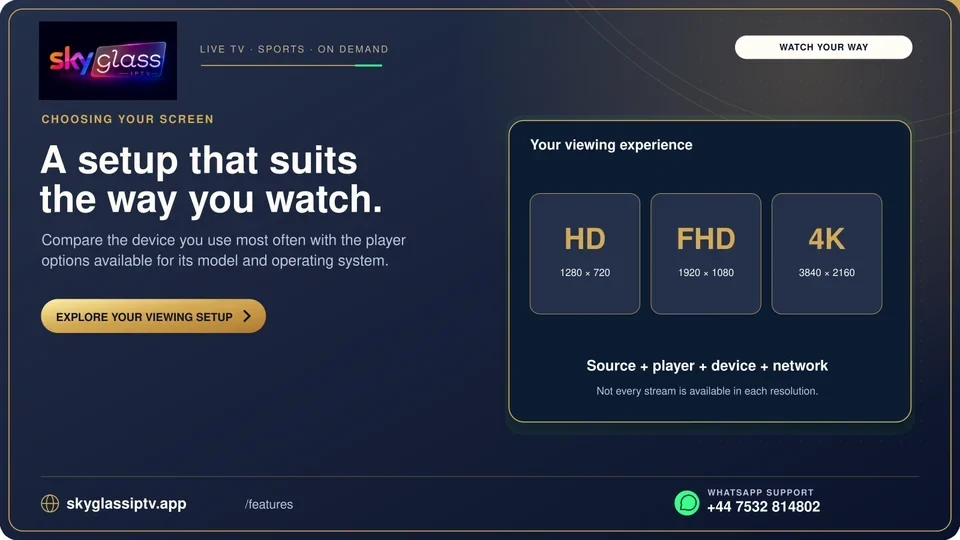
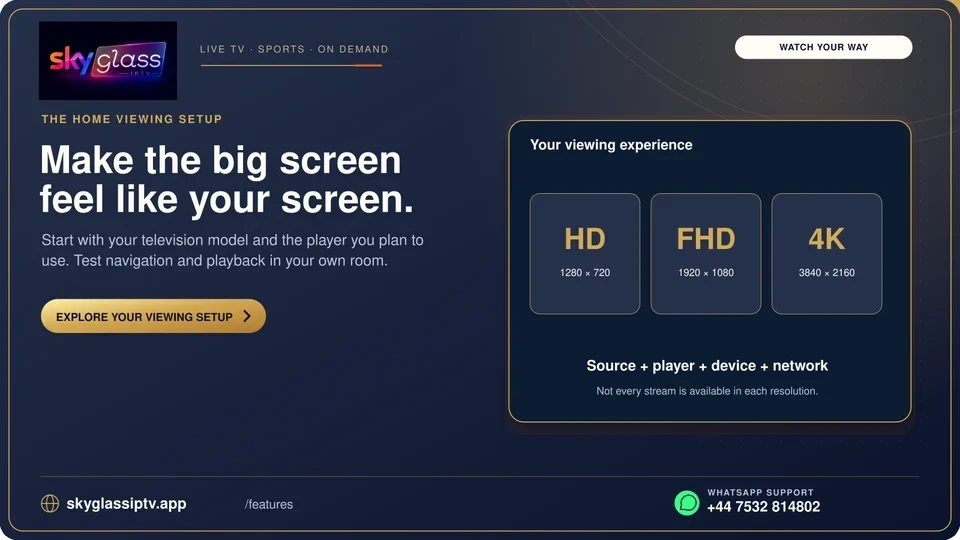
A good first enquiry contains the specific make and model, the installed operating system or connected box and the name of any player already purchased. Add the viewing country and the number of simultaneous screens needed. Ask whether the account can be used in that configuration, whether an extra app fee is likely and which party will handle activation. A broad claim about compatible smart televisions gives a useful starting point for research. It does not answer whether the app you intend to use appears in this model's U.S. store.
If the caller actually owns an official Sky Glass television, ask the manufacturer or its platform documentation which apps the set supports, then confirm the account route with the independent provider. Avoid buying an annual term solely because the device and seller share words in their names. If there is no supported native player for the exact setup, ask about a permitted external device and include its cost before comparing the offer again.
| Term | Full price in GBP | Difference from the preceding listed term |
|---|---|---|
| One month | £6 | First paid month |
| Three months | £15 | £9 for two additional months |
| Six months | £25 | £10 for three additional months |
| Twelve months | £40 | £15 for six additional months |
The annual price is £40. Dividing by twelve gives roughly £3.33 per month for comparison. A U.S. buyer cannot put $3.33 in next month's budget and assume that figure covers the purchase. The service quotes pounds for the term. The payment route and the buyer's account determine what appears on a dollar statement. Retain the seller's GBP amount, any conversion shown before authorization and the final posted charge. When the processor offers a choice of payment currency, use the actual costs disclosed to that buyer instead of adopting a rate someone posted for a different day.
Consider a summer visit lasting two months. Two monthly terms at £6 each would total £12 under the recorded schedule. The quarter costs £15, so a third month costs £3 more than those first two months bought individually. Whether that makes sense depends on the return journey, the expected renewal process and the family's appetite for another transaction. If each transaction carries a separate evidenced fee, put the real fee beside each route. Do not invent an exchange margin or tax because a spreadsheet has an empty cell for one.
Six months at £25 make a different comparison. Four monthly purchases cost £24 if the monthly price stays the same. At four months the extra pound for a six-month term can be attractive to a household that expects any further use at all. One quarter and a month would instead total £21. The apparent “best” plan changes when the comparison includes all available combinations. Confirm that separate terms can actually be renewed as modeled and that time remaining is handled as expected before building a calendar from these figures.
A viewer asking for British television from the United States is rarely asking for every category in a directory. Pick a named bulletin, series episode, sports fixture or documentary. Note the UK broadcaster or station, the proposed air date and the time zone in which the original listing is written. Tell the seller the U.S. viewing location. Ask which feed the intended account could receive there and whether the specific programme is authorized and available. A channel guide can help identify the question. The operator must answer it for the relevant order.
If the seller says a UK feed is available, find the original programme listing on the broadcaster's own schedule and convert the actual event date to the viewer's local time with a date-aware clock. Do not permanently write a single hour difference on the remote. Different dates and U.S. time zones can change the practical answer. Record both clocks beside the programme. For example, identify an evening broadcast in the UK and write the corresponding local date and time for the actual home rather than assuming all U.S. viewers watch at the same hour.
Use the trial to compare the guide entry with the picture. A programme appearing under the right station name at the wrong local time suggests a guide or clock question. A station with a similar name showing a different programme suggests a feed or regional substitution. If the programme has already aired when the family watches, ask whether authorized replay exists for that exact source and how long it remains available. An on-demand menu on the home screen cannot promise replay of every live event.
For a household in which one person grew up with the UK schedule and another schedules everything in local U.S. time, write the record so both can read it. A practical entry names the programme and broadcaster first, then the two observed times and what actually played. No one should have to guess whether “eight o'clock” referred to the original transmission, the local guide or the time the family planned to watch a replay.
Sky Glass IPTV offers a 24-hour trial and asks for the device and player information. Have the correct player installed and the relevant programme calendar to hand before requesting activation. If a household's decision turns on a Saturday event, a trial running from Monday morning to Tuesday morning may settle app compatibility while leaving the event untested. Ask about a useful trial time and keep the answer. There is no benefit in describing unobserved weekend coverage as a successful weekday trial.
Start the first session by checking the account rather than the most attractive poster. Make sure the player opens on the intended device, accepts the approved account method and reaches a usable list. Then search for the named programme, compare the listing to the source schedule and try the audio and captions the viewer needs. If the expected option is missing, ask the seller whether the issue belongs to the account, the feed or the player. A second paid app might offer different controls but cannot create an audio track that the delivered programme lacks.
A second visit to the same screen later in the trial is often more revealing. Ask the regular viewer to return to an item saved earlier. If the television opens its own global recommendation screen, confirm which app the viewer selected. If the guide still points to yesterday, check the device time and the guide's update status if the installed app exposes that information. Take only the minimum screenshot needed for a support question, without account identifiers.
At the end, record the actual hours available and what was checked. A short trial can establish that the setup accepted the account, the remote worked, a named feed appeared in that window and the viewer could hear or read the requested language. It cannot establish that the seller has secured every future programme in every market. Buyers who want the annual price deserve to make their decision on the facts most relevant to their home.
An Apple TV mark on a media page can refer to a device, an app, a storefront or a separate entertainment subscription depending on context. A U.S. buyer choosing Sky Glass IPTV needs to identify which part they actually own. An Apple TV box runs apps available for its platform. A subscription to a separately branded entertainment product belongs to its own provider. An independent IPTV viewing account has the terms supplied by its seller. A promotional image bringing those names together establishes none of the commercial connections a casual reader might imagine.
Ask support a question about a concrete action. Can the account issued for the selected Sky Glass IPTV term be used with this particular tvOS player on this Apple TV model, and does that player require a separate purchase? The answer might point to a legitimate app store listing or ask for more detail about account format. Save the exact publisher and fee. If the person answering instead gives a list of famous platform names, narrow the question again. This is a compatibility and cost decision, separate from any entertainment memberships the family already pays for.
The same issue arises on smart TVs with many subscription tiles on the home screen. Opening one of those tiles may take the viewer to another company's login or payment page. Return to the intended player before concluding that the IPTV account was lost. Set up one favorite inside that player and ask the viewer to find it again after using another app. This small test tells the household whether the ordinary television interface will cause repeated confusion.
A buyer can value the visual guides as aids to identifying an ecosystem without treating every pictured brand as included. Make a list of the separate services the family already pays for and leave them in the budget until there is specific evidence that the family intends and is entitled to change them. Removing a known subscription from the budget on the strength of a logo can make the alleged saving disappear at the next renewal.
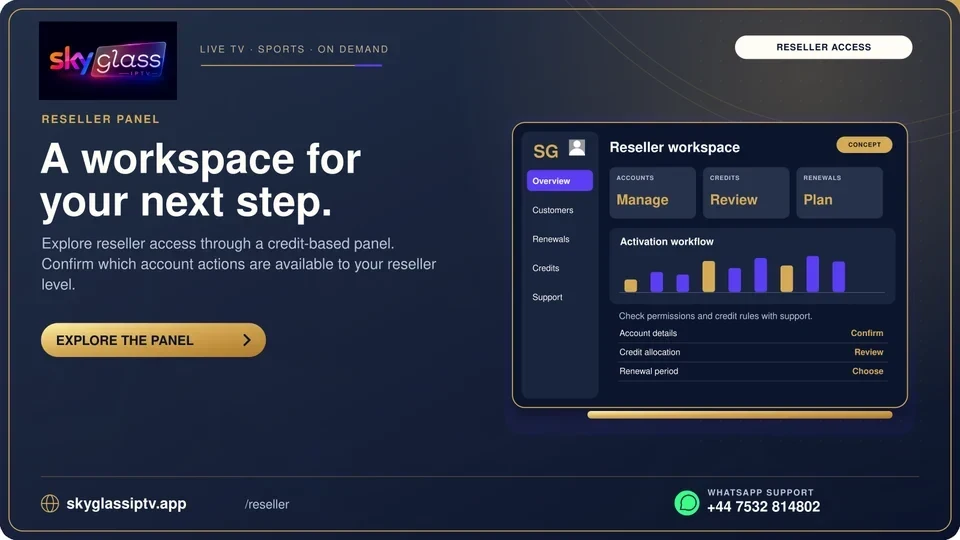
The Sky Glass IPTV reseller information includes four published GBP pairs. The arithmetical relationship between quantity and price is unusual enough that a buyer should read every row. Some of the larger nominal blocks have a higher unit figure than smaller ones. A wholesale page can also describe account tiers, roles or features. Request the entitlement differences in writing before concluding that two combinations of small blocks are commercially interchangeable with a larger tier.
| Published credits | Published total | Nominal price for one credit | What the price alone establishes |
|---|---|---|---|
| 180 | £180 | £1.00 | Price of the stated block |
| 350 | £350 | £1.00 | Price of the stated block |
| 600 | £850 | About £1.42 | Price divided by nominal quantity |
| 1,200 | £1,600 | About £1.33 | Price divided by nominal quantity |
The nominal value is simply the full total divided by the number of credits. It cannot establish how many one-, three-, six- or twelve-month customer subscriptions a block funds. The operator's published credit explanation directs prospective resellers to confirm the current activation table. Keep that missing information visible. No accurate per-activation cost can be calculated until the operator supplies the applicable deduction for the particular account and term.
The site's illustrated routes also include 60-, 120- and 300-credit enquiries, and there is a route for the 600-credit product. A route labelled with a quantity is a useful way to describe an order request. It does not establish the amount payable. In this store, the 60, 120 and 300 selections need a written quote. The 600 selection has an identified published total. Multiplying 60 by the £1 shown on a different pack to create a £60 offer would be a commercial invention.
Ask the operator to distinguish a plain balance top-up from admission to a particular panel tier. A small and a large package could have different account permissions, onboarding, support responsibilities or ordering conditions. This guide has no evidence that such differences explain a specific price. It identifies the question that must be answered before a buyer can compare: exactly what does each quoted total deliver besides the stated number of credits?
Imagine a desk asking how to obtain a balance of at least 600 credits. At the published figures, two 350-credit blocks would give 700 nominal credits for £700. That is £150 below the published £850 total for one 600-credit block and supplies 100 more nominal units. This is an arithmetic observation, conditional on the operator allowing two small orders into the same account on equivalent terms. It is not a claim that such a purchase route is permitted or that it carries the same role or service level.
The comparison is useful because it tells the business exactly what to ask. “Would two 350 blocks at £350 each be available on the same account, on the same terms and with the same permissions as the 600 block listed at £850? Which differences should be included in the decision?” That question names the published figures without accusing the operator of an error. The operator may provide a legitimate distinction, a current price change or confirmation that the options can be combined.
For a larger example, three 350 blocks and one 180 block would total 1,230 nominal credits at £1,230 if all four small purchases were available as assumed. The listed 1,200 block costs £1,600, a £370 difference before any differences in access, agreement or transaction conditions. A buyer who ignores that spread can commit more cash than expected. A buyer who promises the cheaper route to customers before receiving the operator's confirmation has made the opposite mistake.
Keep the result of the enquiry in the decision record. A dated quote for a specific quantity and panel role should show the full GBP total, payment fees, usable balance, any expiry and the rights to use it. If the operator declines to confirm that multiple small packs can be combined, budget the actual offered route. The office's ability to do multiplication does not grant a permission that the seller has not given.
A prospective reseller may know exactly how many subscribers want annual terms and still be unable to choose a Sky Glass IPTV block. The missing variable is the debit for each supported customer term. Ask the operator for four written numbers, with the period and account allowance attached to each. Ask whether a renewal consumes the same as an initial activation, whether test lines have a different charge and whether the panel ever charges an additional fee outside the credit balance.
Describe the calculation in words before building a spreadsheet. Multiply the number of confirmed customer orders for each term by that term's confirmed debit. Add the four results and compare the total with the usable balance. For cash allocation, multiply a single term's confirmed debit by the applicable pack's actual cost per credit, carrying the full precision until the display step. If any debit is unknown, leave the corresponding result open. Use the confirmed terms alone in a partial forecast and label the remainder as pending.
Suppose a buyer asks how many annual accounts £850 would cover. The current schedule associates £850 with 600 nominal credits. An answer in annual accounts requires the operator's annual deduction and any applicable conditions. Replying “600 accounts” equates an account with a credit. Replying “50 accounts” assumes twelve credits per account. Neither assumption is established for this seller by the published pack price. The only defensible immediate answer gives the known block and asks for the missing rule.
This discipline protects the buyer from false confidence and the seller from a misquoted term. When the written rule arrives, keep its date and scope on the worksheet. A new contract, a different market or a different panel level may have different rules. Reusing a chart verified for another IPTV operator because both businesses happen to quote GBP is an especially easy way to produce precise-looking, incorrect results.
For an office operating in dollars, a supplier quote and a customer quote are different documents. Ask the supplier to identify the legal billing party or merchant name, the amount and currency, the block, account role, expiry and confirmed activation rule. Keep the amount in GBP in the supplier ledger. Where the business also records a dollar equivalent, associate it with the actual transaction or accounting method the business uses rather than a rate copied from a general shopping article.
On the customer side, show the amount the customer will really owe, the term, the permitted use, the party providing ongoing support and the currency the customer will pay. If the customer pays in dollars while the business buys stock in pounds, exchange movements can affect the business's margin. They are not a reason to silently alter an amount already quoted to the customer. Set quote validity and renewal arrangements clearly with the parties who actually control those decisions.
Now add the operational questions a supplier invoice often omits. Who approves trial lines? Who handles a double activation? How is an accidental renewal corrected? Can customer service see historic actions and end dates? Which fields may each staff role view? A reseller panel can display an attractive set of screenshots while a particular buyer's account has a much narrower permission set. Ask for the scope of the role being offered and a supported way to demonstrate it before selling to others.
A distributor enquiry is broader still. If the business expects territorial rights, the ability to appoint subresellers, white-label control or access to a managed streaming service, describe each requirement separately. A wholesale contact page establishes a route for the question. It does not establish that the requested right is included in any listed credit pack. Quote the service your business is authorized to supply and retain the written evidence where the staff handling sales can find it.
A household in Arizona might report the same programme time as a household in New York and still mean different things. A support representative reading a report in Britain may interpret an unqualified “last night” as yet another date. Put a calendar date, local wall time and named zone in any enquiry about an event or guide entry. Add the device's displayed time and the broadcaster's schedule time if known. This small detail prevents a seller from checking a completely different programme.
Tell the operator whether the problem is the absence of the station, a wrong programme in the guide, missing audio, a playback failure or a billing condition. For a station displayed correctly but showing a different regional programme, include the station label and the programme actually seen. For a missing category, state what search and guide location were checked. For a paid term that has expired unexpectedly, provide the order and dates through the private support route rather than sending pictures of the playlist to a public forum.
If the account works on the original device and fails on a different set after travel, the seller needs the authorized use conditions and the affected device. The family may have moved the active session, changed networks or changed territory. Report the facts without assuming the cause. A site description of a U.S. or UK market cannot replace an answer about a particular cross-border or simultaneous arrangement. A buyer who expects to travel should resolve that question before paying for the longer term.
When the operator responds, repeat back the agreed next test and who will perform it. If the family needs to check the player clock and support needs to verify the feed label, those are two separate tasks. Send the actual result of the first and wait for an answer to the second. This approach leaves both sides with something more useful than a string of increasingly frustrated messages about an entire service.
A U.S. customer and a UK-facing seller can read a short numeric date differently. An account note that says “renew on 04/05” leaves a real question about both the day and the month. Use a written month and the year when arranging a trial or renewal across borders. Add the viewing zone if the change happens at a particular time. The few seconds saved by writing a short date can easily be lost determining which calendar entry a support person meant.
Consider a six-month order paid for at the end of November but activated when a new television arrives in December. The payment date, account start and expected end can all differ. The customer should keep the receipt with its original date and ask the operator which date starts the viewing term. When the account activates, compare its displayed expiry with the agreed start and end. A calendar term is also different from a fixed number of days in every possible month. Use the dates the seller has agreed rather than improvising a rule from the number six.
This matters to a reseller tracking customer renewals as much as it does to a family. Two colleagues entering an ambiguous date in different regional formats can put the same account on separate renewal lists. Record dates in an agreed unambiguous format in the private ledger. Show them to the customer in plain language, with the time zone when it matters. If an early top-up replaces time already present instead of appending to it, an accurate prior expiry is the piece of evidence everyone will need.
A household may speak English at home and still require an entirely different audio or accessibility feature for a particular programme. One viewer might need alternate commentary, another needs captions or audio description, and another person may simply find a presenter hard to hear through the living-room soundbar. Those needs involve different controls and different parties. Identify the feature by name with the seller and choose a programme on which the broadcaster actually offers it before concluding that an account or player has failed.
During a trial, begin with the television and sound equipment in their normal configuration. Find the programme using the selected player and look for the available track controls. Change to the required option, listen or read for long enough to establish the result, then return to a different channel and back. Record whether the chosen option survived. A single word on an audio menu can be a language identifier without describing commentary or audio description. The viewer who needs the feature should judge the resulting track.
If captions appear on one programme and not another, give support both examples, with dates and feed names. The pattern may concern the source material, the provided feed or the player's handling of a track. It does not justify the claim that every channel lacks captions. Conversely, a success on one programme cannot establish coverage of every future programme essential to this household. Keep the exact examples beside the purchase record, especially when agreeing a long term on the strength of a successful trial.
The numerical comparison between two 350-credit packs and one 600-credit pack is striking. The operational comparison can be more involved. Suppose the business needs the full nominal balance on Friday before an installation team visits several homes. Two orders may require two separate top-up approvals. A maximum account balance, an eligibility requirement, a minimum interval between orders or a different role could change which route is even available. None of those conditions is assumed here. They are the specific questions that make a written answer more valuable than another screenshot of the four prices.
Ask the operator to describe the sequence for the account in question. Can both purchases be made on the same account? Will the balance accrue, or will one pack create a different account? When is the credit usable? Does any part of the price cover onboarding or permissions that the alternate arrangement would leave out? A buyer who asks each question can compare two usable balances by the time the business needs them. A buyer who asks only “which is cheaper?” may get an answer to a completely different question.
If the supplier confirms equivalence and timing, preserve that confirmation with the pack quote. If a second order could create a separate balance with no transfer route, the business may have 700 total nominal credits across accounts and still be unable to allocate the needed customer term from either balance. Keep each supplier account separate in the operating record. A grand total is a management convenience. Only a balance accessible to the correct account can actually fund a customer action.
Many viewing subscriptions outlast the temporary arrangement that prompted them. Someone buys a British service for a visiting relative, the relative goes home and a different family member notices the next payment. Save a short account summary naming the independent seller, the term agreed, the current expiry and any separate app purchase. Record whether continuation requires a new order or an automatic payment under the actual terms. The price list alone cannot answer the latter question. Whoever has responsibility for household bills should know which account or support route can confirm it.
Review the budget a little before the term ends. Which of the original programmes did the viewer actually watch? Is the address or device changing? Does a separately paid player still work? Has the seller quoted the same GBP amount for the next term? A renewal is an opportunity to revisit the purchase in the household's current circumstances. The fact that the original quarter was worth £15 does not decide whether the household needs another quarter or a full year.
For a family that decides to stop, follow the seller's actual process and retain the resulting confirmation. Check separately whether any player licence has its own renewal settings. Remove account details from equipment leaving the home. A buyer who keeps these small records can decide to return later on new terms without arguing about which service was canceled or whether a payment belonged to the hardware, independent subscription or another app. That is a much clearer ending to a short stay than leaving the question for the next statement.
Take a household waiting for a replacement streaming box. The family knows which British programme it wants but has not yet identified the app on the replacement model. Paying £40 immediately buys a full year under a setup that remains uncertain. Preparing the device, requesting the advertised trial and paying £6 for the first month after a satisfactory result gives the household an actual stopping point. The higher average monthly cost can be a fair price for a decision that can be revisited once the routine is established.
Now take a household with a proven player and a known six-month block of use. The six-month term is £25. Two quarterly terms would cost £30 at the same prices. Paying the extra £5 across two purchases buys the ability to reconsider at three months, subject to future renewal terms. If the household has already confirmed the wanted feeds for the address and the account arrangement fits, a £25 payment is an intelligible choice. If an important fixture or an app licence remains unresolved, the £5 difference may be a reasonable cost of flexibility.
In both examples the final decision depends on the viewer's actual use and the written terms. A buyer can also decide that the independent service is the wrong product because the original request was for physical Sky hardware or an official company subscription. Catching that misunderstanding before payment is a better shopping outcome than squeezing a familiar name into the wrong budget.
A simple close to the shopping conversation is to read the accepted terms aloud to the person who requested the service. Include the independent seller, the full amount in pounds, the exact viewing address or market, the device discussed and the programme requirement that motivated the order. If one of those details comes as a surprise, the household has discovered a misunderstanding at the cheapest possible moment. If everyone agrees, store the written response with the account date. The reason for choosing this particular service will still be intelligible when somebody else opens the household budget next season.
Sky Glass IPTV household pricing · Operator FAQ and independence statement · One-day trial · Published reseller and quote routes · Operator's explanation of credit costs and controls · Wholesale enquiries · Distributor enquiries.
Suppose you expect to watch for six months. At the listed single-month amount, six separate purchases would total £36.00 GBP. The six-month offer asks for £25.00 GBP up front. That comparison assumes every new month is available at the listed amount. Check renewal separately before relying on it.
| Viewing period | Separate monthly purchases | Single matching term | Difference | Monthly purchases to reach term price |
|---|---|---|---|---|
| 3 months | £18.00 GBP | £15.00 GBP | £3.00 GBP | 3 |
| 6 months | £36.00 GBP | £25.00 GBP | £11.00 GBP | 5 |
| 12 months | £72.00 GBP | £40.00 GBP | £32.00 GBP | 7 |
Read the final column as a spending threshold. If you expect to cancel sooner, compare the shorter commitment with the cash you would have paid up front. The figures exclude fees the seller has not confirmed.
Check Sky Glass IPTV subscription termsThe smallest priced pack in this register holds 180 credits and costs £180.00 GBP. The largest holds 1200 for £1,600.00 GBP. Their displayed unit costs are £1.00 and £1.33 respectively. A written deduction schedule is needed to turn those units into customer months.
The image link identifies the exact file served by the provider.
Choose a matchup to see the actual currency, term and outcome.
Open the caption on a website-sourced image to see its original. The remaining captions identify material supplied with the provider archive.