
provider
StarShare
Confirm the current domain, plan and authorized login route before renewing an older account.
starshare.app · Check exact market
Open the official StarShare websiteThe current register has no confirmed payable total. Use the provider source for a written offer.

starshare.app
The current register has no confirmed payable total. Use the provider source for a written offer.
The current register has no confirmed payable total. Use the provider source for a written offer.
Confirm the current domain, plan and authorized login route before renewing an older account.
starshare.app · Check exact market
Open the official StarShare websiteStarShare maintains the site at starshare.app. Check who issues the invoice and who replaces the access if the app or TV changes. The buyer needs both answers before paying for a long term.
Document review · November 19, 2026. Playback performance, service rights and ZIP-level access require separate evidence.
The current register has no confirmed payable total. Use the provider source for a written offer.
starshare.app
The domain under review is starshare.app. The owner-supplied website archive carries StarShare's gold star and wordmark, a set of subscription and reseller illustrations, and material about choosing the right app for a streaming device. Those are useful records of the product the site described. On November 19, 2026 the current exact-domain price and order terms could not be confirmed. A buyer looking for today's payable U.S. total needs a current written offer from the responsible seller. This directory leaves the amount open.
That matters more than a small blank on a price card. Without a current total, unit, term and currency, two apparently identical offers can describe entirely different purchases. One might be a viewing subscription, another a licence for player software, and a third a block of reseller credits. A photograph of a retail box can look like evidence of a physical product even when the transaction concerns account access. Start by deciding what the family wants to receive, then seek the confirmation that would establish that precise item.
A person can still do useful work before a price arrives. Identify the television, the device supplying the picture, the app already installed and the programmes or accessibility features on which the household depends. Locate any old purchase record if the enquiry concerns renewal. Decide what information the current seller must supply before the household pays. This makes an unresolved listing useful without filling the gap with an amount copied from an unrelated site.
The decision for a new household is straightforward while those details remain open. There is no defensible annual price comparison involving this StarShare listing yet. An existing customer with a working account has different priorities, including preserving remaining time and finding the party responsible for that order. A prospective reseller faces a third set of questions about stock, deductions and authority. Choose the following sections that match the transaction in front of you.
One retained StarShare image uses a gold star and a phone composition. Another is a device guide about matching a streaming stick to an app. A reseller illustration asks the buyer to check the panel before funding it. These images give the reader a way to recognize the subject. They do not record today's availability, guarantee that a phone will run a particular application or establish what any specific credit purchase will cost. A contemporary written quote and dated operator terms answer those commercial questions.
It helps to read the format of an image before reading the words printed in it. A designed product card can summarize a prior offer or illustrate a question the customer ought to ask. A photograph of hardware can establish an appearance without showing which generation or operating system the user owns. A screenshot can show where a control appeared in one version of an app. Each can be accurate within its original context while being inadequate evidence for a current purchase.
The source collection includes boxes labelled by duration as well as named reseller tiers. A box labelled twelve months tells a researcher that an annual product was part of the referenced design. It cannot tell the reader today's full amount, what the seller calls the product now or whether it includes a second screen. A box labelled Growth may identify an earlier tier. It cannot translate that tier into a stock quantity, deduction schedule or current price without the corresponding terms.
For an existing purchaser, archive artwork may help identify an old receipt or describe which screen looked familiar. Keep the image and the receipt separate. Give the responsible seller the private order reference when discussing a specific account. For a prospective purchaser, the stronger course is to use the artwork as an illustrated question. “Is this the player and purchase you currently support for my device?” gives the seller an answerable request without treating an old graphic as a binding offer.
Start with the name and exact domain the prospective seller claims to represent. If the household reached the listing from a discussion, saved bookmark or search result, record the address displayed at the time. Compare it with the domain on the original order or source material. A similar spelling, a different suffix or an account promising service under the same general name requires independent confirmation from the responsible seller. Logos and display names are easy to repeat and can survive changes in products or staff.
For renewal, retrieve the original purchase confirmation first. Look for the seller name, product name, amount, currency, term and contact or account route used then. The party that issued that order can explain who handles its continuation. If the payment request now identifies another business, ask how it relates to the original purchase. A legitimate change of payment processor may have a straightforward explanation. The buyer still needs that explanation before treating an unfamiliar recipient as responsible for the existing account.
An independent reseller can be the merchant who owes the customer activation and support. If that is the proposed arrangement, the quote should identify the reseller in its own right and describe the product it is authorized to supply. The directory need not decide whether two brands are related merely because their websites show similar imagery. What the household needs is a serviceable chain from its money to the person responsible if the account, term or device setup is wrong.
A practical prepayment note takes less time than looking for an account after the fact. Write the exact product, merchant, currency, intended term, viewing country and private support route. Add a short statement about the status of the relationship if an independent seller is involved. If the merchant cannot identify itself, cannot state the price it expects to collect or cannot tell you who supports the account, there is little benefit in guessing which button to press next.
The easiest message for a seller to answer describes a single intended purchase. Name the television or box, proposed player, viewing market and desired term. Say whether the family needs one active screen or simultaneous use. Ask for the full total and payable currency, any compulsory additional charges, when access begins, when it ends and who handles a service problem. If the family wants a trial, ask whether one is currently offered to this household and how its start and end are determined.
It is better to ask for one specific quote than request every conceivable plan in the first message. A renter needing two months can ask which actual offered periods cover the stay and whether a renewal preserves the same account. A household choosing a full year can ask about the total collected today and what happens at the next renewal. A viewer with a separately paid player can ask whether that player is supported and whether any additional software charge is required. The seller can respond to a real configuration instead of sending an untargeted gallery.
Check that the reply answers the question you asked. “From a small monthly amount” leaves both the full term payment and the minimum payable unclear. An annual average tells you very little about the cash needed this week. A written total without currency leaves an international customer unable to budget. A simple way to confirm is to restate the offer in one sentence and ask whether the amount quoted is the full charge for that device, allowance and period.
Until a current offer has been confirmed, no amount belongs in this profile's price comparison or credit calculator. A private quote may apply only to a particular buyer, country or date. If you later share the experience in a public discussion, label it as the quote you received under those conditions. That is useful evidence for other readers to ask better questions. It is not automatically the universal list price for every StarShare household.
A case involving StarShare can begin with a completely different product from the viewing subscription. A household may already have an app called STAR TV or another player whose screens resemble those in older references. An installed app is evidence that software exists on that device. It does not establish who currently publishes the app, where an account should be bought, whether the software licence is active or whether a viewing provider will support the installed version.
Open the app's information or store listing on the actual device. Record the exact development or publishing name, current version if exposed, platform and any purchase status. A photograph of the app icon helps a support representative recognize the screen, but the publisher is generally more useful for distinguishing similarly named apps. If the software was installed by someone else and its origin is uncertain, establish a legitimate supported store or publisher route before entering new account data or paying for a replacement.
Match the expected account method to the seller's written instructions. Some players ask for several fields. Others use a device registration process or accept a different authorized method. The existence of username and password boxes in an archive screenshot only proves that a referenced interface displayed those fields. It does not establish that a new buyer should copy account details from a public web page or that an old installer is current. The responsible seller must issue the actual private access through its supported route.
For an app already installed on a family television, preserve working settings until the current account and proposed change are understood. A factory reset or deletion can erase locally stored favorites and login information even if the service itself has time remaining. The buyer should know how the account can be recovered or transferred before changing a familiar setup. A clear seller answer can save the family from treating accidental data loss as a new subscription opportunity.
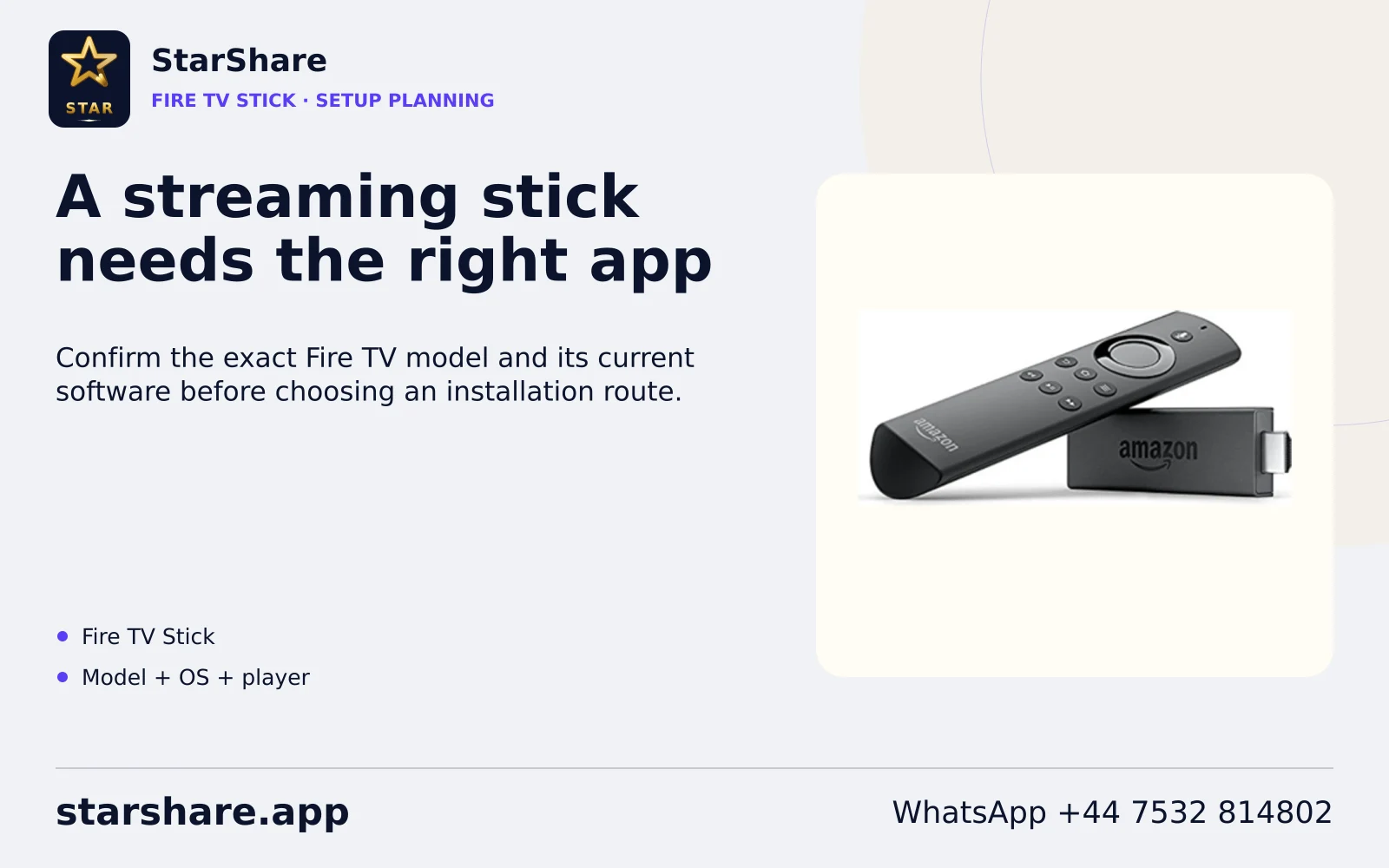
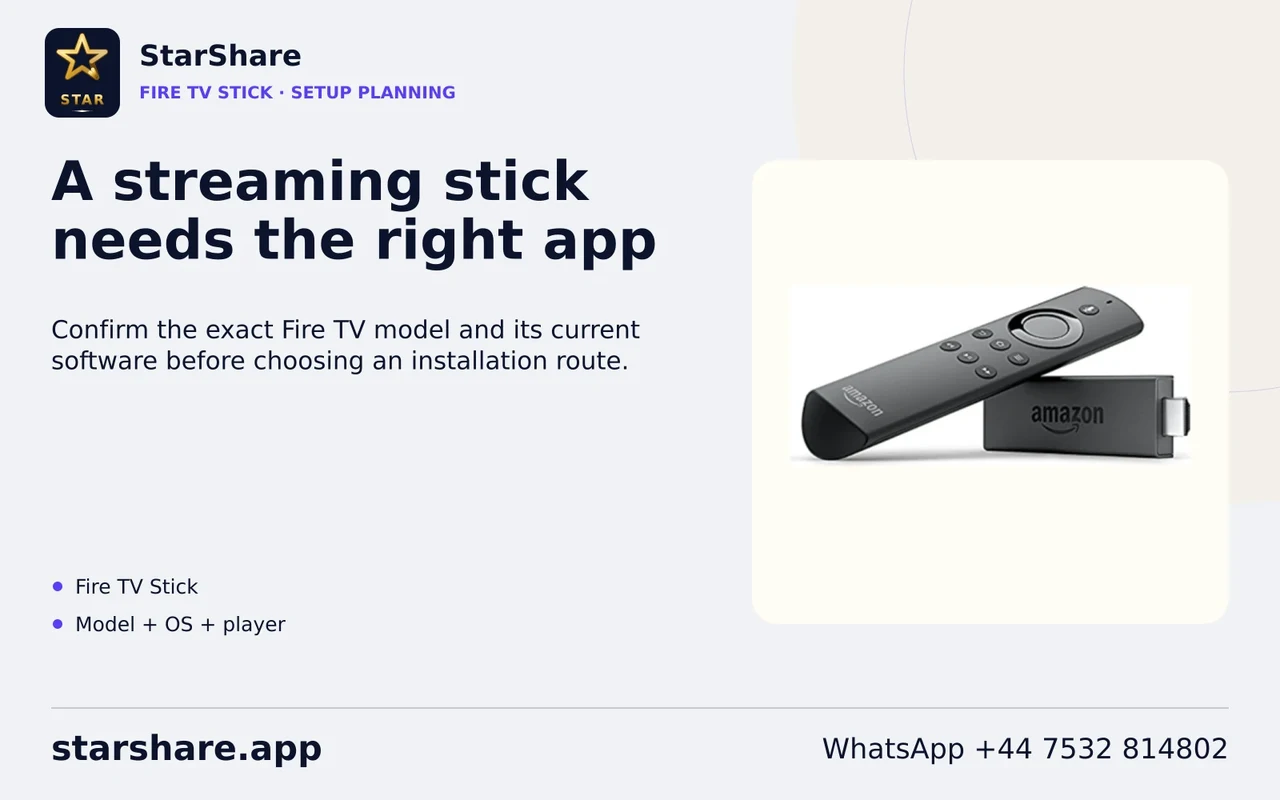
The retained StarShare device artwork makes a useful point about the physical setup. Many sticks are hidden behind the television, with the family recognizing the home screen but forgetting the model. Locate the input that produces that screen. Check the device's settings or label for its full model and software details. A television manufacturer's name says little about an app running on an external HDMI stick. A recent model can also behave differently from an older product with almost the same consumer-facing name.
Use the actual supported app store for that platform. On Google TV, for example, Google's help describes finding and installing apps on the television, with any purchase completed through the applicable store process. That platform instruction does not establish that StarShare has a native Google TV app or that a particular player is supported for an account from this provider. It simply gives the household a reliable way to inspect what is available on its own device. Ask the seller to identify the intended listing and publisher.
Try a few controls before spending a service trial. The app needs to open, let the user move through the setup screen with the ordinary remote and present an account method that can be matched to the intended service. A phone app displayed on a large television can be awkward from the sofa even if it launches. If the viewer cannot reach the account control without borrowing a mouse or phone, decide whether that is a sensible long-term arrangement for the household.
When seeking help, describe the equipment chain in the order it is used. “Samsung television displaying HDMI 2, separate streaming stick, player installed on the stick” is much more precise than saying the app runs on Samsung. The support representative can identify which store, system version and remote behavior are relevant. The family can then judge whether the proposed viewing account has a workable delivery path before its current price even enters the decision.
An older STAR TV interface reference shows how a guide can arrange channels and time columns. Use that kind of screen to identify the task the viewer cares about. Can they reach a familiar station, understand whether the guide time is local and find the programme that is on now? The image cannot tell the reader what channels a new StarShare account will receive today. A programme schedule in an archive is always a snapshot, even when the layout still looks familiar.
Choose one local requirement and one optional interest for the household. The local requirement might be an evening bulletin from a specific U.S. station. Record the call sign or exact broadcaster identity if known, the date of the programme and the local time. Ask the seller which feed it can actually supply at the viewing address and whether the programme and any needed language or caption track are included. The optional interest gives the family a second observation without turning a one-day test into an unwieldy channel count.
If the seller confirms a trial or demonstrated service, compare the actual current entry with the broadcaster's own schedule. A station name attached to the wrong time can send the family looking for an absent programme when the real issue is a guide clock. A guide entry matching the schedule while the picture shows a different region suggests a separate mapping or access issue. Write those observations separately. Changing the account, the app and the device time all at once makes it difficult to discover what helped.
Use visual evidence carefully in a public support question. Crop to the channel label and the affected time window if that is all readers need to understand the problem. Avoid exposing a full account screen, a private login address, household location details or personal identifiers. Another reader can advise that a time-zone setting deserves inspection without seeing any credentials. Only the seller responsible for the actual account can confirm its authorized feed, status and billing arrangement.
A buyer can compare decision structures before a number arrives. Put the full quoted service amount in one row, any mandatory player fee in another and any additional connection charge in a third. Add payment or conversion charges only when they are actually disclosed for the buyer's chosen method. This gives a realistic initial amount. Record recurring items separately from one-time equipment or installation purchases. The seller can then fill in the unknowns without turning an old promotional figure into today's price.
Consider a household planning to remain in a furnished apartment for five months. It asks for a price for a quarter followed by two monthly renewals and a price for a six-month term paid up front. If both options are genuinely offered, compare the total cash each requires, whether the account can continue across renewals and whether the family can use the final month of the longer plan. No price assumption is needed to describe the comparison. The answer depends on the two real offers and the household's dates.
Now consider two family members sharing one television and a smaller bedroom screen. Sometimes the second device is used after the first session ends. Sometimes both would be played at once. Ask how the actual allowance treats those two routines. A family that needs only sequential device switching should not automatically double a pending subscription price. A family that needs concurrent viewing should not assume that installing the same player twice authorizes it. The quote should supply the full charge for the arrangement the family intends.
For an annual proposal, write down what remains unknown even after the total arrives. The app might still be unavailable on the intended device, the local feed could remain unconfirmed or the renewal conditions could be unclear. A price alone cannot settle a buying decision when the service does not yet meet an essential requirement. The household can compare another documented offer while keeping this request open. Doing so does not turn the other seller's figures into evidence about StarShare.
An existing customer has a valuable reference a new shopper lacks. A working viewing account, an original order and an observed expiry can identify what the customer already bought. Save the date on the receipt, the agreed term, the actual start, the remaining time and the merchant shown on the transaction. If the app displays a different date, try to identify whether it is the app's licence expiry or the service account's expiry before requesting an extension.
Suppose a viewer has several months left and a message offers a fresh annual term. Ask whether the proposed purchase will append time to the existing account, replace it, create another account or require a change of app. Keep the original configuration in place until the responsible seller confirms the effect. A new login that produces a usable picture may still leave time stranded on the older account. The customer needs the paid continuity documented, not merely a screen that starts playing again.
Where the household genuinely wants to move an account to a new television, record both the old and new device and the software each uses. Explain whether the old screen will leave the home or remain in use. Ask about the service's device and connection rules and about the independent player's own transfer arrangements. An old screen image is useful for recognizing the previous setup. It cannot establish a current device-transfer policy. Keep those questions with the people responsible for each product.
A customer seeking an account correction should send only the necessary details through the private support path associated with the purchase. State what the order requested, what the device currently shows and the correction being sought. Ask for a clear result and check it afterward. A public complaint can explain a type of discrepancy after personal details have been removed, but a public board cannot look up a private account or restore its remaining time.
One StarShare archive card explicitly draws a prospective reseller's attention to the panel before funding. That is a useful order of work. First identify the operator, account type, expected role and what the purchaser is authorized to sell. Ask whether prospective operators can see a current demonstration of the actions their own role would receive. A picture of a dashboard can illustrate vocabulary. It cannot confirm that a particular buyer will have access to every function pictured in a previous release.
A complete reseller quote needs the stock quantity, total and currency, the applicable deduction for each offered customer term and the conditions that affect the stock. Ask when it becomes usable, whether it expires, who can authorize corrections and how a renewal is distinguished from a new account. Ask about the charging treatment for trial or test access if offered. Without the deduction schedule a pack has no reliable cost per customer activation. Without the price and quantity even the unit cost remains open.
When the operator provides real numbers, test the model with one small mixed order book on paper. Multiply each confirmed customer term by the operator's confirmed debit and add the results. Compare this with the usable balance on the named panel. A schedule for another IPTV seller may deduct one credit per month or a fraction per year. Neither convention becomes StarShare's rule by analogy. Keep every term in its own row and leave any missing debit visibly unresolved.
Separate the different commercial roles. A reseller may be able to create supported accounts for its own customers. A distributor might be seeking authority to supply other resellers. A business asking for a branded app or an event encoder has yet another requirement. A historical tier box does not establish those rights. Ask for explicit scope, responsibilities, territory and permitted claims in the agreement relevant to the proposed business. Do that work before offering a service to customers or accepting a deposit for a product the business cannot yet demonstrate.
Imagine a buyer asks a seller for a current StarShare household quote for one active screen in a U.S. home. The first reply supplies a number with a currency symbol but no period. That leaves open whether the amount is a monthly charge, a full quarter or a fee to activate software. The buyer can answer with a focused question. What exact period or product does this amount purchase, and what full amount will be taken today? There is no need to negotiate price before identifying what is on sale.
A second reply supplies a full term and currency but says only “all devices.” That does not answer whether the player's exact version is supported on the household's model or how many devices may play together. Give the seller the model and store listing already identified. Ask which account method the seller supports on that setup and whether a second screen would change price. If the family needs just one screen, keeping the question narrow should allow a clear usable answer.
A third reply might show a familiar archived box with a previous amount. Ask the seller to state whether it is a current offer for this order, the date through which it applies, the payable currency and any extra charges. A previous retail design can become useful context once the named seller confirms a current offer; on its own it remains an illustration. A fourth reply might identify the current merchant, total, term, start conditions, permitted use and relevant support role. That is a candidate for a real comparison, subject to the household confirming its device and viewing requirements.
These examples are possible reply formats, not claims about messages StarShare has sent. They show how to turn an incomplete response into one better question. A serious existing customer can do that without sharing unnecessary private information. Someone shopping casually can also decide that the effort of resolving the offer exceeds its present value and choose a better-documented option.
An adult child helping a parent has two jobs. The first is to make the ordinary viewing routine work. The second is to make sure the parent or authorized purchaser can recover the setup later. Have the regular viewer choose the programme, hold the remote and reach the relevant channel. Observe where they hesitate. It might be difficult to distinguish the television's home screen from the external player's screen or to locate the exit button after opening a guide.
Leave one short printed note alongside the remote, with only the familiar app name, input and route to favorites. The private purchase record belongs somewhere else. It should say who sold the service, who owns the app licence, the date through which any confirmed term runs and how to contact the responsible party. If the helper used a personal store account to buy an app, resolve ownership and recovery before leaving. A parent should not have to wait for a family visit to discover how to recover a paid viewing setup.
A proposed StarShare order in this situation must account for the cost of help as well as the term. A service that requires laborious text entry every few days can be poor value for someone who struggles with a remote, even if its eventual quoted price looks low. A player with larger guide text can be attractive if it is compatible and a trial establishes that it really works for this viewer. None of those judgments can be reached from the gold star mark on the page. The regular viewer and a functioning supported setup provide the evidence.
A manager asking about viewing in a café, gym, waiting area or hotel is making a different request from a household buying a personal account. The manager needs authorization for the actual setting, including the intended audience, location and use. If the request concerns a particular event, programme, channel or recurring public exhibition, describe it precisely to the responsible rights or distribution parties. The existence of a consumer card or an earlier reseller tier does not establish that the named seller can authorize that use.
Build a business enquiry with the location, number of screens, whether several programmes will play at once, audience access and the exact content requirement. Ask who controls the relevant rights, what contract would cover the proposed use, and which party takes responsibility for support. The business may also need separate hardware, network installation or management. List those requirements independently. A general-purpose cloud live-video product hired to distribute the business's own authorized event is a different product again from a catalogue of supplied consumer channels.
A buyer who receives only a household amount in response should ask whether the responder understood the commercial use. Compare the proposed role, permission and support obligations before considering price. An apparent bargain that does not cover the intended use is not a usable offer. For unresolved StarShare terms, do not convert a household quote into a business estimate by counting television screens and multiplying. There is no evidence that this arithmetic corresponds to the authorization or product the business actually needs.
Choose one precise question for the public board. A reader can help identify whether a certain player screen belongs to the app itself, describe how a device's clock is normally checked or explain the difference between guide times and programme pictures. A reader cannot confirm the terms of your unseen private quote, verify your remaining balance or promise entitlement to a station in your home. Frame the question so a public answer can genuinely help without asking anybody to inspect private data.
For a device question, give the model, operating system, app publisher if known and the last action that worked. For a guide question, name the broadcaster, local time and dated symptom. For a subscription question, it may be enough to say that the service expiry and app expiry differ, without naming the full order or sharing a receipt. A simple crop of the relevant control can make a thread useful. Check the edges of the image for account names, identifiers and preview links before uploading it.
Return to the thread after a supported fix. If changing the television's clock solved a guide problem, say exactly which clock was adjusted and whether the picture itself had ever failed. If the operator instead corrected the account, explain the class of correction without presenting the private exchange. If the outcome remains uncertain because a current StarShare quote never arrived, that is a legitimate outcome too. Leaving the uncertainty visible helps the next shopper avoid mistaking discussion of an old offer for proof that it is currently available.
Today's open price field can change. The strongest update would identify a current page or written offer from the exact provider for a particular product, market, term, currency and amount. Keep the URL or source record and the date checked. For a reseller pack, include both the full purchase amount and the quantity. For the underlying activation rules, record the supported terms separately. The editor or buyer can then update the relevant question without rebuilding every other claim around one new number.
For example, a confirmed annual household amount would allow a like-for-like annual price comparison in the same currency once the service and market match the other offer. It would say nothing by itself about the monthly amount, any trial, the customer-month deduction or the number of screens. A confirmed screenshot of a current reseller panel could improve understanding of available controls while leaving its pack pricing unresolved. Add only what the new evidence actually answers. That habit matters for independent buyers as much as for the store.
Past evidence should retain its old date. Replacing an old image of a device with a new one does not refresh any printed historical price. Reposting a third-party message today does not change the date on which its figure was offered. A buyer considering a renewal needs the terms applicable to this order and a record of any earlier promise that still governs the existing account. Keeping both dates visible lets a real discrepancy be identified without inventing one.
The first is a documented purchase. The responsible seller supplies current terms, the household identifies the supported player and device, the proposed use fits the market and screen allowance, and the total is acceptable. Keep the quote, receipt and end date together. Confirm that the delivered account actually shows the term bought and that the regular viewer can reach the requested programme. If another party supplies the app licence, keep that receipt separately.
The second is a deliberate wait. The buyer may know the price but still need an answer about a local feed, or know the device works but lack a current seller identity and payable total. Write down the single unanswered point and the party who could answer it. The buyer can return to the decision when new information appears without repeating the entire device setup exercise. An existing working account with time remaining can often continue to serve its original purpose under its actual terms while its owner checks a proposed renewal.
The third is a different documented provider or purchase route. A family may require a local language track, a business may require commercial display rights, or a reseller may require an explicit debit schedule before it can price customer service responsibly. Those are substantive requirements. An independent profile should respect the possibility that a familiar brand cannot presently meet them on the evidence available. Leaving StarShare's current total open is the accurate buying advice until the exact seller supplies a figure and terms the reader can use.
If a later reply settles just one point, keep using the rest of the work already done. A confirmed player publisher can settle the installation route while pricing stays open. A written annual total can establish the cost while a particular regional feed remains unconfirmed. The buyer does not have to choose between declaring the whole product verified and discarding everything learned. A short record containing the question, the source, its date and the exact answer is enough to keep those distinctions straight when another similar name or attractive product card enters the conversation.
Named StarShare domain · Retained StarShare artwork showing its reseller conversation guide · Retained StarShare device model reference · Earlier StarShare interface notes from the IPTV forum · Google TV guidance on finding and installing apps.
Ask for a dated answer with the payable currency, term length, seller name and current service address. Keep the reference with the order so a later change can be checked.
Choose a matchup to see the actual currency, term and outcome.
Open the caption on a website-sourced image to see its original. The remaining captions identify material supplied with the provider archive.