
provider
Team 8K
Use the country reference for named feeds and the reseller page for the published credit rule.
team8k.tv · Check exact market
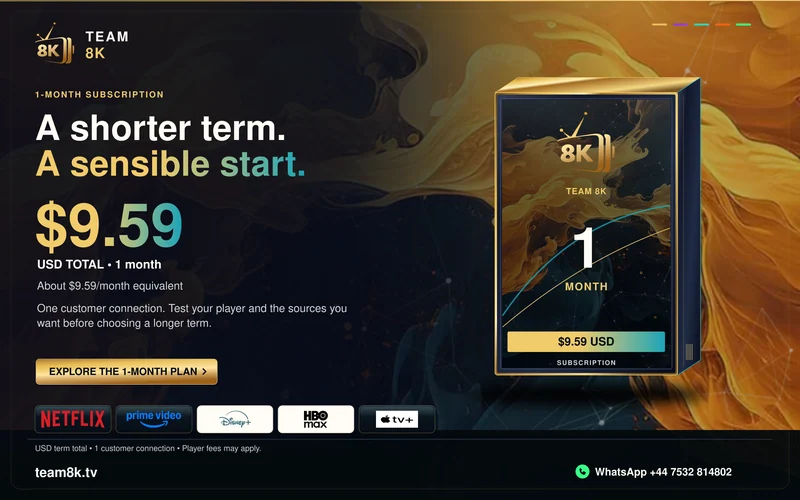
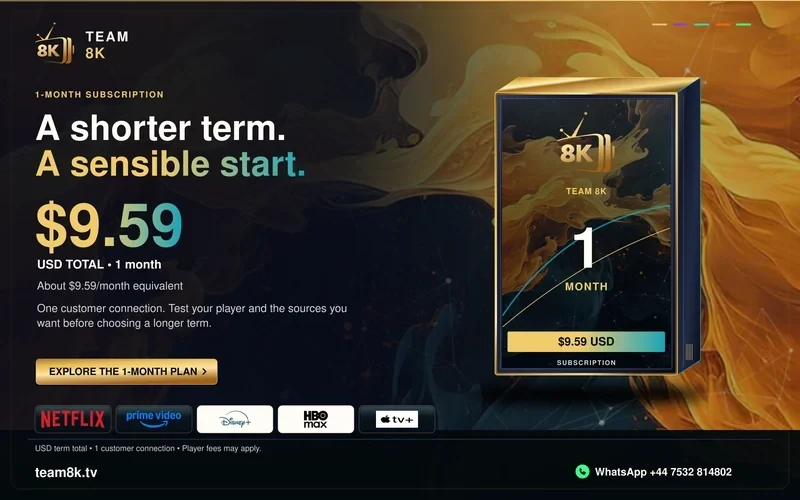
Open the official Team 8K websiteThe 1 month plan is listed at $9.59 USD. The operator also lists 4 reseller pack sizes.

team8k.tv
The 1 month plan is listed at $9.59 USD. The operator also lists 4 reseller pack sizes.
The 1 month plan is listed at $9.59 USD. The operator also lists 4 reseller pack sizes.
Use the country reference for named feeds and the reseller page for the published credit rule.
team8k.tv · Check exact market
Open the official Team 8K websiteTeam 8K maintains the site at team8k.tv. Check who issues the invoice and who replaces the access if the app or TV changes. The buyer needs both answers before paying for a long term.
Document review · November 19, 2026. Playback performance, service rights and ZIP-level access require separate evidence.
The 1 month plan is listed at $9.59 USD. The operator also lists 4 reseller pack sizes.

team8k.tv
The most important word in Team 8K’s pricing material is “one.” Its standard viewing account allows one active connection. A household with three devices that takes turns between them may be perfectly comfortable with that arrangement. Two people who want to watch different things in different rooms on a Saturday evening have a different shopping problem. The four prices on this page settle the term question for a standard account. Ask Team 8K to price any wider allowance against the actual household before committing money.
Start with a little diary. On a normal evening, who turns on a screen first, who joins them, and who wants a different programme at the same time? A second television gathering dust in a spare room contributes nothing to that count. A phone playing in the kitchen while the main set stays on does. The answer matters more than a list of devices on which a player can be installed. It also catches the common case of a household that calls itself single-screen because it owns one television.
Team 8K describes a one-day trial. Install the intended player before asking when the trial can begin. Ring-fence the evening when two people are actually home, pick a programme the household regularly watches, and agree which screen gets the trial. A successful first picture answers whether that particular setup worked on that occasion. The reasons to take a full term come later, after testing whether the guide, sound, subtitles and account rules fit ordinary use.
The calculations below use Team 8K’s publicly listed U.S. dollar totals checked on November 19, 2026. They describe a choice someone can make before purchase. There is no independent playback benchmark or guarantee attached to them.
| Term on the Team 8K site | Full published total | Monthly equivalent | Standard active connection |
|---|---|---|---|
| 1 month | $9.59 | $9.59 | 1 |
| 3 months | $23.99 | About $8.00 | 1 |
| 6 months | $39.99 | About $6.67 | 1 |
| 12 months | $54.99 | About $4.58 | 1 |
At the one-year price the arithmetic starts with $54.99 divided by twelve. The monthly equivalent rounds to $4.58. A person paying for a full year still needs the $54.99 on the order date, plus any separately disclosed charge. Enter the total in the household budget against the payment date. Someone with $20 set aside for the first month has enough to investigate the one-month listing, even though the lowest monthly equivalent appears on a different card.
Compare adjacent terms in dollars before calculating percentages. Moving from one month to three adds $14.40 to today’s bill and buys two further months. Moving from three months to six adds $16.00 for three more months. Moving from six to twelve adds $15.00 for six more months. That last step explains why the annual card draws attention. The next question is what could change during those additional six months. A move, a replaced television or another person joining the household can change the answer.
Rounding belongs at the end of the calculation. Six lots of the displayed $6.67 equivalent come to $40.02, although the seller lists $39.99. Entering six rounded instalments creates a reconciliation problem where none existed. The same applies when sharing household costs. Two people can agree how to divide a single $54.99 payment between them, but the arrangement does not create two simultaneous connections.
Ask for the final payable figure if checkout adds a separate player licence or a payment-method charge. Record who invoices each part. An app bought through a television store may use a different receipt and renewal date from the viewing account. A single line marked “TV” on the household budget obscures that difference until a family member tries to renew the wrong thing.
Work backwards from a date you know. Someone working away from home for three months could pay $23.99 for the whole assignment. Three separate one-month purchases at today’s rates would total $28.77. The saving for committing at the start is $4.78. If the assignment ends after four weeks, the buyer who chose the three-month option has paid $14.40 more than the monthly price for time that may go unused. Both figures help a buyer think clearly about an uncertain end date.
Six planned months make the comparison less obvious. Two three-month purchases at the current figure add up to $47.98. A six-month purchase is $39.99. The extra $7.99 buys a decision point after the first quarter if the price of the second quarter holds. That can be worth keeping when the broadband or television contract is about to change. If the household already knows it can use the proposed setup throughout the term, fewer payment dates and the lower six-month total point the other way.
For seven months on the same terms, a six-month purchase followed by one monthly purchase would add to $49.58. The annual price is $5.41 higher. This example assumes Team 8K permits that renewal sequence, that the second charge stays the same and that each term begins at the appropriate expiry. The example gives you a question worth asking before payment. If support can only describe the renewal available today, write down that limitation and budget accordingly.
For a full year, paying the monthly rate twelve times would give $115.08 at unchanged prices. Four quarters would cost $95.96, and two six-month purchases would cost $79.98. Someone who will actually use all twelve months can read what each extra decision point costs. Someone who expects to watch for only half that time should cross out all three twelve-month totals and begin with the shorter horizon.
There is a simple way to avoid clever calculations running the household. Choose an earliest likely end date and a latest likely end date. Work out the actual payable total for each. If the same term is sensible at both ends, the choice is relatively easy. When the decisions differ, name the event that would settle the uncertainty. A delivery date for the new TV might arrive tomorrow. It can be cheaper to wait one day for that answer than to buy an annual term tonight.
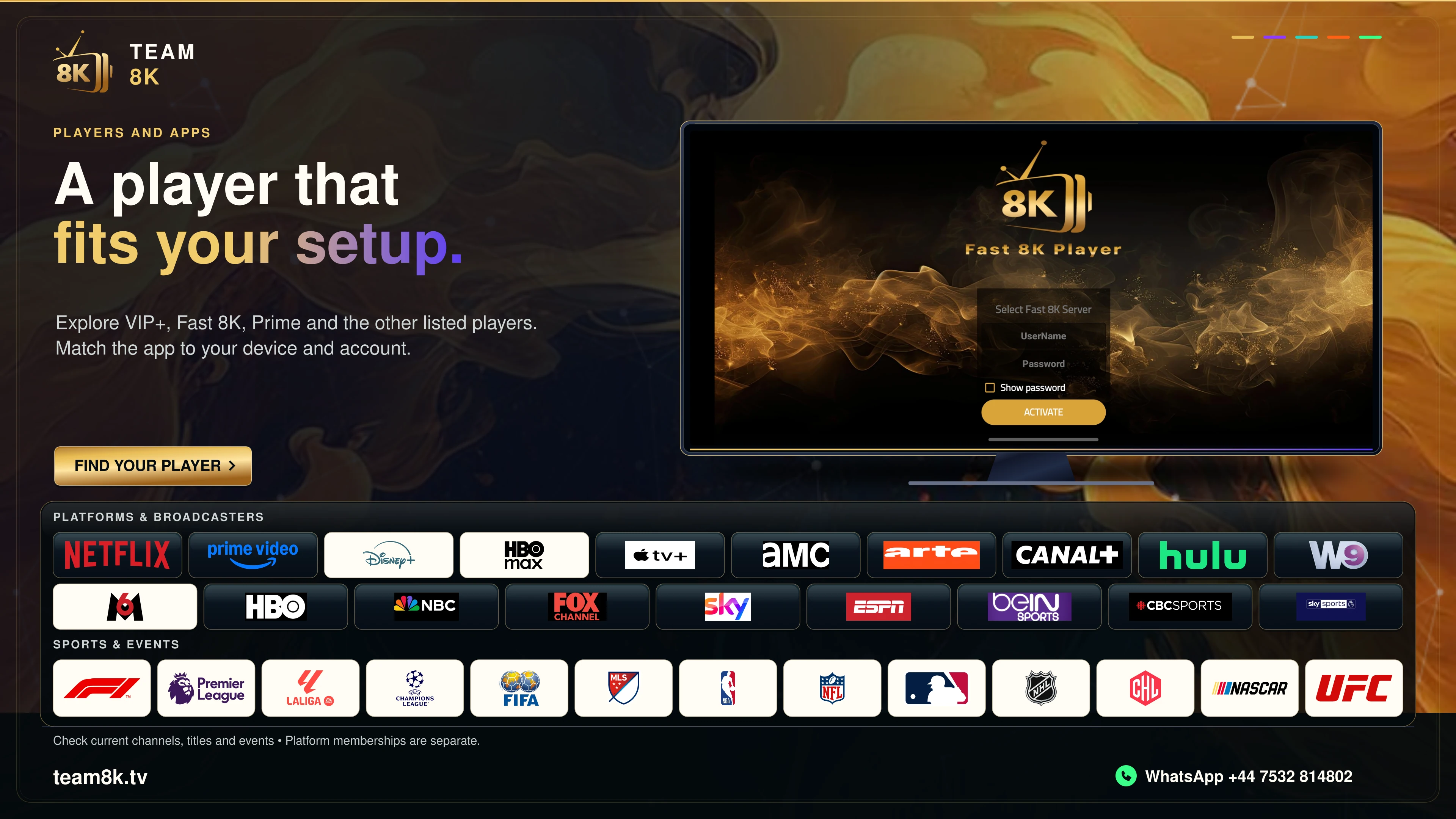
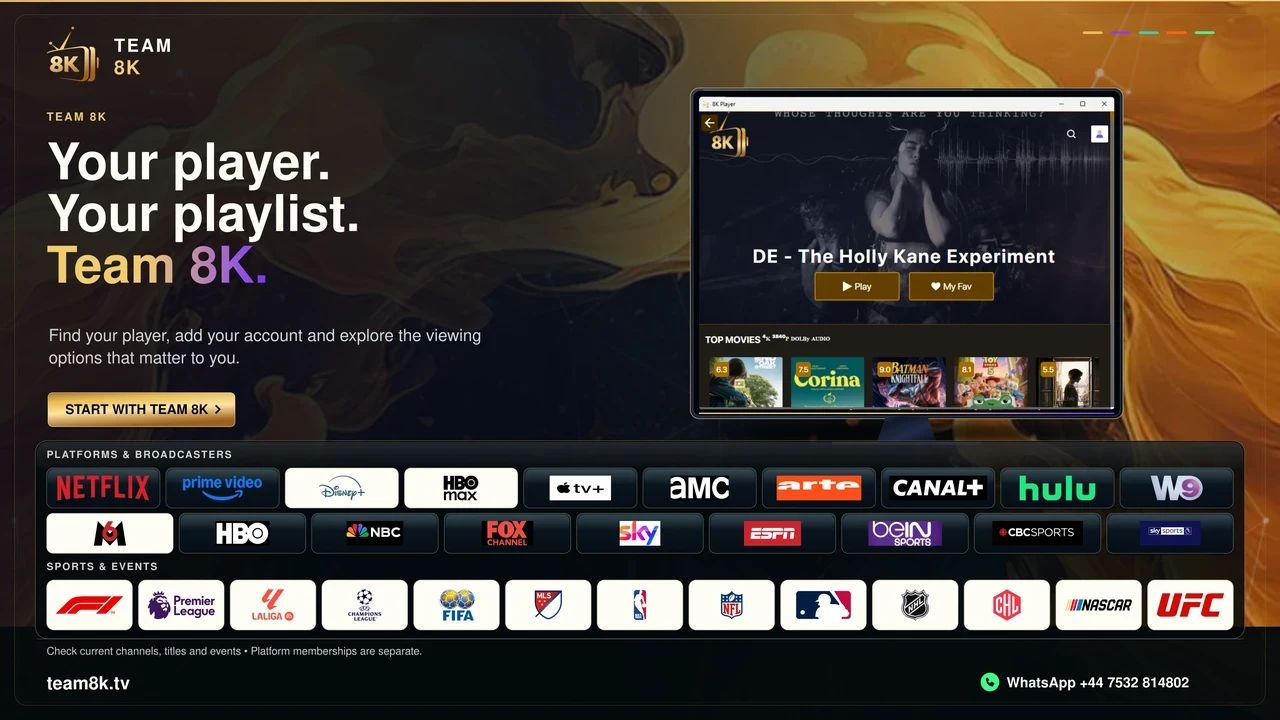
Team 8K publishes a first-setup guide specifically for a Fire TV Stick. Before opening an app store, use the device’s settings to identify the exact model, system and installed software. The stick connected to the television may be several generations newer than the television itself. A Fire-branded product label also spans more than one operating-system route. Give the seller enough detail to identify an appropriate player before following installation advice written for a different model.
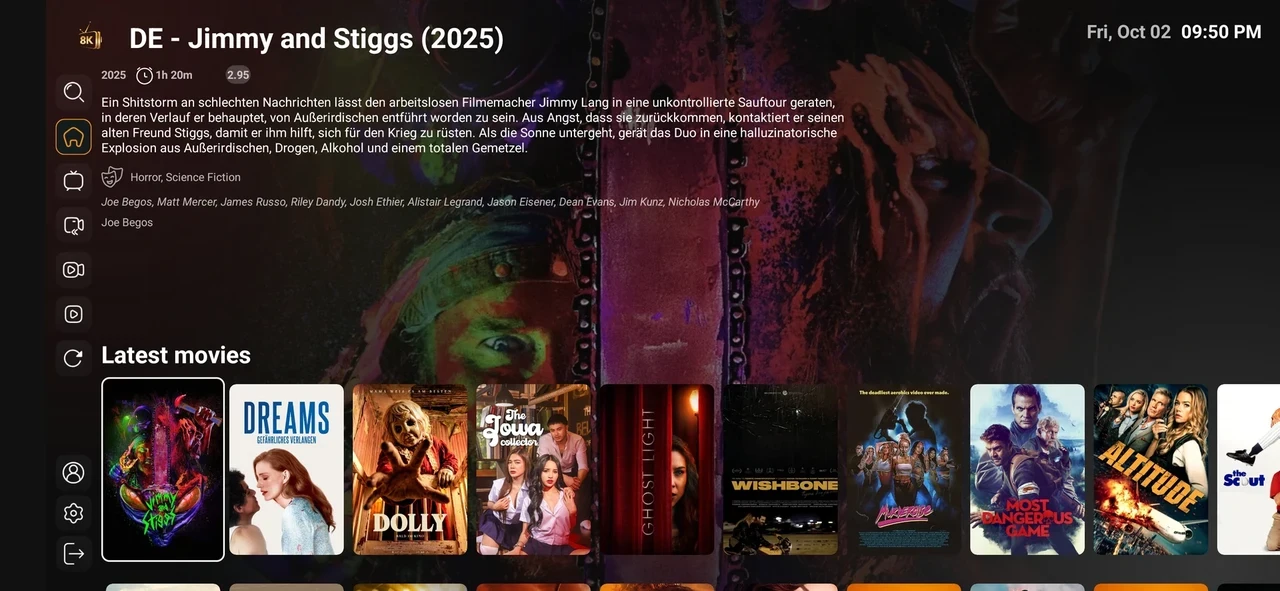
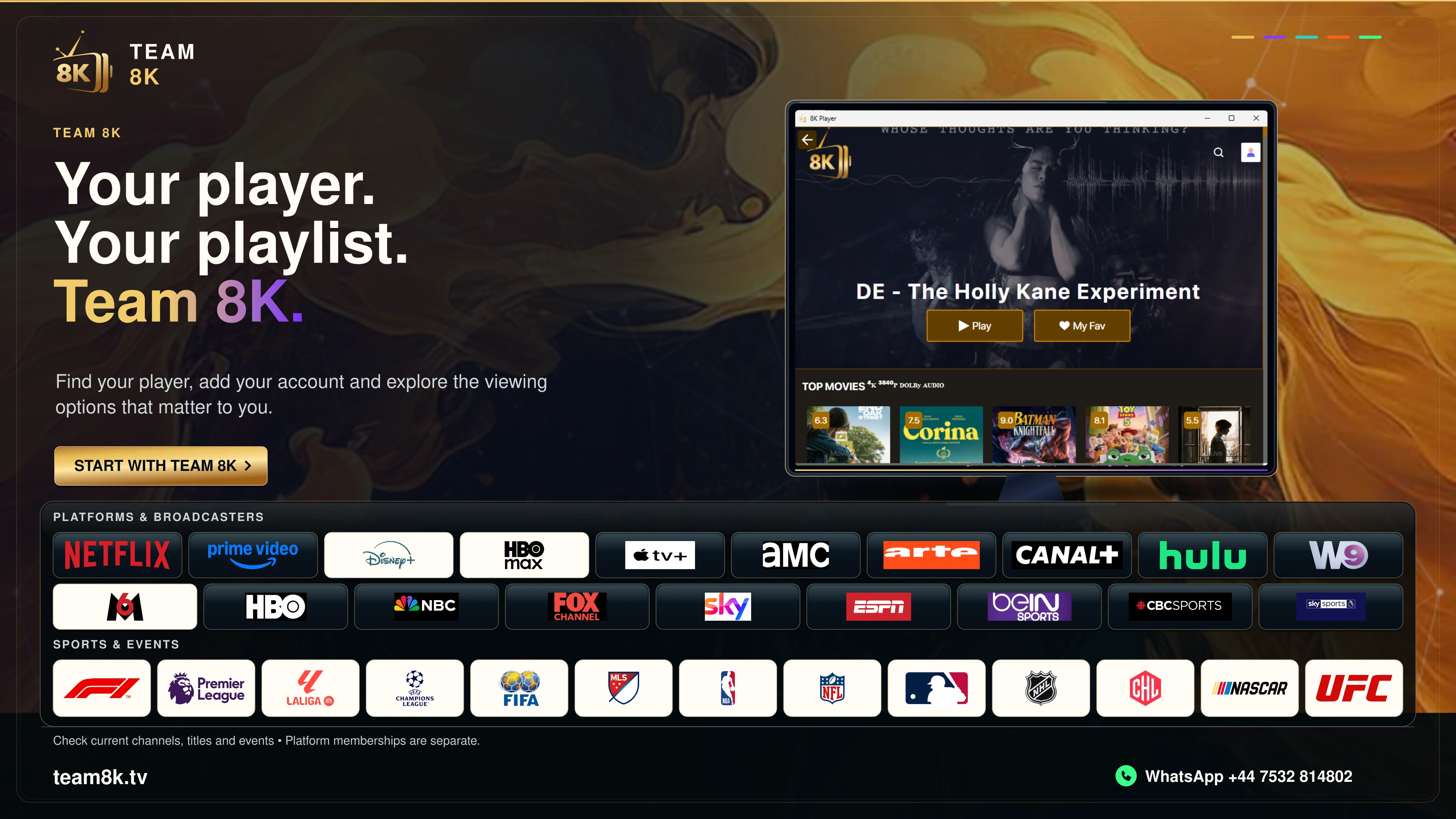
Start with one player. Record its name and developer as displayed on that device, then open its account screen and note the kind of input it asks for. Some players ask for an account supplied by the seller. Others need a separate player licence or device activation before account entry. Ask which applies to the proposed setup. Purchasing an app before hearing the answer can turn a low-cost trial into a paid software experiment that still says nothing about the viewing service.
Pick one readily identifiable programme for the first check. An evening newscast with an on-screen station name is a stronger choice than a clip whose origin nobody can identify. Use the normal household connection and the HDMI input people will actually use. Confirm that picture and sound start. Leave the player normally, switch the set to its usual other input, and return. These actions reproduce the ordinary interruption that leaves families wondering why an otherwise working player appears to have vanished.
Next hand the remote to the person who did not set the account up. Ask them to find that same station from the home screen. Watch where they hesitate. The difficulty might be distinguishing the television’s launcher from the stick’s launcher, recognizing the icon of the chosen player or finding the channel guide once inside. The solution can be a renamed HDMI input or a written note beside the remote. Paying for a longer subscription will not simplify the remote sequence.
Finally make the first support note. A useful note fits on a few lines and includes model, system, app, time, expected result and observed result. “I can open the named player on the living-room stick. The guide shows tonight’s bulletin but selecting it returns to the guide” gives support a place to begin. Keep account passwords, playlist addresses and personal information out of that note, especially if you later share it in the forum.
A guide is a schedule linked to station entries. Video and schedule information can disagree. Team 8K publishes a second Fire TV guide dealing with programme times and EPG data. Before assuming the whole subscription is wrong, choose one channel whose schedule you can confirm with the broadcaster. Record what the broadcaster says is airing, what the Team 8K player says is airing and what actually appears on the screen. Include date and local time.
If the picture agrees with the broadcaster but the guide labels the previous show, the account has delivered more information than a simple “failed” rating suggests. Check the device clock and time zone. Compare a second station from the same area. Look for a uniform displacement across the whole guide or a single misplaced row. Those observations give support two different leads. A uniform offset may involve time handling. One station carrying another station’s description suggests the mapping is worth examining.
A time-zone label on a broadcaster’s national schedule can be easy to miss. A household in Arizona, for example, should compare the actual local airing with a schedule for the correct station, date and feed. Reading the large network logo alone leaves out the part that fixes the clock. A reader who travels between a home and a relative’s house should record where the comparison was made. Team 8K’s country material is introductory, and the account still needs confirmation for the selected viewing location.
Try a future entry as well as the programme on now. Ask the regular viewer to find tomorrow’s familiar show. A guide that covers only the current evening might be fine for somebody who channel-surfs. A viewer who uses the guide to plan the week has a practical requirement that the headline subscription total cannot answer. Measure whether listings are present on the stations you care about, rather than counting a large number of unrelated guide rows.
Captions and audio deserve the same precision. Open a familiar show known to carry the relevant track on the feed under discussion. Record the options actually offered by the player, choose the desired one and see whether the choice remains after changing away and back. A prominent caption icon alone gives little information about the availability, readability or timing of the track that a particular viewer needs.
A standard account with one connection can suit people who watch together. Trouble begins when the household imagines that all devices used at one address count as one active screen. Team 8K’s pricing page describes stopping one session before testing another. Ask what counts as a stopped session in the player you plan to use. Leaving the picture paused or switching the television to another input may leave the player in a different state from choosing its ordinary exit control.
A fair switching test starts by recording the first device and its playback state. Stop the programme, leave the player, and allow the ordinary transition the seller recommends. Open the second approved device with the relevant account and see whether it can start the selected station. If a connection-limit message appears, record its text and time. Repeatedly signing in from several devices creates extra uncertainty about which session the service is counting.
There is no need to exceed the allowance to understand it. If two people need simultaneous viewing, describe that use in the enquiry. Include whether the screens share a home network and whether either must work at another address. A seller might propose another line or a separately priced arrangement. Ask for the full total, allowed viewing locations, applicable device rules and how each line renews. A quote that names everything gives the buyer an actual alternative to evaluate.
Consider a parent who watches at home and a student who takes a device to another city. That situation raises both concurrency and location questions. Even if the parent turns the television off first, permission to use the account at the student’s address remains a separate matter. Get the proposed arrangement from the operator in writing. A successful login during a visit does not establish that the terms permit repeated use at that location.
Where a trial uses a special allowance, record the scope before relying on the result. A technically successful simultaneous test on a demonstration account tells you little about the one-connection product in the pricing table. The seller can settle the purchase question by identifying the allowance that will be attached to the actual paid account. Save that answer with the selected term and receipt.
Someone who purchased a large television often wants a quick verdict about picture quality. On Team 8K, a service name alone cannot identify the native detail, bitrate or frame rate of the individual programme reaching your screen. A live local bulletin, a studio programme and a sports broadcast have different production chains. The television may also scale the incoming signal. A useful evaluation begins with the programme, input and device settings that will matter in your home.
Sit at the normal viewing distance. Choose a scene with small text the household regularly reads, such as a news ticker or standings graphic. Observe whether the text remains legible during motion. Try a familiar conversation and see whether voices line up with faces. Measure a problem by describing its effect. “The ticker is legible while stationary but breaks up when the camera pans” will help another reader far more than an unsupported guess about a number of pixels.
Keep the television’s picture mode and processing settings fixed while comparing behaviours. If a different HDMI input uses another picture preset, note it before comparing the two. A player that appears sharper might be using a more aggressive television setting. Restrict any conclusion to what was actually visible during the trial. An especially good picture on one source says little about a second source that comes from a different feed.
When motion stutters, note whether the symptom recurs at a predictable point or appears after a device has been playing for some time. Try a second permitted item with the same player while leaving the rest of the setup alone. If both suffer at the same moment, check whether something else in the home is heavily using the network. If one station alone is affected and the player menus remain responsive, give the seller the station, date and local time so they can identify the relevant feed.
There is also a cost question. A family may already own a perfectly usable display, stick, remote and internet connection. Before replacing equipment to pursue a resolution claim, ask what evidence links the visible problem to that piece of equipment. If the chosen station is supplied at a lower resolution, replacing the television may leave the picture substantially the same. A trial can save the cost of hardware the buyer had no reason to purchase.
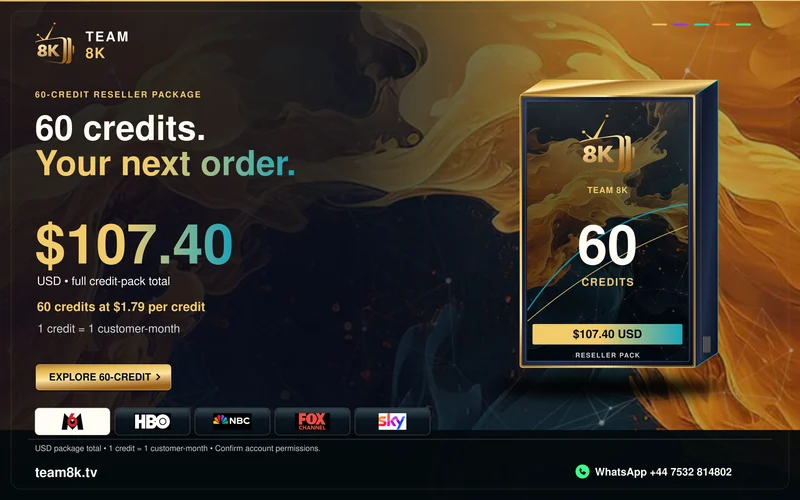
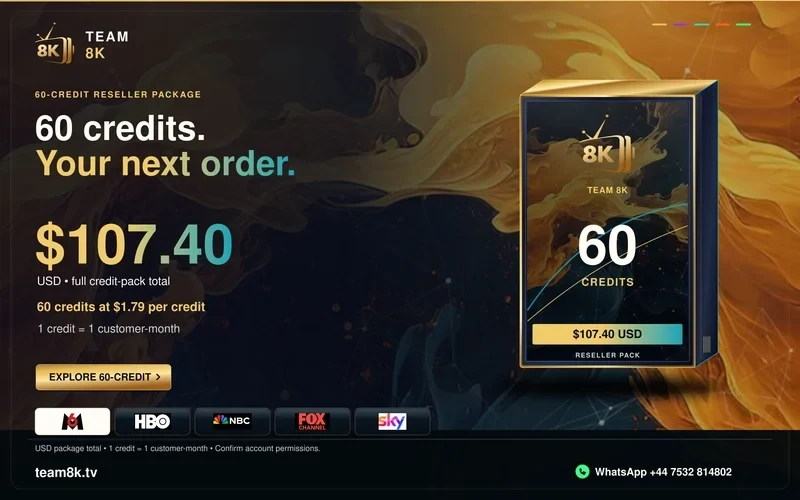
Team 8K prices four reseller packs in dollars. The standard rule is one credit per customer month on a standard line. A one-month term consumes one credit. A three-month term consumes three, six months consume six, and twelve months consume twelve. That rule makes the pack meaningful. A ticket labelled sixty credits is not an offer for sixty annual accounts. For the standard schedule it can cover five annual terms, provided all sixty credits are available for that purpose.
| Pack | Purchase total | Cost per credit | Annual term at that pack rate |
|---|---|---|---|
| 60 | $107.40 | $1.79 | $21.48 |
| 120 | $202.80 | $1.69 | $20.28 |
| 300 | $477.00 | $1.59 | $19.08 |
| 600 | $894.00 | $1.49 | $17.88 |
Those annual figures are direct credit allocations for a standard term. Even someone looking only at direct inventory has two different questions. How much credit cost belongs to the line I just issued, and how much cash do I need to open the panel or replenish stock? Issuing one annual term from the 60-credit pack allocates $21.48 against that term. Buying that pack requires the full $107.40. The remaining 48 credits are inventory subject to the seller’s conditions.
Start a pack enquiry with the quantity you actually expect to issue and the quantities already promised to existing customers. Suppose three households need new annual lines and four existing households are due for three months each. The new lines need 36 credits. The renewals need 12. A total of 48 would leave 12 from the sixty-credit pack. That remaining balance happens to match one further standard annual term. Whether to commit it depends on what still must renew before new stock is available.
A pack of 120 costs $202.80, while two packs of 60 at the current listed rates total $214.80. An operator certain to consume the full balance would spend $12 less on the single 120 pack, assuming both purchase methods are available on identical terms. Buying 60 first makes $95.40 less cash leave the account on day one. A reseller expecting to buy the second pack only if customers renew may value that difference more than the $12 full-cycle saving.
The same thinking applies at the top end. Two 300-credit packs total $954, against $894 for one 600-credit pack. That $60 difference matters only once there is evidence for comparable use of all 600 credits under the same rules. Ask when unused credits expire, whether one package can follow another on the same panel, how a top-up is acknowledged and what happens to an already active customer if an operator changes terms.
A reseller can have money in the bank and still miss a renewal because the panel balance and the calendar were never reconciled. Build a renewal book with one row per promised action. Use a private internal customer reference, the permitted number of connections, current expiry, intended new term, observed debit, and the operator responsible for supplying the account. Leave passwords and playable playlist addresses outside it. People who schedule renewals rarely need to see login secrets.
Imagine a sixty-credit opening balance on Monday. Two standard six-month renewals use twelve credits, leaving 48. On Tuesday an annual line uses twelve more, leaving 36. Three standard quarter renewals on Wednesday consume nine, leaving 27. A prospective customer asking about a year on Thursday has not yet used anything. Write the enquiry in a separate column so that the available balance remains 27 until the actual panel action is confirmed.
Friday brings two more annual renewals already promised to existing buyers. They would use 24 credits and leave three. If Thursday’s enquiry converts before those renewals and consumes twelve, the available balance would fall to fifteen, leaving a nine-credit shortage against Friday’s commitments. The arithmetic is easy. The difference between an enquiry, a confirmed sale and a promised renewal is the detail worth protecting. Treating all three events as independent opportunities makes the same credits look available twice.
Write down the balance before and after each completed panel operation. A six-credit change against a six-month standard order is straightforward. A different figure is a reason to pause and ask the operator to identify the account configuration and term that were actually applied. Keep the customer’s promised access and any necessary correction together in a private support record. Do not correct an uncertain deduction by immediately repeating an activation and hoping the second action comes out right.
If a top-up is due, allow for the seller’s confirmation process in the schedule. A bank acknowledgment, an operator invoice and a panel balance update are different events. A reseller who promises instant activation on the strength of an unconfirmed top-up has introduced a deadline the published price table never offered. Quote the customer a time only when someone with responsibility for provisioning can support it.
A seller talking about Team 8K through a public referral may be a distributor, an independent reseller or the direct point of contact for a particular account. Ask who issues the account, who operates the panel and who handles an error that staff cannot reverse. Write those answers against the specific order. A public panel screenshot can show the shape of an interface while revealing little about the permissions granted to a new applicant.
The first permissions question is about customer actions. Can the proposed reseller account create a trial, convert it to paid access, extend a running line and correct an incorrectly chosen term? Which action costs credits and at what point? The standard published rule supports an estimate for a standard issuance. Special configurations and discretionary corrections need written confirmation. Ask whether an action can be previewed before it takes effect and what record the panel produces afterward.
The second question is about cooperation. A reseller who is allowed to manage individual customers has no automatic reason to assume the account can create another reseller, transfer credit across panels or sell into a particular territory. Team 8K has separate wholesale and distributor enquiry routes. Use the wholesale conversation for the amount to buy and how it is allocated. Use the distributor conversation for the ongoing authority and support duties of the proposed relationship.
The third question is about a customer leaving. Ask who can disable or change access, how an unspent credit balance is handled if the reseller stops trading, and who handles support for customers with time remaining on their paid terms. Bring one real example with the dates and customer details removed. A provider who answers how to resolve a standard three-month line with ten days remaining has supplied more useful information than a general promise about “full access.”
Keep the business agreement, package invoice and customer promise as three separate records. The agreement sets out authority and responsibilities. The invoice records what the reseller purchased. The customer promise states which service term, account allowance and support were sold. When a dispute arises, those records answer different questions. A screenshot of a positive credit balance answers only how much stock appeared in the panel when the picture was taken.
Give the first message a narrow job. Choose whether you need help obtaining the player, signing in after installing it, finding an entry in the guide, starting a known channel or confirming a bill. Include the apparatus nearest the problem. A Fire TV sign-in issue needs the stick model, player name and exact error stage. A missing local programme needs the station, viewing area, date and local time. A billing question needs the order reference through the named seller’s private channel.
Consider how two messages describe the same evening. “Nothing works, send another account” gives the recipient almost no evidence. “The player opens and other permitted stations play. The local evening bulletin returns to the guide from the living-room stick at 6:10 Eastern” tells support where to look. Both can be written by an ordinary viewer. The second message avoids a needless account replacement that might erase working settings without fixing the station.
Keep a concise private chronology if more than one person contacts support. Record the time, contact route, proposed change, person who will act and what you should check next. If a replacement login is issued through a private channel, keep it away from the public description. The person following up tomorrow needs to know the account was replaced and whether the issue persisted. They do not need a copy of yesterday’s password in the general discussion thread.
When a reply proposes clearing the player or restoring the device, ask what information will be lost first. A factory reset can remove installed apps, accessibility settings, remote pairing and household preferences. A guide refresh or the selected player’s normal restart may be enough for the specific symptom. Make a change only after understanding how to return to the previously working arrangement.
Close the thread with the observation that settled it. A genuinely useful conclusion might read “The seller corrected the guide entry; the same station and time were checked on Saturday.” If the issue remains open, state that precisely. It allows another buyer to understand which parts of the setup worked and which question still needed help. It also produces a richer forum than a series of unqualified claims about an entire service.
A one-year term can last longer than the equipment on which the buyer first tried it. Ask Team 8K what to do if the television or stick changes, whether a player licence is tied to the original hardware and what account details must be available for a transfer. The seller may handle the viewing account while the application publisher handles the software licence. Keep separate records so that a legitimate licence on the old device does not get mistaken for proof that the subscription disappeared.
For a planned household move, ask about the destination before choosing the longest term. A named network may appear in two cities under different local stations. A station that supplied the old address may not be the one that carries the desired local news at the new address. Give the seller the relevant ZIP or general viewing area and the exact station or programme. A general U.S. coverage statement cannot identify the local schedule your household expects.
For temporary travel, describe the destination, duration and whether anyone at home intends to use the account at the same time. A one-connection account, a household-only restriction and an application tied to one device address three different considerations. Neither testing quietly on another network nor assuming a familiar logo settles permission. Getting the practical rule ahead of the journey avoids asking for help from a hotel room on a poor connection.
If you are giving the stick to a relative, remove private account information from the device using the player’s documented account removal or sign-out procedure. Agree who owns the viewing account and who has the right to move or cancel it. An old receiver and a subscription are often handed over together informally, and the paperwork can remain attached to someone who no longer has the device. A short written handover saves time when the next renewal comes around.
Bring the decision back to the account you will actually order. Write the provider domain, term, total, number of permitted active connections and the confirmation date. Add the name of the installed player, any separate fee, the support route and the address or market that the seller checked. Three trial observations are enough if they cover the household’s decisive needs. “Our local bulletin appeared under the expected station name, the guide time matched, and the regular viewer could reach captions with the supplied remote” tells another family member why the choice makes sense.
Give each unanswered requirement an owner. The provider can answer the scope of the viewing account. The app publisher can answer a separate licence or transfer question. The person who controls household spending can decide whether $54.99 is comfortable this week. The viewer who relies on captions can say whether they are readable from their own chair. Buying a longer subscription because nobody knows who should answer one remaining question rarely ends well.
A trial can yield a perfectly reasonable decision to wait. A family moving in a fortnight, a reseller awaiting permission for a second territory and a buyer who cannot yet operate the player independently each need a different piece of information. Keep the work already done. Record the term price and date beside the unresolved condition and reopen the decision when somebody answers it. There is no need to repeat tests unrelated to the open question.
When all conditions line up, use Team 8K’s current offer page, confirm the total and keep the receipt. Check the resulting expiry on the actual account while the order record is still to hand. Renew only after checking the next quoted amount and how early renewal handles existing days. A household that performs these small checks once has a decision it can explain at the next move, upgrade or renewal. A reseller that does the same has an account it can support without guessing what it promised.
A worked order is easier to audit if the family follows one term all the way through. Take the three-month standard listing at $23.99. An interested household first identifies its device, confirms the intended viewing address with the operator, installs the agreed player and checks its familiar programme within the permitted trial. At this point the household has information and a possible purchase. It has yet to acquire three paid months. A screenshot of a player that opens belongs in the setup record. It does not belong in the column for the amount actually paid.
Next comes the payable quote. Put the selected term, currency and price into a single private note with any separate disclosed charge. Check whether the seller must know that this will be a conversion of a trial. Ask whether paid time begins at order, when the account is activated or after the remaining trial. The difference could be immaterial for a short handover, or quite inconvenient if the house will be empty on activation day. A support reply that names the start condition settles the issue more usefully than an attractive countdown on a marketing page.
Once the household pays through the confirmed route, pair the receipt with the account expiry the operator actually recorded. A three-month term should be identified explicitly on both. Calendar months and a fixed number of days can produce different dates across month boundaries, so ask which convention applies to the account if the dates appear inconsistent. Keep the seller's answer. Setting a reminder a few days before the confirmed expiry gives the family time to ask about the next price while the service is still in use.
After the first week, give the regular viewer the final say about the setup. Ask which part of the written handover they actually used. Keep that part close to the television. Move the seller receipt and account particulars to the private household records. The next buyer who uses the same television will thank you for a short, accurate note that starts from the correct HDMI input.
Suppose you expect to watch for six months. At the listed single-month amount, six separate purchases would total $57.54 USD. The six-month offer asks for $39.99 USD up front. That comparison assumes every new month is available at the listed amount. Check renewal separately before relying on it.
| Viewing period | Separate monthly purchases | Single matching term | Difference | Monthly purchases to reach term price |
|---|---|---|---|---|
| 3 months | $28.77 USD | $23.99 USD | $4.78 USD | 3 |
| 6 months | $57.54 USD | $39.99 USD | $17.55 USD | 5 |
| 12 months | $115.08 USD | $54.99 USD | $60.09 USD | 6 |
Read the final column as a spending threshold. If you expect to cancel sooner, compare the shorter commitment with the cash you would have paid up front. The figures exclude fees the seller has not confirmed.
Check Team 8K subscription termsThe smallest priced pack in this register holds 60 credits and costs $107.40 USD. The largest holds 600 for $894.00 USD. Their displayed unit costs are $1.79 and $1.49 respectively. The published deduction for a standard twelve-month customer is 12 credits. Check the operator’s treatment of additional screens and renewals.
The image link identifies the exact file served by the provider.
Choose a matchup to see the actual currency, term and outcome.
Open the caption on a website-sourced image to see its original. The remaining captions identify material supplied with the provider archive.