provider
UK IPTV
Read the quote in pounds and verify the location and named feed on the intended account.
ukiptv.app · Check exact market
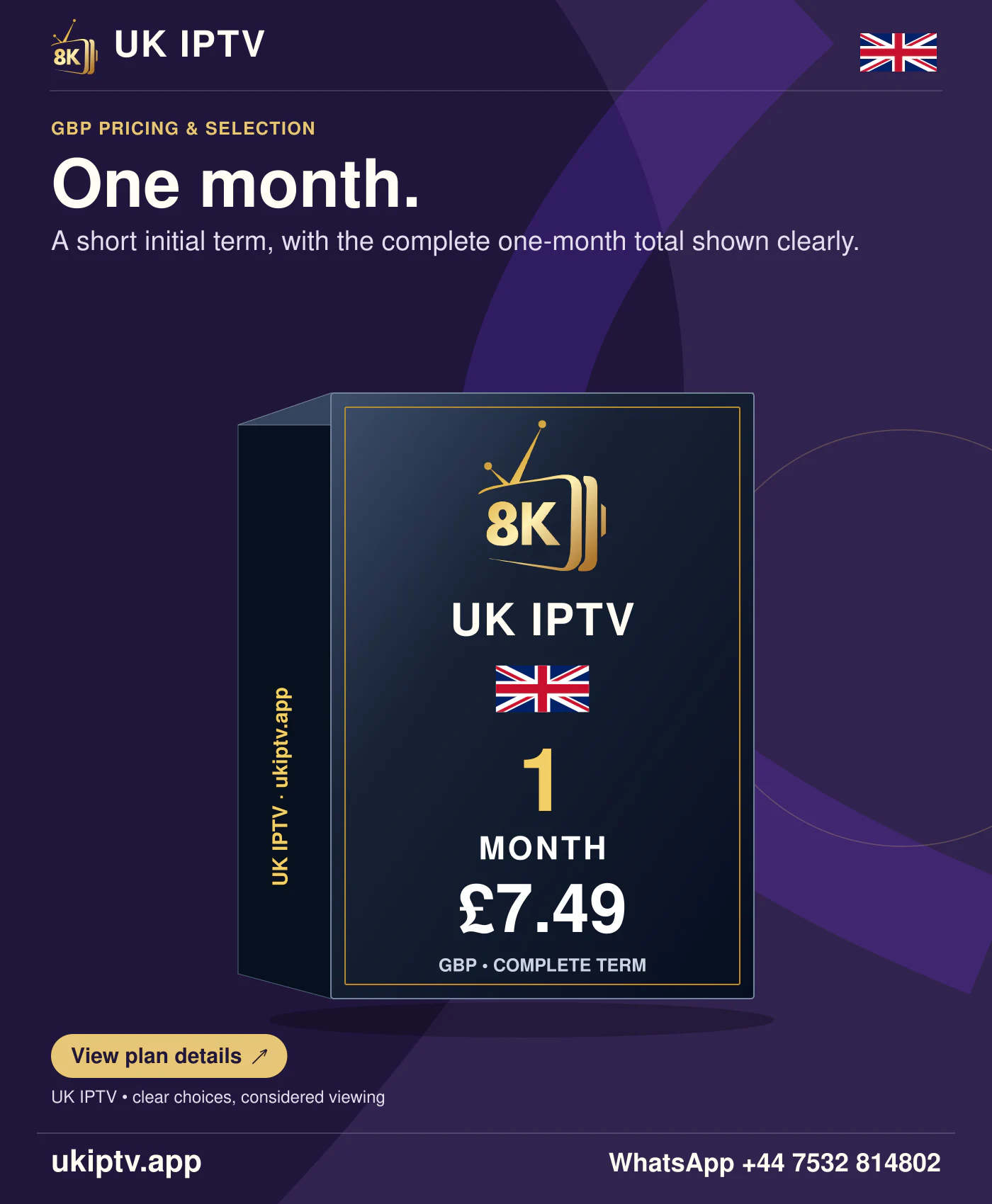
Open the official UK IPTV websiteThe 1 month plan is listed at £7.49 GBP. Check the account and app terms before choosing a longer term.

ukiptv.app
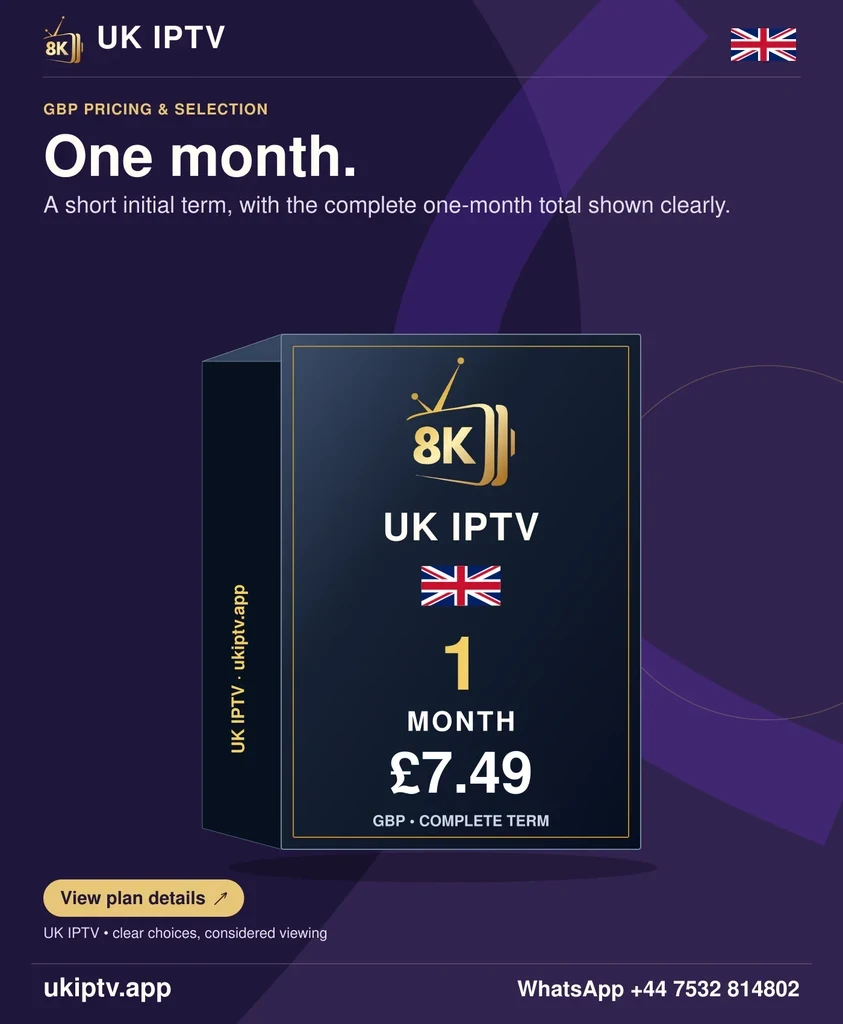
The 1 month plan is listed at £7.49 GBP. Check the account and app terms before choosing a longer term.
The 1 month plan is listed at £7.49 GBP. Check the account and app terms before choosing a longer term.
Read the quote in pounds and verify the location and named feed on the intended account.
ukiptv.app · Check exact market
Open the official UK IPTV websiteUK IPTV maintains the site at ukiptv.app. Check who issues the invoice and who replaces the access if the app or TV changes. The buyer needs both answers before paying for a long term.
Document review · November 19, 2026. Playback performance, service rights and ZIP-level access require separate evidence.
The 1 month plan is listed at £7.49 GBP. Check the account and app terms before choosing a longer term.

ukiptv.app
A UK IPTV enquiry sent from New Jersey can mean several different things. One viewer wants the London regional news they grew up with. Another wants to watch a Welsh-language drama with English subtitles. A third is visiting family in Britain next month and is organising television for the UK stay. All three may see a familiar union flag and a price in pounds. They need different answers from the seller before choosing a subscription.
On the UKIPTV.app schedule reviewed for November 19, 2026, the complete prices are £7.49 for one month, £18.99 for three months, £29.99 for six months and £40.99 for a year. These are GBP totals. They describe the length and listed price of a personal term. The practical purchase depends on the particular service the seller is authorized to offer at the viewer's address, the regional edition, the player that opens it, any separate charges and the terms at checkout.
Try writing the wanted programme before opening the price table. Add the nation or English region, whether a live transmission or a later episode will do, and the local U.S. time when the family usually sits down. If the answer reads “one series in English subtitles after dinner,” check the rights holder's own international options as well. A twelve-month subscription needs a stronger reason than a flag that feels like home.
The BBC framework agreement describes BBC One versions for Scotland, Wales and Northern Ireland and variations for English regions and the Channel Islands. That is enough to show why “BBC One” alone can be an incomplete request. At times several editions share a network programme. At other times their local or national schedules differ. A buyer who wants a particular programme can specify the edition, a known date and the local programme title. The broadcaster's current schedule then helps both parties identify what is meant.
A family from Glasgow might want a Scottish bulletin while keeping a separate interest in network drama. A seller might correctly supply an authorized route for the drama without supplying the particular bulletin. Ask two questions. The answer to either can be useful on its own. Filing them as one demand for “all UK channels” makes the buyer dependent on an imprecise promise that is difficult to verify at trial or dispute later.
A London label can hide just as much variation. “London news” could mean an English regional opt-out, a UK-wide newsroom based in London, a local station or a clip reposted internationally. Give the presenter or programme name if the family knows it. Include a programme before or after it in the schedule if the title is generic. Two adjacent schedule entries are often enough to distinguish the edition without sharing a private stream, account image or copyrighted video extract.
For the commercial broadcaster side, Ofcom publishes a licensee lookup and Channel 3 information by region. ITV also explains why it asks for a postcode on its own UK service. These references can identify a service's UK regional identity. They do not confer domestic reception conditions on an American home. Tell UKIPTV.app the true viewing country and ask which regional service is available there through the proposed product. Treat an honest reply limited to a named edition as a more useful answer than a sweeping list of familiar network names.
On an ordinary November evening after the clock changes, 7:30 p.m. in London is 2:30 p.m. in New York and 11:30 a.m. in Los Angeles. In a short period of spring or autumn the gap differs. The UK government publishes the dates on which the clocks change. The United States changes on its own dates. A weekly U.S. reminder fixed to a wall-clock hour can miss an episode even if neither broadcaster nor seller has changed anything.
| Example London listing at 7:30 p.m. | New York local time | Los Angeles local time |
|---|---|---|
| October 21, 2026 | 2:30 p.m. | 11:30 a.m. |
| October 28, 2026 | 3:30 p.m. | 12:30 p.m. |
| November 4, 2026 | 2:30 p.m. | 11:30 a.m. |
| November 19, 2026 | 2:30 p.m. | 11:30 a.m. |
The UK clocks moved back on October 25 in 2026. The U.S. switch followed on November 1 in the places used above. The middle row is the one a calendar template copied from the previous week is likely to get wrong. Enter London as the source time zone on the event and let the calendar perform the conversion. If a programme is published in 24-hour notation, translate 19:30 only once. A device that has already shown the entry as 3:30 p.m. local during the crossover week should not have another four hours subtracted by hand.
Now ask about the family's actual evening. At 8 p.m. in New York on November 19 it is already 1 a.m. in London on November 20. A viewer wanting a UK programme after dinner may need authorized catch-up or a later repeat. A live television service delivering exactly the expected early-afternoon feed does not solve an evening-only viewing arrangement. Ask how a specific replay is reached, how long it remains available, whether captions survive and whether its access rights cover the household's country.
If the family crosses U.S. time zones itself, quote named cities and dates on both sides. Phoenix and Denver are a poor pair to treat as interchangeable year-round, and a clock abbreviation copied from a screenshot can be ambiguous. A source date and “London time” beside the U.S. viewing city give the seller or forum helpers enough information to check the observation. Correcting one troublesome station by changing the television to British time would also change every other reminder on the device.
| UKIPTV.app personal term | Listed full amount | Monthly comparison, rounded |
|---|---|---|
| One month | £7.49 | £7.49 |
| Three months | £18.99 | £6.33 |
| Six months | £29.99 | £5.00 |
| Twelve months | £40.99 | £3.42 |
On the six-month term, £29.99 divided by six rounds to £5.00. That does not set up six charges of five pounds. The price page presents £29.99 for the entire term. The difference is worth spelling out for a buyer who has budgeted a small regular payment but has no intention of spending the full annual amount today. Ask checkout to identify the total, currency, payment recipient, activation conditions and whether further renewal happens automatically or by a separate request.
The cheapest way to cover a known period can depend on an apparently unimportant month. Three separate months cost £22.47 at the recorded price, compared with £18.99 for one quarter. A quarter and one month cost £26.48, cheaper than a six-month term for a fixed four-month stay. A quarter and two months cost £33.97. The six-month term at £29.99 is lower even if the family only expects to need five months. These examples assume the same account allowance, unchanged prices and a seller that permits sequential purchases without wasting the remainder.
For seven months, a half-year plus one month totals £37.48, still below £40.99 for a year. Add a second month and the total becomes £44.97. An eight-month assignment therefore gives a reason to consider annual payment, although the family may still prefer the flexibility to stop after six. Four quarters over a full year would cost £75.96 and two half-years £59.98. The £18.99 difference between two half-years and one year is exactly a current quarter's listed cost. That is a useful way to think about paying for the chance to reconsider halfway through.
A U.S. dollar figure needs an actual quotation. The seller publishes sterling. The buyer's payment method may convert the amount and apply its own terms. Keep a screenshot of the specific GBP offer and the confirmation while discarding sensitive payment information from anything posted publicly. If you later see a different amount in an old screenshot or generic FAQ, match the evidence by date, term, currency and seller. Request a fresh total before paying. An older promotional price and a recent standard price should not be averaged into a fictitious middle price.
The BBC's support pages distinguish its international subscription and BBC iPlayer. Its own help says iPlayer is available in the UK and access is tied to a valid UK TV licence. A U.S. buyer should not interpret a BBC logo on a third-party site as including an iPlayer account or removing a service's territorial conditions. The BBC also explains that its international subscription can expose different programmes or channels when the subscriber travels. Name the specific product every time a household compares access.
A relative might say “the BBC works here” while showing BBC.com news in an American web browser. This can be entirely consistent with another relative being unable to open a domestic iPlayer programme on the same network. There is no puzzle for the seller to fix until the family identifies which product it purchased and what programme it needs. Look for the programme through the rightsholder's published U.S. options and use the title, episode and date in any independent seller enquiry.
The same care applies to an app on the television. A media player that can accept a seller's supported account format is one application. A broadcaster's branded catch-up service is another. Selecting a UK-themed menu inside a player does not sign into a broadcaster app. A buyer who wants a particular broadcaster account should ask about that product directly. A buyer who wants a seller's subscription should ask the seller for its approved player and actual scope. Keep the two sign-ins and billing relationships separate.
Suppose the family initially wants one documentary but later wants a year of regional news. The official international release of the documentary may be the right purchase for the first need. The second requires a separate check of authorised regional coverage. It is reasonable to buy the single programme or use an available official collection while investigating the longer-term option. The seller's low annual price should enter the discussion only after the family can name what that payment would add.
A Welsh-language household can have fluent speakers, learners and English-speaking relatives on the same sofa. S4C publishes dedicated information about English subtitles, including ways to identify programmes with that option. Use that guide to find a real title whose original language and subtitle availability matter to the family. Then establish what authorized route carries the programme at the U.S. address and whether the specific player preserves the required track.
If everyone understands Welsh but one viewer relies on captions for hearing access, a translation into written English may not be the preferred result. Ask about the actual language and type of subtitle available for that programme. If learners want English subtitles and original Welsh audio, confirm that changing subtitle language does not replace the soundtrack with a different edition. A label in the app's general language settings may affect only its menus.
Take a short note during a permitted sample. Write the programme, edition, subtitle language, whether timing stayed aligned and which remote button opened the controls. Test both the ordinary live path and a confirmed replay if the household plans to watch after the UK broadcast. If captions appear only on one path, describe that outcome plainly. A seller can investigate the right feed or point the family to an alternative official version more easily than it can investigate “Welsh doesn't work.”
Leave room for the viewer's preference. High-contrast text at the bottom of a small guest-room TV may overlap a lower-third graphic or be difficult to read from an armchair. Try the size and background controls available in the actual player without changing several unrelated television settings. Ask the person who will use the feature to close it, reopen it and restore it next day. That ability is a real part of the value of the subscription for this household.
A relative in England can use Freeview's postcode-based checker to see which terrestrial services are predicted for their UK address. It can help identify an appropriate region and explain a familiar channel number. It does not predict internet carriage at an apartment in Illinois. If someone sends a picture of their Freeview lineup as evidence of what the seller “ought to have,” use it to identify the service, then ask a separate question about permitted U.S. availability.
Consider a viewer who remembers a station only as “the third button.” The number might refer to a remote shortcut, a terrestrial channel number or a saved favourite in an old app. Ask what region the person lived in, what they watched and which news programme followed. A station name and an identified licence area from Ofcom's records are better purchase evidence than a button number. The number can then become a convenience after a permitted account is set up, perhaps as part of a new favourite.
ITV's own support material explains that a UK location can affect the relevant region and that connected television platforms may vary in their regional content support. A seller's Apple TV reference therefore should not be read as a guarantee that a different broadcaster's app will expose every regional option on that hardware. Use the actual manufacturer's store and the broadcaster's current platform guidance when the request is about that broadcaster's app. Ask UKIPTV.app separately about its own approved setup.
There is no benefit in providing a false UK postcode to make a menu look familiar. Give the seller the true U.S. viewing location and the British region you want as separate fields. If an official UK portal asks for location to deliver a local UK service, follow that service's own conditions. Knowing the code for a former home does not establish current territorial rights. A programme can still have a separately authorized U.S. outlet, and that is the outlet worth identifying.
The provider describes a one-day trial. Check that the offer is currently available and suitable for the U.S. location, exact player and expected account. For someone whose viewing centres on a particular Saturday programme, a Tuesday afternoon trial can answer technical questions while leaving the decisive content question untouched. Ask when the trial can be activated and whether the planned programme or a comparable published regional slot falls within that window.
Prepare two examples. The first should be something common enough that the household can test the player and remote immediately. The second should distinguish the specific nation, region, language or rights window that prompted the purchase. A working national picture on the first test is good evidence of basic playback. It is weak evidence for a regional programme that was not scheduled at the time. Keep the two results separate so a successful basic test does not quietly become a promise of everything on the viewing list.
Use the equipment as the family normally uses it. Start from the TV's home screen or the correct HDMI input. Find the player, select a favourite, open captions if needed and leave the programme. If somebody usually uses the television's own remote instead of the external box remote, try that path as well. A helpful person with the right remote in their hand can make a setup look much easier than it will be when a guest is alone. Actual use on an ordinary Saturday is more informative than an idealized demonstration.
A household that watches sport should treat the match as a separate entitlement question. Identify the competition, team or fixture, UK broadcaster, U.S. viewing location, live or replay requirement and commentary language. A studio show discussing the match does not establish live coverage. A permitted trial during another game cannot promise a future tournament. If the seller is unable to confirm the particular authorized production, check the rightsholder's U.S. viewing information before making the event the reason for a long-term purchase.
UKIPTV.app publicizes business enquiries for resellers, wholesalers and distributors. Its consumer prices provide a firm basis for a personal term comparison. Those prices do not reveal the wholesale cost of issuing another person's account. The material here does not establish payable reseller pack totals or the deductions for one, three, six or twelve months. An operator's panel may display credits; the commercial agreement has to define them.
A small installer might expect to help eight households for a quarter and four for a year. That is 72 customer months of proposed service. To translate it into inventory, obtain the actual quarterly debit and annual debit for the permitted account type. Multiply the first debit by eight and the second by four. Add any separate fee identified by the operator and check whether trial activations consume stock. The price of a personal £7.49 month plays no part in this calculation until the operator gives a documented business relationship between the figures.
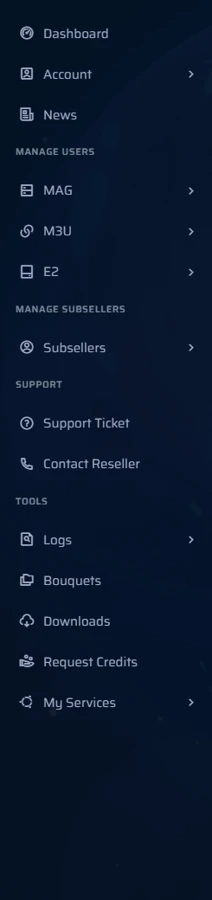
Ask about the contracting business, the countries that agreement covers, what constitutes a new account, whether renewals consume the same credits, and how mistaken activations are handled. A reseller taking U.S. customer payments and paying for stock in GBP also needs a consistent currency ledger. Use the operator's written pack total in sterling, record the actual settlement costs and attach the genuine private order references. A polished image of a panel with a balance of one hundred units supplies none of that information on its own.
A sports bar, hotel lounge or workplace television is a different customer from a private home. Public or commercial display rights must be established for the venue and programming. A reseller account or a regular household term does not settle that authorization. Bring the premises, proposed audience, dates and use to the relevant operator or rightsholder. A store that calls itself a provider of streams can receive the enquiry without being the party entitled to grant every permission the business needs.
A programme scheduled on a main service and a one-hour time-shifted version can have nearly identical guide entries. If a seller identifies a plus-one feed, write the exact label on the household decision sheet. Suppose the hypothetical main broadcast begins at 19:30 London time. On November 19 a 20:30 London showing corresponds to 3:30 p.m. in New York. That is also the New York time for the main 19:30 slot during the October crossover example. The same number can therefore describe two different situations. The date, feed label and source time tell them apart.
A scheduled repeat behaves differently again. It may air a day later and a guide may carry a newly edited edition. A catch-up copy can become available at an operator-specific time and can expire. A personal recording, where the provider and relevant rights allow it, has its own storage, availability and device requirements. If the viewer says “I want to watch later,” ask which of these actually matters. A one-hour delay is of limited use to a household that will still be at work five hours after transmission.
Try a repeat that can be positively identified. Write down whether it has the right episode, language and regional edition, whether it begins from the opening and how much of it the viewer can reach with the ordinary controls. Then exit and see if the player returns to live or resumes the same copy when reopened. A family member using an app for the first time may reasonably think a replay that restarts live has disappeared. The button sequence and the seller's declared access window are the two pieces of information that solve that confusion.
For a report back to support, distinguish “wrong episode at the scheduled time” from “correct replay expired before our evening.” The first is a mapping or schedule question. The second is a product fit question. Extending a subscription for a year cannot by itself extend a permitted replay right for each programme. The household needs a particular access window, not simply a greater number of calendar months.
A family following a returning drama can narrow the entire order to season, episode, original UK transmission date, available U.S. release and preferred viewing language. It is possible for two catalogues to have the same series title and different seasons. It is also possible for a catalogue entry to describe a forthcoming episode, a trailer or a licensed repeat. Check the episode length and description on the official programme page. A promotional poster is designed to identify a work and is a poor record of regional episode rights.
Estimate how long the family will actually need the account. If six episodes become available weekly and the chosen authorized service retains them long enough, the relevant question might be whether the viewer watches as released or waits until later. A single one-month purchase might cover a permitted catch-up window after release, or it might miss an early episode that expires. Only the service's published release and expiry information can settle that. The more expensive annual card does not repair a wrong assumption about a past episode's availability.
Now ask about another viewer in the same home. One may want original audio and English dialogue captions while another wants the television linked to hearing equipment. Confirm which device and sound path each will use. For a short series, one well-set-up screen can be a better buying criterion than an unconfirmed claim about many devices. Keep the term's account allowance and the accessibility outcome together in the decision, because buying another screen allowance will not add a missing caption track.
When a requested series is already licensed to another U.S. outlet the household pays for, compare the exact seasons there. If it satisfies the need, retain the UKIPTV.app enquiry for future regional programmes and avoid buying a second subscription just to reproduce a show you can already watch. If the existing service carries only older episodes and the seller can substantiate the wanted new release for your address, the household can value that specific difference.
Start the move enquiry before the shipping crate leaves. List the television and external player separately, the existing UK app-store account, the proposed U.S. address and the programme that matters. The physical equipment may travel with the household while the broadcaster determines access from the new territory and the seller applies different account conditions. Ask which parts of the setup can legitimately continue, which need a new agreement and which are specific to the original location.
If the household has time left on a personal term, request the existing expiry and any documented options in writing. A seller might offer a change, require a new term or have no suitable product for the new location. Avoid assuming that a UK viewing credit, separate player licence or broadcaster subscription automatically converts into a U.S. entitlement. Give support the order reference privately and retain both the old and proposed terms. A change to the payment card's billing address is also a distinct operation from permitting a television stream at a different viewing address.
During a move, avoid confusing a power or input issue with a subscription failure. The basic observations are simple. Does the television itself turn on? Does the external device's ordinary home screen appear? Can it open a known working, permitted local service? Does it show the right date, time and app store region? The seller needs to know where that sequence stops. Follow the equipment manufacturer's guidance on power and setup for the actual model. The television service cannot fix a display that has yet to receive an input signal.
The first evening after the move is a good time to reset the household's idea of “tonight.” Write down one London or Cardiff listing alongside the American viewing time. Choose an ordinary authorised comparison available in the new location. If the family discovers that most live UK evening broadcasts occur during its U.S. workday, re-evaluate whether live, replay or another official release now matters most. A year-long order made for an old daily routine deserves a fresh look after an international move.
Consider two cards, one from UKIPTV.app at £40.99 and another from a U.S. seller marked in dollars. Looking only at the numbers can make forty look lower than fifty. The cards can differ in currency, payment method, permitted territory, connection count, regional feed and support responsibility. A household paying in the United States needs a settled like-for-like price and a comparable account before naming a cheaper seller. An editorial comparison can truthfully leave the cross-currency outcome open while still reporting both local totals.
A practical comparison takes one screen and one programme as its unit. Under each seller put the confirmed full-term charge in its actual currency, whether that particular programme is authorized at the address, the required player fee and the renewal arrangement. If the household must pay for an additional app with just one option, include that real charge once. If it already owns that app regardless of seller, charging both options a full new licence distorts the result. Write down the assumption so another family member can reproduce the calculation.
Changing term can change the outcome even if a seller lowers a nominal monthly equivalent. A person expecting to move in six weeks may prefer two monthly payments at £14.98 over a quarter at £18.99. Someone confident of staying three months saves £3.48 with the quarter against three monthly purchases. If the first month is already paid, compare only the future money and remaining period from that point. Adding the same first-month receipt to one side twice makes an otherwise sound comparison look paradoxical.
Ask what happens when the home renews early. Does the new term extend from the existing expiry or start afresh? If the answer is unclear, get the current expiry and quote before confirming another order. A family trying to buy ahead to avoid a missed episode should know whether it is preserving the days already purchased. Keep the written answer near the receipt and put a reminder a few days before the agreed renewal decision.
The seller's Apple TV guide distinguishes hardware, an app and a streaming subscription. Use that distinction when setting up a guest room. Name the external box, its operating system and the separate player publisher. If the viewer instead opens an Apple-branded app built into their television, identify the television model and its actual operating system. A shop listing an app for one platform may have no version for the other. The difference is easy to miss in a conversation held from two countries.
After a trial, put the app on the first screen or in an accessible position if the device provides that option. Make one favourite with the exact region and programme service the viewer requested. Close the app without deleting the account and reopen it from the normal home screen. Ask the regular viewer to turn captions off and back on. A setup with fifteen screens of choices and no clear return path can feel less usable than a modest guide with one carefully named favourite.
If a remote launches the wrong input or app, describe the actual symptom. A television that returns to its built-in apps while the external box continues playing has not necessarily lost the paid subscription. If the correct player opens but asks for a new activation, check the seller's account and independent player status separately. One correct receipt may belong to a part of the setup that is still working. Before buying another term, identify the part that is asking for money.
The note left beside the remote can be short. Give the TV input, app name, favourite label and the normal way back to the home screen. The person who pays keeps the order reference, renewal date, amount, source programme and confirmed location privately. When a visitor needs help in the middle of a programme, they can get back to the correct screen without exposing the family's payment information or handing a stranger a private account token.
A completed decision might read as follows. The household wants one particular Welsh-language drama, needs English subtitles, can watch only after 7 p.m. local time and owns one correctly identified external player. It has asked the rights holder for U.S. availability and the seller for its authorized offer and replay window. If the episode and track work on the household screen and the price remains the chosen GBP amount, the family has a reason to purchase. If one condition fails, record which one rather than describing every British service as unsuitable.
Other households will end in a different place. A sports fan may wait for confirmation of a U.S. fixture. A London regional news viewer may value an early-afternoon live transmission. A reseller may have no viable business quote until its operator defines the local pack, deductions and support roles. These are different reasons for opening the same website. The right purchase is the one for which the programme, place, time, screen and price can all be written down together.
When a relative sends a UK schedule photograph, ask them to include the selected region, date and the channel heading as well as the row that contains the programme. A tight crop of a title and 19:30 loses precisely the facts a person in another country needs. A screenshot taken on a phone travelling abroad may already have localized the time. Record what setting was selected before converting it. When the U.S. household finds the entry, compare the programme before and after it and mark the actual observed source edition. This small habit is particularly valuable for a returning series whose title appears several times in a week. It can distinguish a repeat from the premiere without depending on somebody's recollection of the advert.
Suppose you expect to watch for six months. At the listed single-month amount, six separate purchases would total £44.94 GBP. The six-month offer asks for £29.99 GBP up front. That comparison assumes every new month is available at the listed amount. Check renewal separately before relying on it.
| Viewing period | Separate monthly purchases | Single matching term | Difference | Monthly purchases to reach term price |
|---|---|---|---|---|
| 3 months | £22.47 GBP | £18.99 GBP | £3.48 GBP | 3 |
| 6 months | £44.94 GBP | £29.99 GBP | £14.95 GBP | 5 |
| 12 months | £89.88 GBP | £40.99 GBP | £48.89 GBP | 6 |
Read the final column as a spending threshold. If you expect to cancel sooner, compare the shorter commitment with the cash you would have paid up front. The figures exclude fees the seller has not confirmed.
Check UK IPTV subscription termsThe image link identifies the exact file served by the provider.
Choose a matchup to see the actual currency, term and outcome.
Open the caption on a website-sourced image to see its original. The remaining captions identify material supplied with the provider archive.